
Level 3
HARDHow to solve Sand Loop level 3? Get instant solution for Sand Loop 3 with our step by step solution & video walkthrough. Sand Loop 3 tips and guide.
Play Sand Loop Now
Experience the puzzle challenge firsthand
Game Screenshots
Sand Loop Level Guides
Level Overview: The "Sunset Bull" Supply Chain
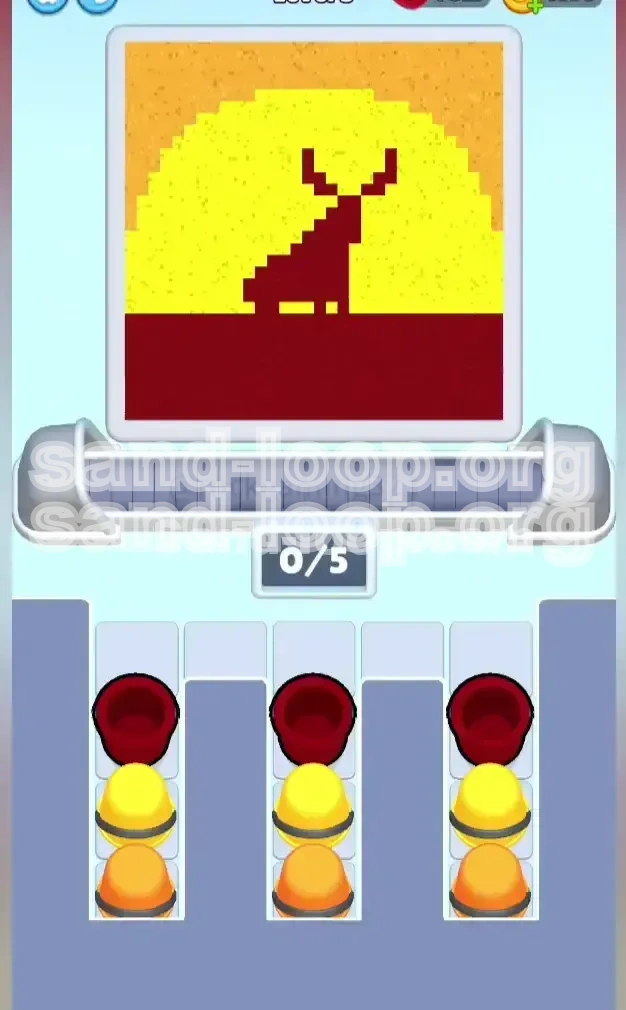
Level 3 acts as a harsh introduction to the game's logistical engine. Visually, the task seems straightforward: compose a silhouette of a red bull against a setting sun. However, the gameplay shifts drastically from "relaxing art" to "precision queue management." The level is gated by a "Vertical Stack" system where resources are physically hidden behind one another. You cannot simply paint what you want when you want; you must unlock the colors in a specific sequence, all while managing a conveyor belt that has a critical capacity limit.
The central tension of this level is the "Bottleneck Economy." You are tasked with processing 9 units of sand, but your buffer zone (the conveyor belt) can only hold 5 units at any given moment. This means your operating capacity is capped at 55%. If you tap source trays without checking your belt inventory, you will cause a "Slot Jam," stalling production and ruining your flow state. To succeed, you must stop looking at the art and start looking at the logistics.
Vertical Stacking Mechanics
Unlike previous levels where all colors might be visible, Level 3 buries your resources. The trays are arranged in columns. The Yellow tray is physically locked behind the Red tray, and the Orange tray is locked behind Yellow. This design forces a linear production line. You cannot prepare Yellow cups until the Red cups are physically moved from the source tray to the belt. This mimics a "Just-in-Time" manufacturing process where you must clear the front inventory to access the back stock.
The Capacity Crisis (9 Cups vs. 5 Slots)
Mathematically, this is your biggest hurdle. With 9 total cups to process and only 5 slots available, you have a margin of error of essentially zero. If you fill slots 1 through 5, the entire machine locks up until a cup is consumed. This "Slot Lock" is the primary cause of failure. You must understand that the belt is not just storage; it is a buffer that must be constantly cycled. If the belt stays full for more than 3 seconds, you lose the rhythm required to maintain the "Zero Idle" bonus.
Visual Zoning Analysis
The artwork is split into three non-overlapping horizontal bands. The bottom 35% is the "Deep Red" zone (Bull and Ground). The middle 40% is the "Bright Yellow" zone (Sun). The top 25% is the "Orange" zone (Sky). Because these zones do not blend, there is no artistic forgiveness. If you pour Red into the Yellow zone, it looks like a mistake. This strict zoning requires you to stop pouring exactly at the boundary lines, demanding high precision from your queue management.
The Flow State Requirement
This level is designed to force a "flow state." The sand pours continuously, and the dispenser does not wait for you. If you pause to admire the bull's horns, the belt will keep moving, potentially emptying out and causing a gap in production (a "Dry Spell"). Alternatively, if you tap too frantically to catch up, you fill the belt and lock the machine. You must find a rhythm where your tapping speed matches the consumption speed of the sand exactly.
Physics and Momentum
The sand physics engine introduces a delay between your tap and the sand hitting the canvas. This is "travel time." When you tap a cup, it travels from the tray to the dispenser, then the sand pours. Because of this momentum, you must tap the next color roughly 1.5 seconds *before* you visually need the color to change. This anticipation is the key skill separating beginners from experts. If you wait until you see the color change on screen, you have already waited too long.
Clear Objectives: Mission Goals
To achieve a 3-star rating on Level 3, you cannot simply finish the painting. The game's scoring algorithm penalizes idle time heavily. You must optimize the "Cycle Time" of your dispenser. Below are the specific metrics you need to hit to ensure a perfect run.
Objective 1: Break the Red Bottleneck (0-15s)
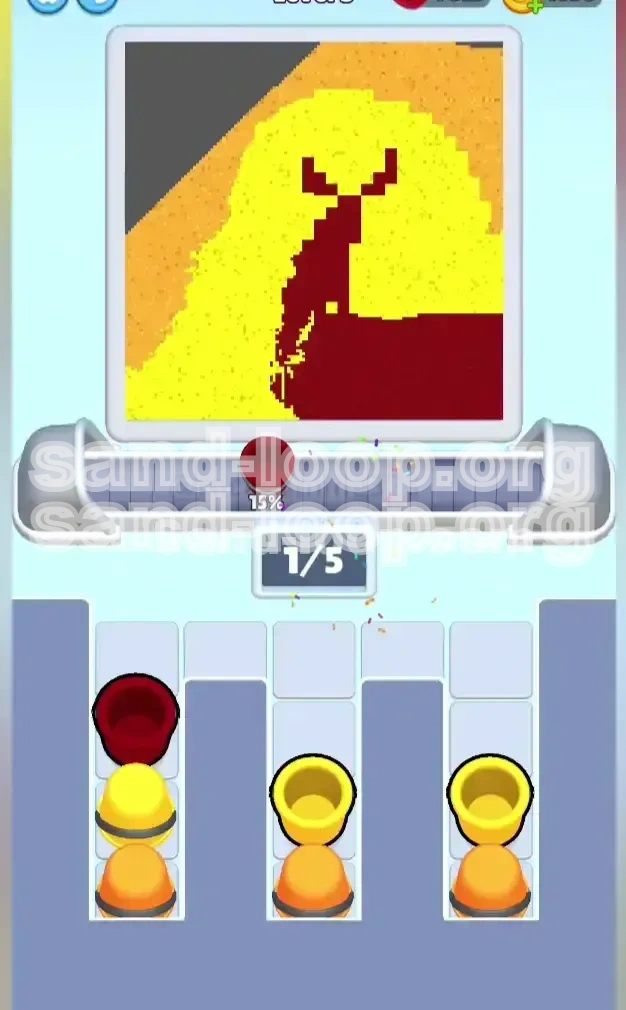
Your first and most urgent goal is to clear the Red Tray. This is not just about painting the bull; it is a logistical necessity to unlock the rest of the level. You must aim to move all 3 Red cups from the tray to the belt within the first 10 seconds. Until this is done, the game is essentially paused for you. Clearing this bottleneck frees up the Yellow tray, allowing the second phase of production to begin.
Objective 2: The Seamless Transition (Yellow Zone)
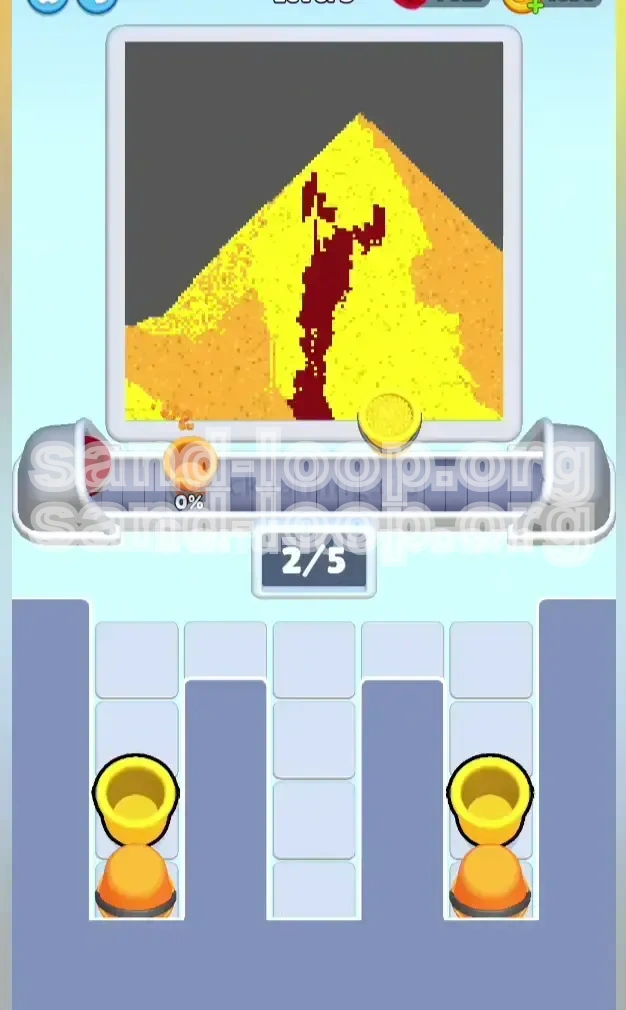
The second objective is to bridge the gap between the Red and Yellow phases. The goal is "Zero Air Time." As the very last grain of Red sand falls, the first grain of Yellow sand should immediately follow. If there is even a 0.5-second gap where no sand falls, you lose your combo multiplier. This requires you to have the first Yellow cup queued up in Slot 1 of the belt *before* the final Red cup finishes pouring.
Objective 3: Full Inventory Cycle (Orange Zone)
The final objective is to clear the board. You must pour all 3 Orange cups to fill the top atmosphere. While this seems easy, the danger here is relaxing too early. You must process the final 3 cups without stalling the belt. The objective is to finish the level with an empty belt and a full canvas, ensuring no sand was wasted and no time was left on the clock.
Maintain the "Goldilocks" Flow
You must maintain an average belt inventory of 3 to 4 cups at all times.
- Too Low (1-2 cups): You risk a "Dry Spell" where the dispenser runs empty, causing a score penalty.
- Too High (5 cups): You risk a "Slot Jam" where you cannot add new cups, causing a bottleneck.
- The Goal: Keep the belt fluctuating between 3 and 4 cups. This indicates a healthy, flowing supply chain.
Accuracy Metric: The Boundary Line
You must achieve a 95% accuracy rate on the color boundaries.
- The Bull/Sun Line: Red must stop exactly where Yellow begins. No red splatters in the sun.
- The Sun/Sky Line: Yellow must fill the circle but not bleed into the Orange sky.
- The Corner Fill: The Orange cups must reach the absolute top corners of the canvas.
Step-by-Step Walkthrough: The Perfect Run
This section provides a chronological timeline for a successful 3-star run. Follow these inputs precisely. Do not deviate from the sequence until you have mastered the level mechanics.
Phase 1: The "Red Rush" (Start - 0:15)
The level starts with only the Red tray available. You are in a race to clear these to unlock the rest.
- 0:00 - Step 1: Immediately tap Red Cup 1. Send it to the belt.
- 0:02 - Step 2: Tap Red Cup 2.
- 0:04 - Step 3: Tap Red Cup 3.
- CRITICAL STOP: Do not tap anything else. Your belt now holds 3 cups. You must wait for the first cup to finish pouring and vanish from the dispenser. Watch the slot counter.
Phase 2: The "Yellow Window" (0:15 - 0:30)
As soon as the first Red cup vanishes, a slot opens (Belt count: 2/5). The Yellow tray unlocks.
- 0:15 - Step 4: Immediately tap Yellow Cup 1. It fills the open slot.
- 0:17 - Step 5: Tap Yellow Cup 2.
- The Belt Check: Your belt is likely full or near full (Reds are finishing, Yellows are filling). You might be blocked from tapping Yellow 3 immediately.
- 0:20 - Step 6: Wait for a Red cup to finish. As soon as a slot opens, tap Yellow Cup 3.
- Visual Cue: Watch the dispenser switch from Red to Yellow. Ensure the transition is smooth.
Phase 3: The "Orange Clearout" (0:30 - 0:45)
Once the last Yellow cup is on the belt, the Orange tray unlocks. The belt should be clearing space rapidly now as the early Reds are gone.
- 0:30 - Step 7: Tap Orange Cup 1.
- 0:32 - Step 8: Tap Orange Cup 2.
- 0:34 - Step 9: Tap Orange Cup 3.
- Flow Note: At this stage, you can often tap these three in quick succession (1-2-3) because the consumption rate of the dispenser is high enough to keep up.
Phase 4: Final Polish (0:45+)
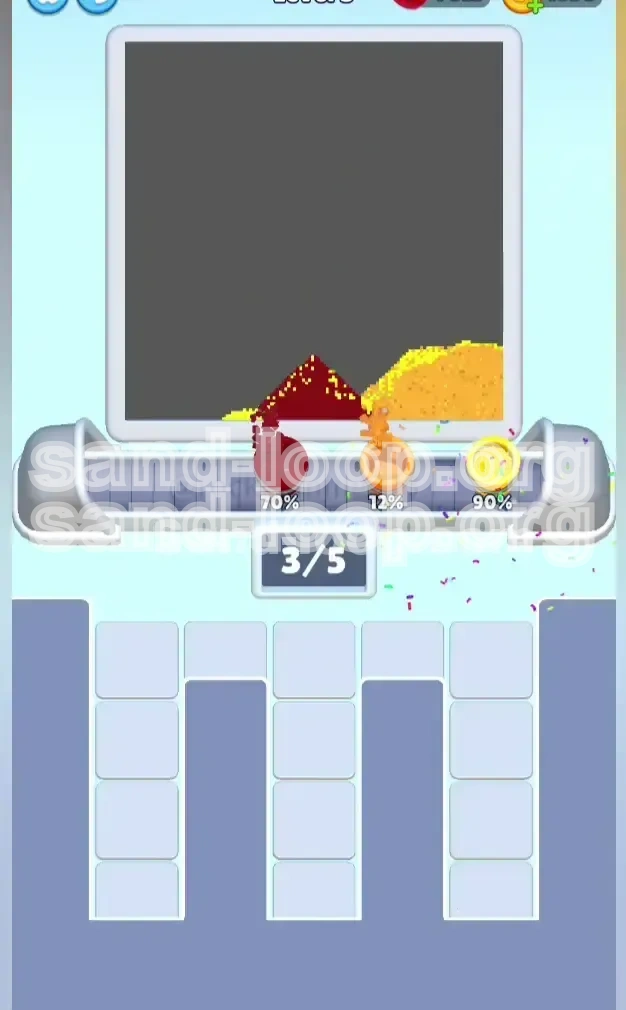
Do not exit immediately after the last tap.
- Action: Watch the final Orange cup pour.
- Check 1: Verify the top corners are filled. If they are empty, you needed to tap slightly later (physics delay).
- Check 2: Verify the "Sun" is perfectly round.
- Exit: Only exit or click "Next" once the "Level Complete" banner appears.
Color Order Strategy: Why Sequence Matters
The game enforces a strict "Stack Dependency" rule, but there is also a logical, physics-based reason for this order. Understanding the "Why" helps you execute the "How."
Priority 1: Deep Red (The Foundation)
Red is the "Anchor" of the composition. Physically, it is the top item in the stack, so it must be cleared first to access the other colors. Visually, Red is the darkest and heaviest element. In sand physics, heavy colors act as a base. If you were to pour Red *last*, it would bury the Yellow sun, creating a dark, muddy mess. The Red defines the foreground subject and must be established before the background elements.
Priority 2: Bright Yellow (The Bridge)
Yellow is the "Transition." It sits directly above the Red. The physics engine creates a slope where sand meets sand. By pouring Yellow second, it flows up to the Red boundary and stops, creating a sharp contrast line. If you reversed this and poured Red over Yellow, the Red granules would slide down the Yellow slope, contaminating the bright sun with dark red grit. The order is essential for maintaining the vibrancy of the colors.
Priority 3: Orange (The Atmosphere)
Orange is the "Atmosphere." It fills the negative space at the top. Because it is the last item in the stack, it is poured last. This is strategically sound because Orange is a background gradient. It doesn't need to interact sharply with the other colors; it just needs to fill the void. Pouring it last allows you to use any leftover momentum or "messy" sand to fill the corners without ruining the focal point (the Bull).
The "Horn" Logic
The bull's horns are the most critical detail. They are thin protrusions of Red that reach high into the canvas.
- The Risk: If you switch to Yellow too early, the Red stream cuts off, leaving the horns stumpy.
- The Rule: You must ensure the final Red cup is 100% dispensed before the Yellow stream starts. This ensures the horns reach their full length and artistic integrity.
Queue Logic: FIFO (First In, First Out)
You cannot rearrange the cups on the belt. If you tap Red, then Yellow, then Red again, the belt becomes a jumbled mess of timing. The strategy relies on "Batching." Group your actions: Handle all Reds, then handle all Yellows. Trying to alternate colors (Red-Yellow-Red-Yellow) confuses your internal rhythm and makes it impossible to track when the belt will fill up.
Key Tips & Common Mistakes to Avoid
Level 3 is a test of discipline. Most failures come from impatience or panic. Use these tips to stay calm and efficient.
Pro Tip: The "80% Rule" (Pre-Loading)
Never wait for a cup to completely vanish before tapping the next one. Watch the pouring stream. When the current cup is about 80% empty (the stream becomes thin/weak), tap your next color. This queues the next cup so it arrives at the dispenser the exact millisecond the previous one leaves. This eliminates "air time" and keeps your multiplier safe.
Pro Tip: Eyes on the Belt, Not the Bull
This is the Golden Rule. It is natural to want to watch the art form, but you must train your eyes to look at the bottom of the screen (the belt). Your peripheral vision is sufficient to check the art. Your central vision must track the inventory count (e.g., "3/5"). If you watch the art, you will miss the moment a slot opens, causing a delay.
Common Mistake: The "Slot Lock" Panic
The Scenario: You tap 3 Reds, then 2 Yellows. The belt is full (5/5). You instinctively try to tap the 3rd Yellow, but nothing happens.
The Panic: You tap frantically, thinking the game is broken.
The Reality: The game is waiting for a cup to finish.
The Fix: Stop tapping. Look at the active cup. Wait 2 seconds for it to finish. As soon as the counter drops to 4/5, tap your queued cup. Accepting the pause is part of the rhythm.
Common Mistake: The Premature Switch
Players often abandon the Red phase the moment the Yellow tray unlocks.
The Error: You see the Yellow unlock animation and immediately switch targets, leaving the last Red cup untapped.
The Consequence: The Bull's legs are cut off, or the ground is missing.
The Fix: The "Unlock" is a cue to *finish* your current Red sequence, not to abort it. Ensure all Reds are on the belt before switching focus.
Common Mistake: Audio Ignorance
The game provides distinct audio cues: a "click" for unlocks and a "pop" for cup arrival. Playing on mute makes this level 50% harder because you lose the sensory cue that tells you the next layer is available without looking away from the belt.
Solutions for When You Are Stuck
If you are failing repeatedly despite following the guide, you are likely encountering a specific physics or logic error. Here is how to diagnose and fix common problems.
Problem: Muddy Colors (Brown Sludge)
Symptom: The boundary between Red and Yellow looks brown and dirty.
Diagnosis: You are pouring the next color while the previous color is still "wet" and spreading.
Solution: Increase the delay between color switches by 0.5 seconds. Let the Red sand settle into a stable pile before introducing the Yellow flow. This prevents the granules from mixing at the microscopic level.
Problem: The "Floating Bull"
Symptom: The red bull looks like it is hovering above the ground.
Diagnosis: You stopped pouring Red too early. You likely painted the body but forgot the "Ground" layer requires the full volume of all 3 Red cups.
Solution: Ensure you tap all 3 Red cups every single time. The ground is painted by the overflow of the body. Do not stop tapping Red just because the "shape" looks done.
Problem: Incomplete Corners
Symptom: The top-left or top-right corners of the Orange sky remain white/empty.
Diagnosis: Physics "Air Push." The stream of sand pushes air away from the center, sometimes leaving corners untouched.
Solution: Try tapping the final Orange cup slightly *later* in the belt cycle. A slight change in timing alters the angle of the pour, which can help the sand drift into the corners more effectively.
Problem: The Belt Stall (Music Slows Down)
Symptom: The background music drops in pitch, and the belt stops moving.
Diagnosis: You caused a "Soft Lock" by having no cups ready to pour while the dispenser was empty, or you jammed the inputs.
Solution: You have to wait for the penalty timer to recover. To prevent this, always keep a "buffer cup" in Slot 2. Never let the belt drop to 0 cups while the dispenser is active.
Speed Run Tips & Shortcuts
Once you have mastered the logic, you can optimize for time. Level 3 can be completed in under 40 seconds with perfect execution.
The "Triple Tap" Burst
At the very start (0:00), do not tap slowly. Execute a rhythmic Tap-Tap-Tap on the Red tray immediately. Loading the belt instantly is better than waiting. Since the belt is empty, you want to maximize the distance between the first and last cup to create a long stream of work.
Pre-Loading the Transition
This is the pro move. As the *last* Red cup is pouring (about 50% full), hover your finger over the Yellow tray. You can tap the first Yellow cup the *exact moment* the Red cup vanishes (or even slightly before, if you know the unlock timing). This shaves off 2 seconds of idle time.
The "Bulk Finish" (Orange)
Because Orange is the last set and the belt is moving very fast by this point, you can tap all three Oranges in a "1-2-3" burst immediately. You do not need to wait for slots to open individually because the dispenser is consuming the earlier cups fast enough to clear space for the new ones almost instantly.
Audio-Reactive Tapping
Stop relying on sight. The sound of the sand hitting the can changes pitch when the cup is nearly empty (it becomes a higher pitched "hiss"). Use this audio cue to trigger your finger tap. Audio processing is faster than visual processing, giving you a split-second advantage.
Skip the "Admire" Phase
Do not wait for the art to "settle" before clicking the level completion button. As soon as the final grain of sand lands and the score UI pops up, click it. Every second spent watching the bull is a second wasted on your potential personal best.