
Level 167
HARDHow to solve Sand Loop level 167? Get instant solution for Sand Loop 167 with our step by step solution & video walkthrough. Sand Loop 167 tips and guide.
Play Sand Loop Now
Experience the puzzle challenge firsthand
Game Screenshots
Sand Loop Level Guides
Level Overview: The Lavender Windmill Challenge
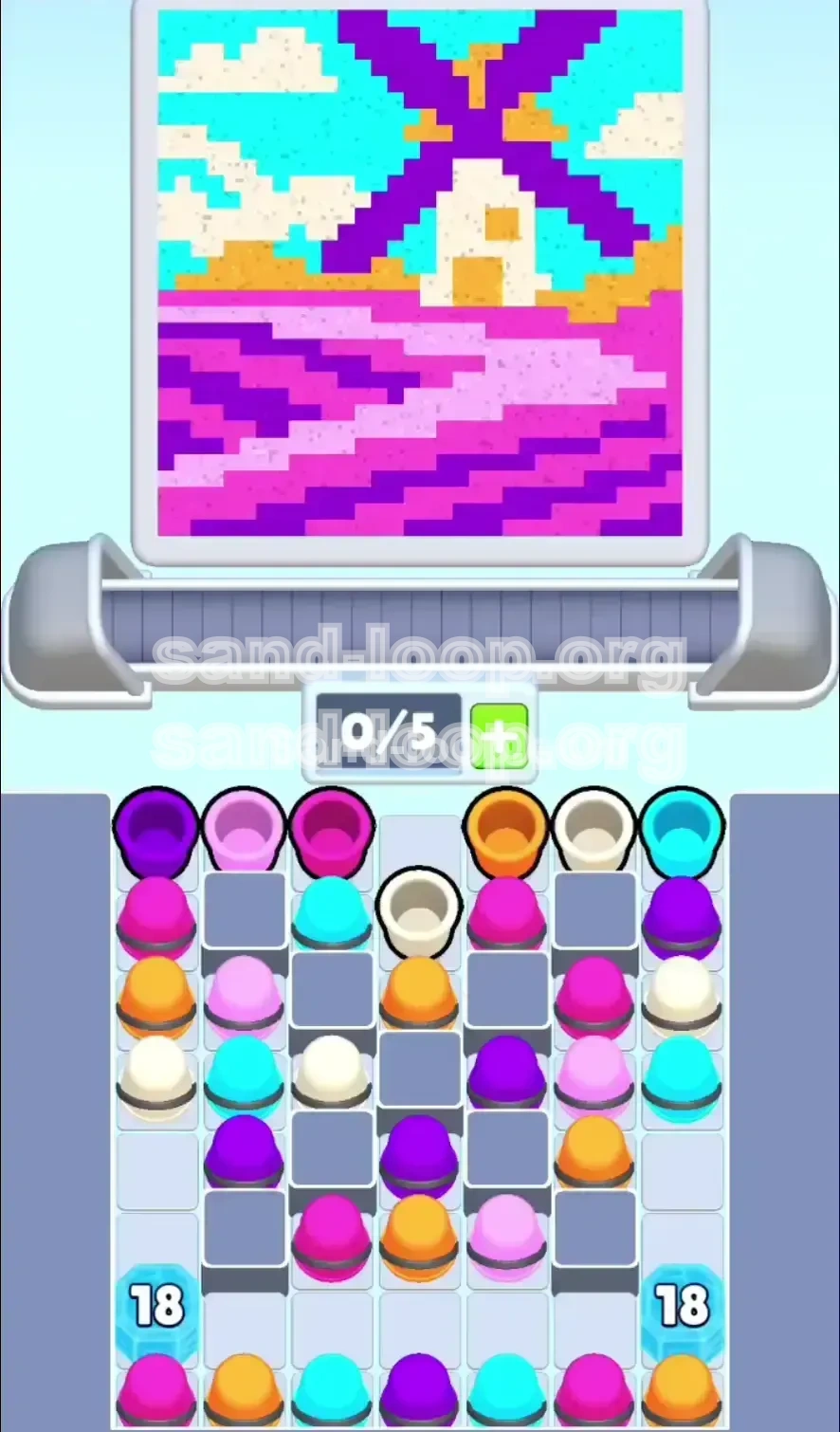
Sand Loop Level 167 presents a unique artistic challenge set against the backdrop of a serene lavender field and an iconic windmill. While the visual aesthetic suggests a relaxing experience, the underlying puzzle mechanics are strictly defined by vertical physics and inventory management. This level is classified as a Supply Management stage, where your primary adversary is not the clock, but the cluttered supply tray and the specific "bottom-up" filling requirements of the canvas.
The stage features a complex color palette that includes three distinct shades of violet and pink for the field, golden orange for the ground, and cyan and white for the sky and windmill. The difficulty arises from the fact that the colors you need immediately—the purples and pinks—are buried behind other colors, while the tray is obstructed by a unique "W-Shape" configuration of gray blocker squares. Success in this level depends entirely on your ability to prioritize the correct columns in the correct order, ensuring that the paint fills the canvas layer by layer without mixing or creating gaps in the pattern.
The Visual Aesthetic and Layout
The level is visually striking, featuring a pixel-art representation of a Dutch-inspired landscape. The canvas is divided into three horizontal zones: the flower field (bottom 40%), the ground and windmill base (middle 30%), and the sky with clouds (top 30%). Understanding these zones is crucial because the game's physics engine forces paint to settle from the bottom up. If you attempt to paint the sky before the field is adequately saturated, the cyan paint will simply pass through the empty space and disappear, wasting your valuable moves.
Supply Tray Obstacles
Unlike previous levels where cups might be loosely arranged, Level 167 utilizes a strict grid system interrupted by static obstacles. The most prominent feature is the "W-Shape" gray block formation located in the center of the tray. This formation effectively locks the most critical paint cups (often the middle shades) behind a wall of obstacles. You cannot access these center cups until you have cleared the peripheral columns on the far left and far right. This creates a strategic bottleneck, forcing you to follow a specific "Outside-In" clearing path.
The "Bottom-Up" Physics Constraint
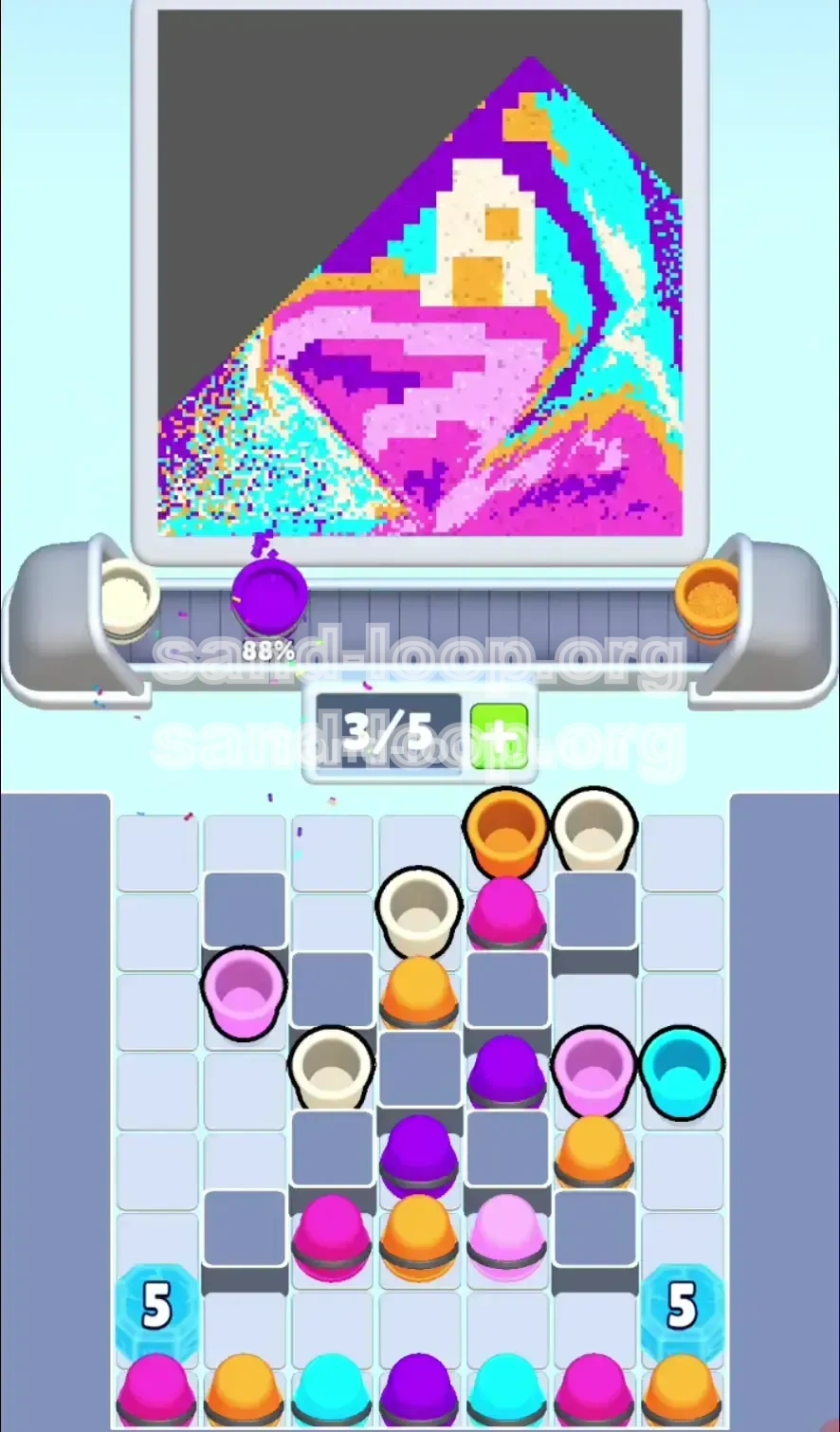
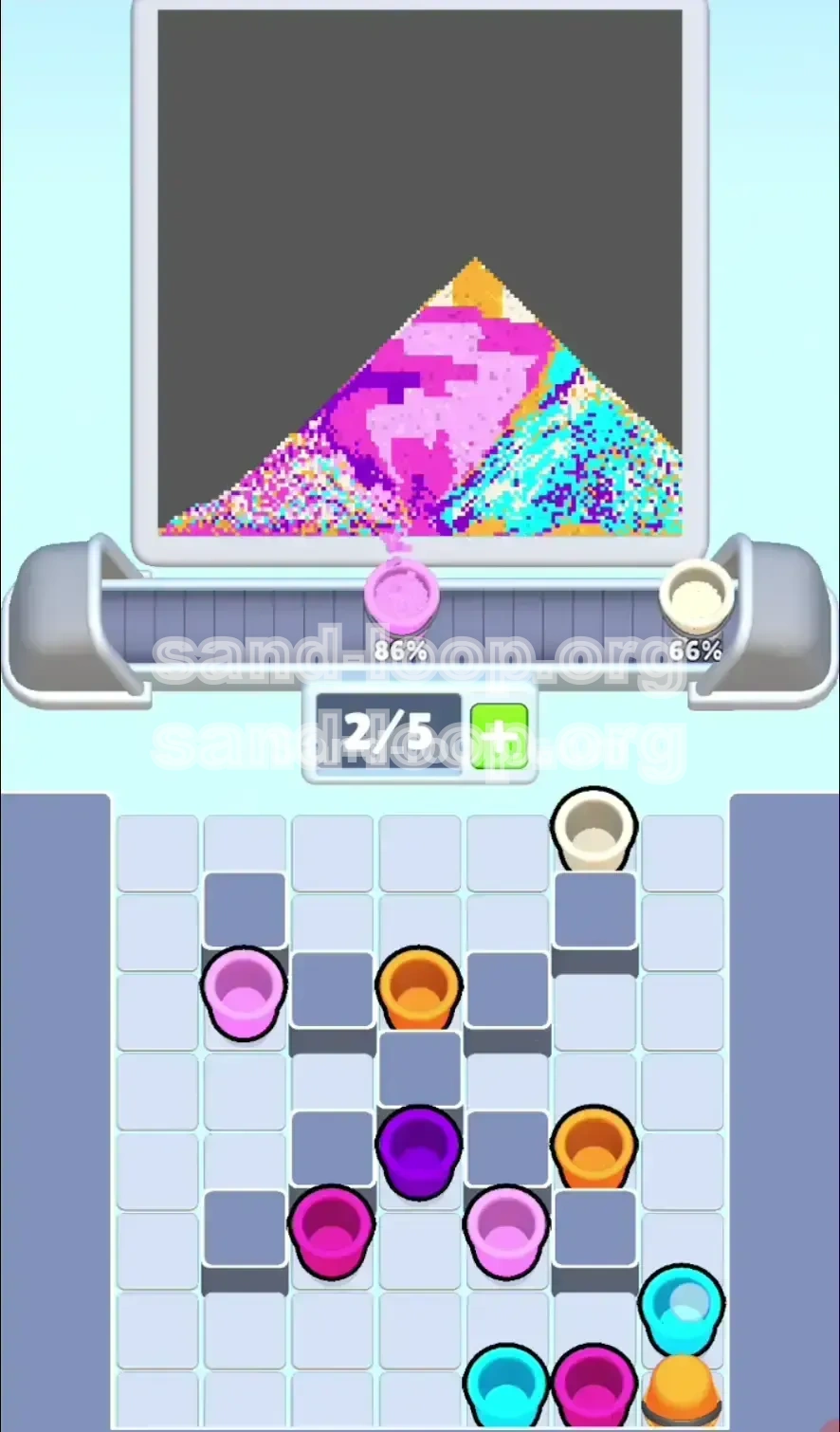
This level is a masterclass in Sand Loop's gravity mechanics. The game engine prioritizes filling the lowest available pixels first. Because the lavender field occupies the bottom of the screen, it acts as a container for everything above it. If you pour Orange or Cyan paint before the Purple field is filled to about 80% capacity, those colors will leak through the unfinished field and settle in areas where they don't belong, creating irreparable "pollution" in your pixel art. You must resist the urge to work on the sky until the ground is solid.
Color Complexity and Similarity
A significant mental challenge in this level is distinguishing between the three violet-based colors: Deep Purple, Magenta, and Light Pink. These colors are used to create a zigzag pattern in the flower field. To the untrained eye, the Magenta and Light Pink cups can look very similar under pressure, especially when they are moving rapidly in the supply tray. Misidentifying these colors can lead to a malformed zigzag pattern, which usually results in a failed level attempt because the pattern matching algorithms are strict about shade placement.
The Ice Block Mechanic
Adding a layer of time-management pressure is the presence of two Ice Blocks marked with the number "18" located at the bottom corners of the supply tray. These blocks are not just obstacles; they are a countdown. They contain the emergency reserves of paint required for the final sections of the level (specifically the White and Cyan needed for the sky). The number 18 represents the number of moves or cup clearances required to shatter them. You do not need to target these blocks directly; playing the level naturally will chip away at their integrity. However, if you play too slowly or inefficiently, you might find yourself needing these reserves before they are available.
Clear Objectives for Completion
To successfully complete Level 167 and achieve a three-star rating, you must move beyond simple color matching and execute a precise strategy. The primary goal is to fill the canvas in the correct order: Field first, Ground second, and Sky last. Below are the specific objectives you need to keep in mind to navigate the "Lavender Windmill" efficiently.
Objective 1: Clear the Peripheral Columns
Your immediate first goal is to clear the cups on the far left and far right edges of the supply tray. Because the "W-Shape" gray blockers are locking the center, you have no access to the inner cups initially. You must systematically drain the top-left and top-right columns. This involves matching the Deep Purple and Magenta cups on the left and the Cyan and White cups on the right. Clearing these edges is the only way to destabilize the center block formation and reach the critical paint supplies hidden underneath.
Objective 2: Achieve 80% Field Saturation
Before you even think about clicking an Orange cup or a Cyan cup, you must ensure the bottom 40% of the canvas (the lavender field) is at least 80% full. The Deep Purple and Magenta paints must form a solid base. Why 80%? This is the threshold where the paint is dense enough to catch subsequent layers. If you switch to the ground colors (Orange) too early, they will bleed into the empty pockets of the field. Monitor the bottom of your screen; once the zigzag pattern is distinct and continuous, you can proceed to the next objective.
Objective 3: Execute the Horizon Transition
Once the field is stable, your objective shifts to the "Horizon Line." This is the visual barrier between the flowers and the windmill base. You need to deploy the Golden Orange paint to establish this boundary. This step is tricky because the Orange cups are often buried in the middle layers of the tray, which you only just unlocked by clearing the sides. Your goal here is precision: send the Orange cups to paint the ground strip and the windmill base without splashing over into the unfinished flower field below.
Objective 4: Shatter the Ice Blocks
Midway through the level, keep a close eye on the "18" counters on the Ice Blocks. Your objective is to reduce this counter to zero as quickly as possible. This is achieved by clearing cups from the board—every cup cleared contributes to chipping away the ice. Do not rely on these blocks for your primary paint supply; treat them as a "release valve" for the endgame. Once they shatter, they usually reveal the final batches of White and Cyan paint needed to polish off the sky.
Objective 5: The Sky and Cloud Layering
The final objective is the most delicate. You must fill the Cyan sky while simultaneously placing the White clouds and windmill blades. The challenge here is that White is a "dominant" color in the game's physics; if you send a White cup while the sky is still empty, it might spread too wide. You must alternate Cyan and White to create contrast. The windmill blades are thin lines, so you need to be precise with your White placement to ensure they stand out against the Cyan background.
Step-by-Step Instructions
This walkthrough provides a turn-by-turn strategy for navigating Level 167. Follow these steps in order to manage your supply tray effectively and paint the Lavender Windmill without running out of moves.
Phase 1: The Violet Rush (Moves 1-15)
At the start of the game, do not scan the whole board. Focus your eyes exclusively on the top-left quadrant of the supply tray. You will see a stack of Deep Purple and Magenta cups.
- Identify Targets: Look for the Deep Purple (darkest) cups first. These form the shadowed parts of the lavender field.
- Ignore the Sky: Even though you might see a Cyan cup available on the top right, ignore it. Clicking it now is a trap; it will waste a move.
- Match and Clear: Start matching the Purple cups. Your goal is to clear the top layer of the left column.
- Trigger Chain Reactions: Try to set up matches that will cause the cups above to fall into place, creating automatic matches. This saves moves.
- Magenta Introduction: Once the initial Purple layer is thinned out, introduce the Magenta (Hot Pink) cups. These usually sit just below the Purple cups in the tray.
Phase 2: Managing the "W-Shape" Blockers (Moves 16-30)
After clearing the initial top layer, you will encounter the gray blockers. You cannot clear these directly.
- Work the Edges: Shift your focus to the far-left and far-right columns. You need to clear the cups "outside" the W shape.
- Right Side Awareness: On the right side, you will find Cyan and White cups. Clear these even if you don't need the paint yet. You are clearing them to unblock the center.
- Center Unlocked: Once the outer columns are down by about two layers, the center cups will slide outward, replacing the gray blockers or becoming accessible.
- Harvest the Center: The center usually hides the Light Pink and Orange cups. Now is the time to start integrating Light Pink into your field to finish the zigzag pattern.
Phase 3: The Horizon Transition (Moves 31-45)
At this stage, your lavender field should be taking shape, but you will notice pockets of empty space still lingering near the bottom.
- Assess Field Density: Look at the canvas. Is the purple/pink mix solid? If it looks like a solid wall of color, proceed.
- Locate Orange: Scan the tray for the Golden Orange cups. They are critical now.
- Deploy Orange: Send the Orange paint. It should settle right on top of the purple field, creating the ground strip.
- Fix Gaps: If you see Orange leaking into the purple area, stop sending Orange. Go back and find more Purple/Pink cups to patch the hole.
- Windmill Base: Use a few extra Orange cups to build the base of the windmill structure in the center of the screen.
Phase 4: Breaking the Ice (Moves 46-55)
By now, the "18" counters on the ice blocks should be dropping rapidly (likely down to 5-10).
- Monitor Counters: Don't panic if the number isn't zero yet. Keep clearing the remaining cups in the main tray.
- Cyan Reserves: The ice blocks are guarding the last of the Cyan paint needed for the sky.
- White Reserves: They also hold the White paint for the windmill blades.
- Force the Break: If you are stuck and can't make a match in the main tray, look for moves that clear cups closest to the ice blocks to speed up the shattering process.
- Unleash the Cache: When the blocks shatter, immediately grab the revealed cups. Do not leave them sitting in the tray.
Phase 5: The Sky and Windmill Finale (Moves 56+)
The endgame is about precision and layering.
- Sky Foundation: Start by sending the Cyan cups from the shattered ice blocks. You want a deep blue background.
- Cloud Placement: Send the White cups immediately after the Cyan. Because White spreads, sending it right after Cyan ensures it sits "on top" of the sky layer, forming distinct clouds.
- Windmill Blades: You will need specific White shots to form the blades. If the white paint spreads too much, it ruins the blade shape. Try to clear White cups when the immediate area below the blade is already filled with Cyan or Orange.
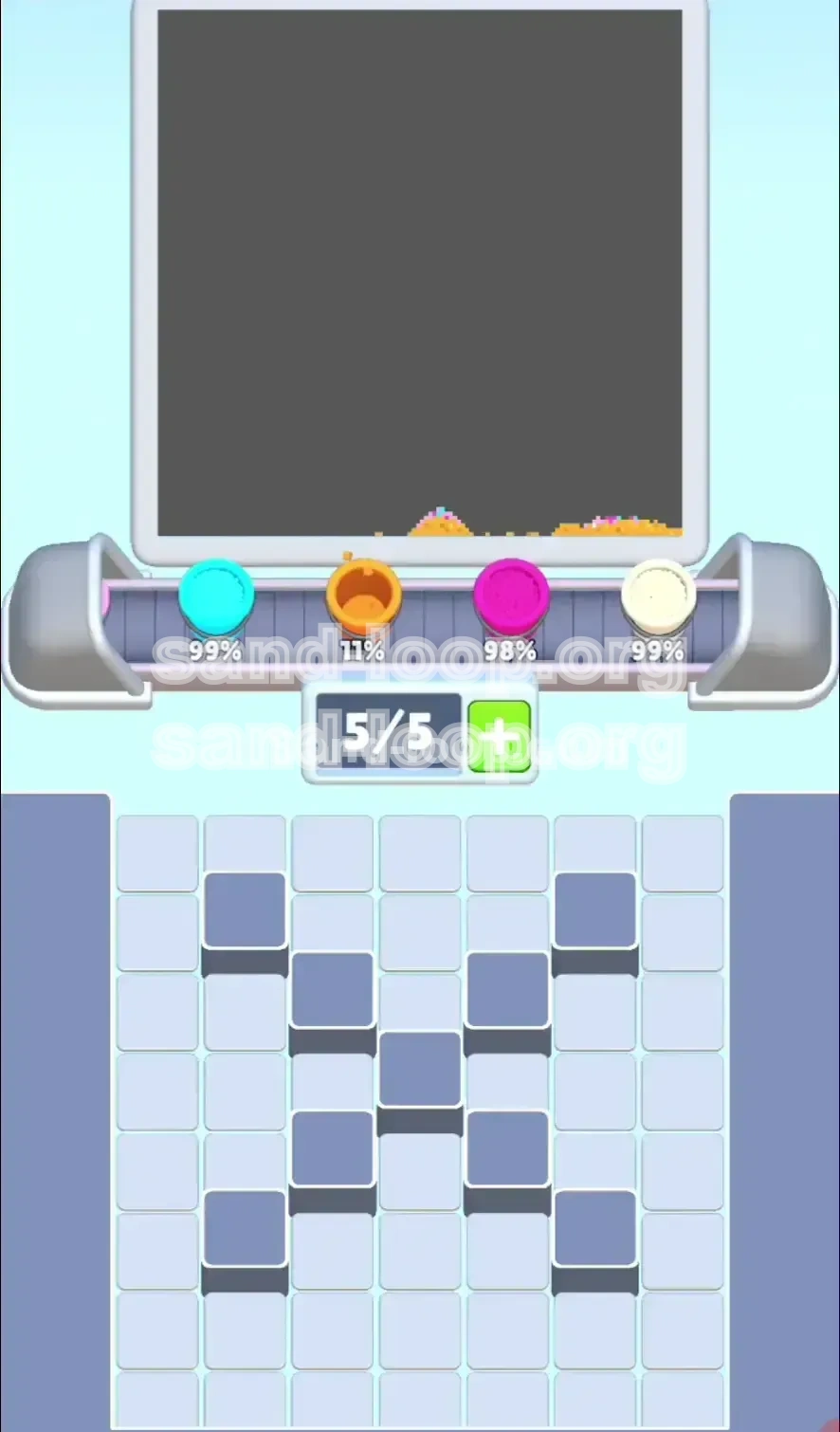
- Final Polish: Use any remaining moves to clear out "stray" cups that don't match the remaining empty pixels on the canvas.
Color Order Analysis
Understanding the hierarchy of colors is the secret weapon for Level 167. If you process colors in the wrong order, you will fail. The physics of Sand Loop dictates that heavier, darker colors usually form the base, while lighter colors sit on top. Here is the optimal processing order for this specific level.
Priority 1: The Deep Purple & Magenta Foundation
These are your "Tier 1" colors. They are the most dense and occupy the lowest physical space on the canvas. You must process these first. If you have a choice between matching a Purple cup and an Orange cup, always choose the Purple. The Magenta serves as the highlight for the purple shadows, so it should be processed immediately after the Deep Purple, but before any other colors are introduced. Failing to prioritize this will result in a "muddy" base layer where the greens or blues of the background bleed into the flowers.
Priority 2: The Light Pink Highlights
Once the base is established, you introduce Light Pink. This is "Tier 2." It is lighter than Magenta and represents the tips of the lavender flowers or the flowers catching the most light. Because it is lighter, if you pour it too early, it will sink underneath the Magenta and disappear, wasting the cup. Pouring it after the base is ready ensures it floats on top, creating the necessary zigzag texture in the field.
Priority 3: The Golden Orange Ground
Orange is "Tier 3." It represents the soil and the windmill structure. This color has a heavier weight than the sky colors but sits above the field. You must wait until the Purple/Magenta/Pink layer is essentially a solid wall. If you pour Orange while the field has holes, the Orange will fill those holes, turning your flowers into mud. The Orange paint acts as a "seal" over the floral layer, separating it from the sky.
Priority 4: The Cyan Sky
Cyan is "Tier 4." It is the background for the upper atmosphere. It is less dense than the Orange ground. You pour this only after the ground line is visible. The challenge with Cyan is that it spreads rapidly. If there are any gaps in the Orange ground layer, the Cyan will leak through and turn your ground blue. Always ensure the horizon line (Orange) is unbroken before opening the Cyan floodgates.
Priority 5: The White Accents
White is "Tier 5," the final layer. It is the most volatile color in the game. It is used for the windmill blades and the clouds. Because it is the lightest color, it wants to sit on top of everything. However, its volatility means it can accidentally overwrite your previous work if not placed carefully. You process this last to ensure it sits crisply on the Cyan sky and Orange ground, defining the sharp edges of the windmill blades without blurring into the background colors.
Key Tips and Common Mistakes
Even with a step-by-step guide, the chaotic nature of the supply tray can lead to errors. This section highlights the critical strategic nuances of Level 167 and helps you avoid the pitfalls that ruin a perfect run.
Tip 1: The "Peel the Onion" Strategy
Always remember the layout of the tray. The "W-Shape" blockers mean the level is designed like an onion—you must peel away the outer layers to get to the center. Do not waste moves trying to pick away at the gray blockers directly; it is impossible. Focus your energy on the columns at the extreme edges (columns 1 and 7, if we number them 1-7). As you clear these edges, the game's gravity mechanics will naturally shift the inner cups into reachable positions. Patience with the outer columns is the key to unlocking the center.
Tip 2: Ice Block Countdown Management
Don't view the Ice Blocks as a "panic button" for the very end. View the number "18" as your resource budget. Every move you make should ideally contribute to lowering that number. If you find yourself making moves that clear cups but *don't* chip away at the ice (e.g., clearing cups on the opposite side of the board from the ice blocks), you might be inefficient. Try to balance your moves between clearing the board for the paint you need *now* and clearing cups near the ice blocks to prepare for the paint you need *later*.
Common Mistake: Premature Sky Painting
The single most common mistake in Level 167 is painting the sky too early. Players see a Cyan cup available in the top-right corner of the tray and click it immediately. This is fatal. The Cyan paint will fall through the unfinished lavender field and settle at the very bottom of the canvas, effectively "poisoning" your purple pixels. You will then have to waste Purple paint to cover up the blue splotches. Resist the urge. If you see a Cyan cup in the first 20 moves, pretend it doesn't exist.
Common Mistake: Ignoring the Horizon Seal
Another frequent error is switching from Purple/Pink directly to White or Cyan, skipping the Orange ground layer. While it might seem like a shortcut to go straight to the top, the physics engine requires a medium-density layer to catch the light sky colors. Without the Orange "seal," the White paint for the windmill will drift down and merge with the purple field, turning your lavender bushes into a blurry gray mess. Always ensure the Orange strip is clearly visible before moving to the top tier colors.
Stuck Solution: The "Restart" Threshold
If you are halfway through the level and you realize that your lavender field has turned into a muddy mix of Purple, Orange, and Blue, you are in a "Death Spiral." The physics engine will not allow you to fix this easily because the heavy paint is already at the bottom. In this scenario, the best strategic move is to restart the level immediately. Trying to dig your way out of a muddy base usually costs more moves (and frustration) than starting fresh and adhering strictly to the "Bottom-Up" color priority.
Speed Run Tip: Pre-Loading the Tray
For advanced players looking to optimize their time, you can use the brief animation delay while paint is falling to scan the tray for the *next* color you need. While the Purple paint is settling on the canvas, identify exactly where the next Magenta or Light Pink cup is located. By the time the current animation finishes, your cursor should already be hovering over the next target. This "pre-loading" of your cursor position can shave seconds off your time and prevent the timer from running out on the final few moves.