
Level 269
HARDHow to solve Sand Loop level 269? Get instant solution for Sand Loop 269 with our step by step solution & video walkthrough. Sand Loop 269 tips and guide.
Play Sand Loop Now
Experience the puzzle challenge firsthand
Game Screenshots
Sand Loop Level Guides
Level Overview: The Abstract Floral Challenge
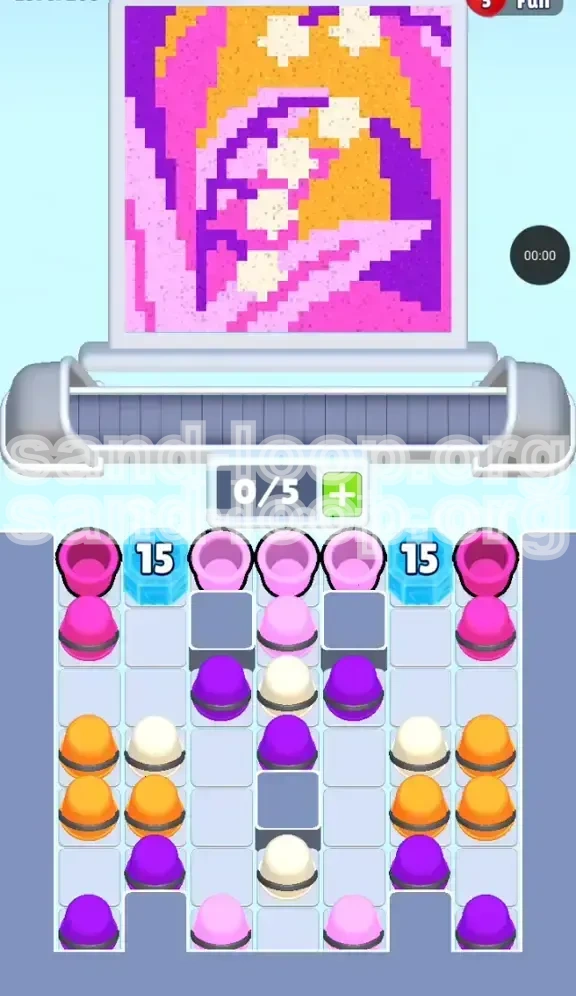
Welcome to Level 269, a stage that deceives players with its artistic visuals while demanding strict logical execution. At first glance, this level appears to be a simple painting task involving drooping flowers—likely resembling Lily of the Valley—set against a swirling, psychedelic backdrop. However, beneath this aesthetic lies a resource management puzzle.
The primary difficulty in Stage 269 stems from its tight inventory constraints and the deceptive placement of "useless" resources. The most vibrant colors, the Magenta buckets located on the far left and right flanks, are essentially dead weight for the first half of the level. They are visually distracting and trap inexperienced players into wasting valuable inventory slots early on.
Furthermore, the level utilizes a "15-Hit Ice Block" mechanic that acts as a hard gate on your primary flow of resources. You cannot simply paint from left to right; you must surgically dismantle the center of the board to unlock the sides. The color palette is also treacherous: Pale Pink stems and White flower bells are incredibly similar in hue, and the background Purple frequently bleeds into the foreground shadows. Success in this level requires distinguishing between these subtle tones and managing your queue limit of 5 buckets with absolute precision.
The Visual Deception
Do not be fooled by the bright Magenta buckets on the edges. They are "trap items." Clicking them early will clog your conveyor belt (which has a limit of 5 active slots), preventing you from accessing the critical Pale Pink and White buckets in the center. Treat the side columns as "locked" until the mid-game.
The Ice Block Barrier
The numbers "15" on the blue hexagonal barriers indicate specific destruction criteria. These blocks guard the side columns. You cannot break them by attacking directly; instead, you must generate flow by processing the center columns. The ice acts as a progress gate—only as you approach the 40-50% completion threshold will the game physics allow these barriers to shatter.
The Inventory Crisis
Your tray capacity is strictly limited to 5 slots (5/5). If you fill your belt with colors that cannot currently be poured (e.g., grabbing Magenta before the side columns open), you will create a deadlock. You must maintain "flow discipline"—only activating a bucket if you are certain it can pour immediately.
Color Palette Risks
The biggest risk to your accuracy percentage is the confusion between the White flower bells and the Pale Pink stems, or the White bells and the Orange background. Because the White bells are small, isolated pixels, "spamming" or holding down the pour button will cause the sand to bleed into adjacent zones, ruining your completion rate.
Strategic Objectives
To conquer Level 269, you need to abandon the instinct to paint the brightest colors first. Your objective is to clear the "garbage" layers (Pale Pink) to access the "core" resources (Orange and Purple) that drive the level's progression engine.
Clear the Central Choke Point
The immediate objective is to clear the top row of the center columns. These are filled with Pale Pink buckets. They serve as the lid on a box; until you remove them, you cannot access the critical White and Orange buckets buried beneath them in the tray's second and third rows.
Generate Flow for Ice Breaking
You need to accumulate roughly 40-50% completion progress to trigger the shattering of the Ice Blocks (15). This is achieved not by painting perfectly, but by moving the massive amount of Orange sand required for the background. The Orange pour is your "key" to the rest of the level.
Preserve White Resources
White buckets are the rarest commodity in this level. There are very few of them, and they are needed for the most detailed, high-contrast parts of the image (the flower bells). Your objective is to waste zero sand. Do not pour White sand until the sensor is perfectly aligned.
Unlock the Flanks
The final objective is to survive until the Ice Blocks break. Once the side columns unlock, you will have a sudden influx of Magenta buckets. The challenge here is not to panic and pour them all at once, but to integrate them into the remaining empty spaces without over-painting your completed work.
Step-by-Step Walkthrough
Follow this exact sequence to ensure a smooth clear. Deviating from this order, particularly by clicking side buckets too early, is the most common cause of failure.
Phase 1: The Pink Opener (0-15% Completion)
As the level loads, your eyes will naturally drift to the sides. Ignore them. Focus entirely on the top-center of the sand tray. You will see a row of three Pale Pink buckets.
- Action: Tap all three Pale Pink buckets in quick succession.
- Result: These will move to the conveyor and pour, painting the slender stems of the flowers.
- Reasoning: This clears the top layer of the "stack" in the tray, physically revealing the Purple and White buckets hidden underneath. It is the only way to start the chain reaction.
Phase 2: The Purple and White Dance (15-30% Completion)
With the top layer gone, you now see a mix of Purple and White buckets in the center. The White buckets are for the flower bells; the Purple is for the lower shadows.
- Action for White: Tap ONE White bucket. Watch it pour. Wait. Ensure it finishes the specific bell cluster before tapping the next. Do not queue multiple White buckets.
- Action for Purple: The Purple zones are larger (the lower swirls). You can tap two Purple buckets in a row if your belt has space, but generally, stick to a 1:1 rhythm to be safe.
- Goal: As you clear these, you are digging deeper. You are exposing the Orange buckets in the 3rd and 4th rows of the tray.
Phase 3: The Orange Flood (30-50% Completion)
This is the "grind" phase. You have exposed the Orange buckets, and you need to paint the massive background area.
- Action: Tap Orange buckets as soon as they appear. The Orange zones are huge and can take 3-4 buckets in a row.
- Monitoring: Watch the "15" Ice Blocks on the left and right. As your Orange sand pours and your percentage climbs, you will see these blocks start to crack or visually destabilize.
- Note: Keep an eye on your belt count (Max 5). It is easy to overload the belt here because the Orange pours are long. Don't let the belt fill up while an Orange bucket is still pouring.
Phase 4: The Shatter and Magenta Release (50-75% Completion)
Around the 50% mark, the game will trigger a scripted event. The Ice Blocks will shatter, and the conveyor belt will extend or unlock to reveal the Magenta buckets on the far left and right.
- Action: Pause for a second. Do not spam click the new Magenta buckets.
- Tactics: Identify the remaining empty zones on the canvas. These are likely the outer "swirls."
- Execution: Tap the Magenta buckets. Since Magenta is a strong color, it covers quickly. Alternate between Magenta and any remaining Orange/White buckets to finish the image.
Phase 5: The Cleanup Sprint (75-100% Completion)
You are in the endgame. The belt is likely chaotic, with a mix of leftover colors.
- Priority: Finish any White details first. White is the hardest to fix if you paint over it.
- Final Touches: Use the remaining Magenta and Purple to fill in the "noise" pixels—the tiny spots that were too small to hit with the big Orange pours.
- The Reserve: Try to keep one slot open (4/5) in the final moments so you can grab the very last bucket if it gets stuck behind a block.
Color Order and Processing Guide
The specific order of operations is dictated by the physical layout of the sand tray and the unlocking logic of the Ice Blocks. Processing colors in the wrong order is the primary cause of "soft locks" where no valid moves are available.
1. Pale Pink (The Opener)
Status: Unlocked at Start.
Usage: Low volume. Used only for stems.
Strategy: These must be cleared immediately to free up the tray slots for the valuable colors underneath. Do not save them.
2. White (The Precision Tool)
Status: Unlocked after Phase 1.
Usage: Extremely Low volume. High detail.
Strategy: Treat White as a "single-action" tool. One tap, one pour, one wait. The White zones are small "islands" surrounded by Orange. If you pour while the sensor is drifting, you will contaminate the Orange background.
3. Purple (The Shadow Layer)
Status: Unlocked after Phase 1.
Usage: Medium volume.
Strategy: Purple forms the base of the flowers and the background swirls. It is generally safe to pour, but be careful near the bottom of the screen where it might mix with the Magenta (which comes later).
4. Orange (The Progress Driver)
Status: Buried deep in the tray.
Usage: Massive volume.
Strategy: This is your "break glass in case of emergency" color. You need the volume of Orange sand to drive your completion percentage up to trigger the Ice Block break. This is the only color where "spamming" (tapping 2-3 in a row) is acceptable.
5. Magenta (The Finisher)
Status: Locked behind Ice Blocks (15).
Usage: Medium/High volume.
Strategy: Completely useless until the ice breaks. Once unlocked, it defines the outer edges of the painting. Do not use it until the center (Orange/White) is mostly established, as Magenta is darker and will cover up your lighter details.
Pro Tips and Common Mistakes
Even experienced players can stumble on Level 269 due to its psychological traps. Here is how to play like a pro and avoid the pitfalls that lead to restarts.
The "0/5" Slot Management Trap
The most common mistake is treating the tray like a storage unit. In this level, the tray is a processor. If you pull a Magenta bucket while the ice is still up, it sits on the belt. If you do this 5 times, your belt is full (5/5). You cannot pull any more buckets. You cannot make moves. The game ends. Rule: Never pull a bucket unless you know where it is going.
Confusing "White" with "Pale Pink"
The flower stems are Pale Pink. The flower bells are White. The background near the top is Orange. In the heat of the moment, it is easy to think a stem is a White bell. If you use a White bucket on a Pink stem, you waste 20% of a White bucket that you needed for the actual bell. Tip: Zoom in (if possible) or pause before pouring White. Look for the "bell" shape.
The "Bleeding" Effect
Sand physics games often have "bleeding," where sand piles up and spreads to adjacent colors. The White bells are often isolated pixels. If you hold the pour button too long on a White bell, the sand overflows into the Orange background. Tip: Use short, staccato taps for White. Tap-pause-tap-pause. It is slower, but it prevents "pollution" of your background.
Breaking the Ice Too Slowly
Some players are too cautious, trying to paint the Purple and White zones with 100% accuracy before moving to Orange. This is inefficient. The Ice Blocks break based on flow and volume. You need to get to the Orange sand quickly to trigger the event. Tip: Don't obsess over perfect edges in the first 30%. Focus on clearing the tray to get to the Orange.
Premature Magenta Pouring
When the ice breaks, the Magenta buckets become available. A panic reaction is to click them all immediately. However, the conveyor belt logic often means your previous Orange pour is still finishing. If you send Magenta while Orange is pouring, they mix on the canvas, creating a muddy brown-grey mess. Tip: When the ice breaks, finish your current pour first. Wait for the conveyor to clear a slot, then introduce the Magenta.
Stuck Solutions and Speed Run Tips
If you find yourself at 90% stuck with a single pixel remaining, or if you want to optimize your time for a speed run, these advanced techniques will help you secure the win.
Stuck at 99%? Check the "Noise" Zones
The "Swirl" pattern of this level creates many tiny, isolated corners where sand can't reach.
- The Fix: Look specifically at the intersection of the Orange background and the Purple shadows. There are often "triangle" pixels that are ambiguous in color.
- The Reserve Bucket: This is why the guide suggested keeping a slot open (4/5). If you are stuck, scan the tray for a single remaining bucket of the color you need. If it's buried behind a block you haven't cleared, you may need to strategically waste a bucket to move the belt.
Speed Running: The "Double Tap" Technique
For experienced players looking to lower their time:
- Phase 1 & 2: You can safely "Double Tap" the Pale Pink and Purple buckets. As soon as the first bucket hits the conveyor, tap the next. You don't need to wait for the pour to finish because the zones are large enough to absorb the overflow.
- Phase 3: Queue 3 Orange buckets at once. The background is so large that it will take all of them. This prevents downtime and gets you to the Ice Break event faster.
- Phase 4: Do not double tap Magenta. Magenta covers small, distinct swirls. Over-pouring here forces you to redo the White bells. Stick to single taps.
Resetting the Board
If you have completely deadlocked your belt (5/5 slots full of useless colors), your only option is to restart. However, if you have 3 or 4 slots full, you can sometimes recover by pouring the current active bucket as fast as possible (spilling sand) just to clear it off the belt. This sacrifices accuracy percentage but saves the run. Only do this if you are confident you can make up the percentage later with the Magenta buckets.