
Level 428
EXPERTHow to solve Sand Loop level 428? Get instant solution for Sand Loop 428 with our step by step solution & video walkthrough. Sand Loop 428 tips and guide.
Play Sand Loop Now
Experience the puzzle challenge firsthand
Game Screenshots
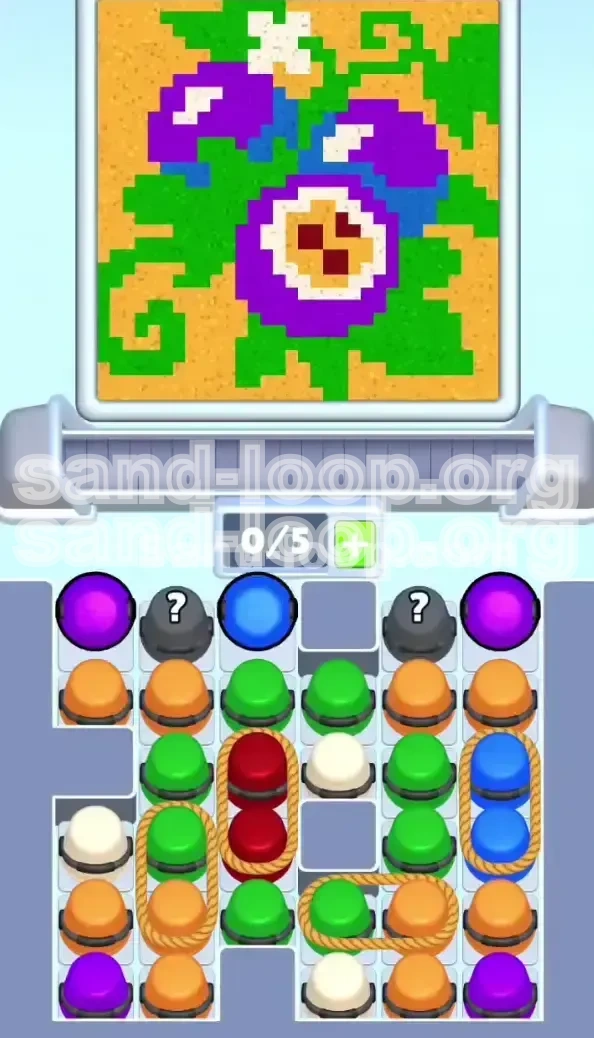
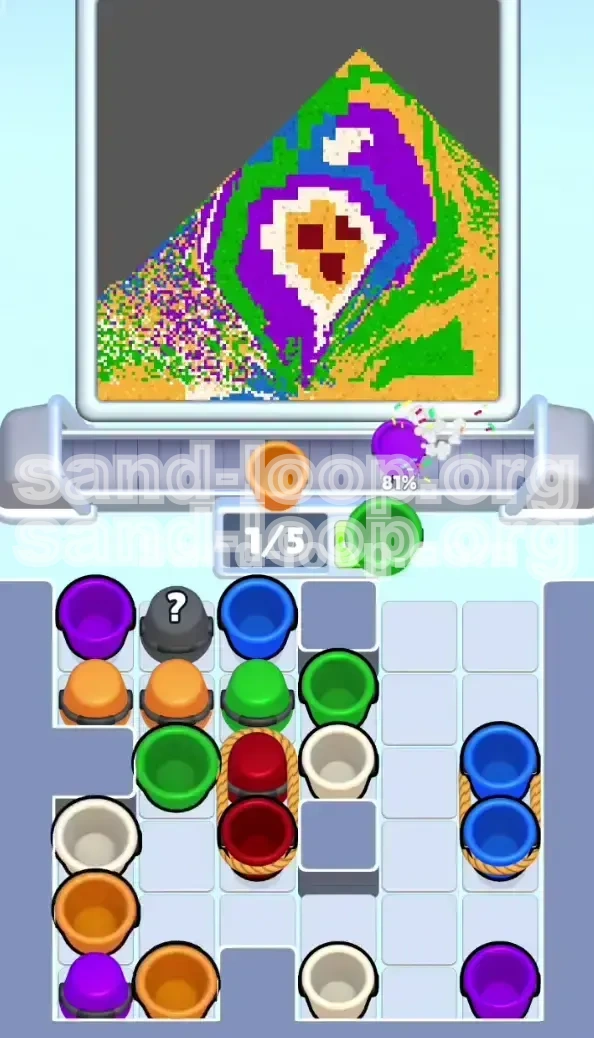
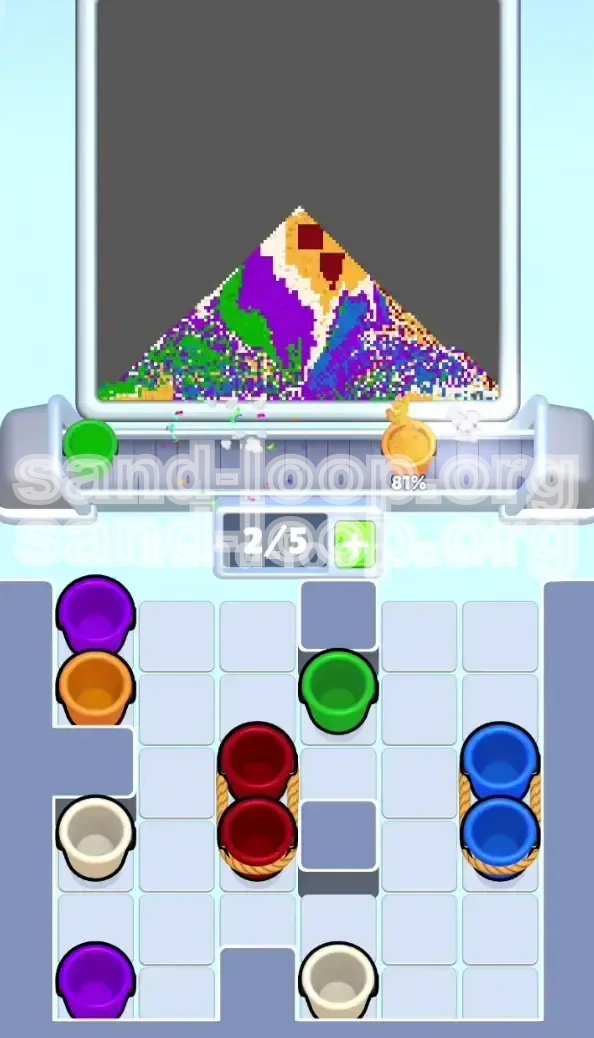
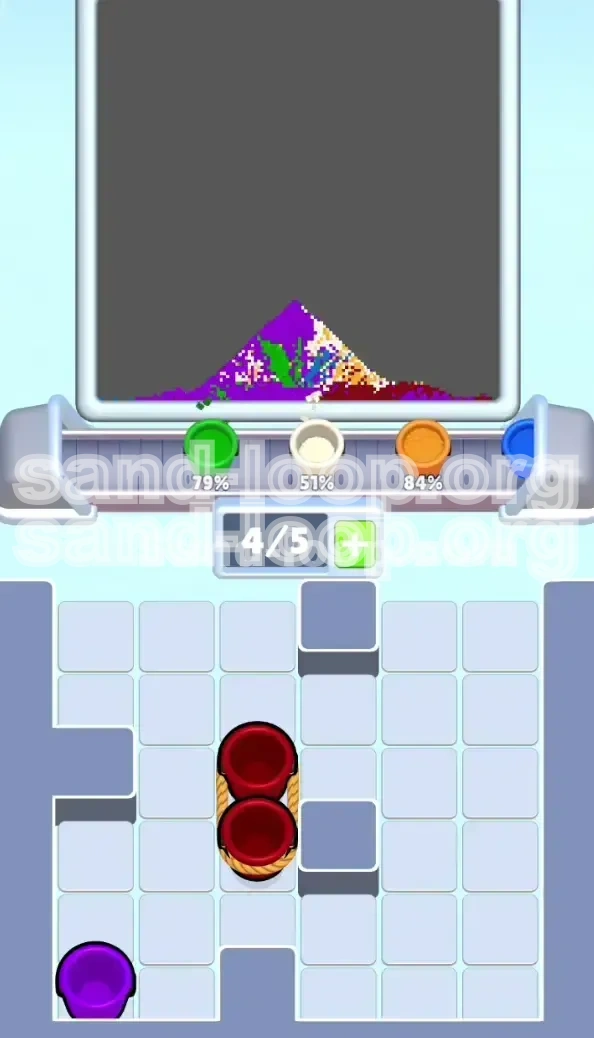
Sand Loop Level Guides
Level Overview: The Pixel Art Grape Challenge
Sand Loop Level 428 stands out as a distinct puzzle stage that prioritizes strict logic over quick reflexes. Unlike standard levels where rapid tapping often leads to victory, this stage demands a calculated, architectural approach. The visual target is a pixel-art schematic of purple grapes hanging from a green vine, set against a textured orange-tan background.
The core difficulty lies in the severe restrictions placed upon you. The grid is vast, but your conveyor belt capacity is crippled, limited to only five slots. This small margin for error turns the level into a high-stakes resource management game. Furthermore, the game introduces "Rope Mechanics," where specific cups are bound together. Activating a rope instantly loads two items into a single slot on your belt, which can easily overwhelm your system if you aren't prepared.
Statistically, this level has a high failure rate for players who attempt to brute-force it. The game physics are particularly sensitive to "color bleeding" here—a phenomenon where sand layers mix unintentionally due to gravity and fluid dynamics. To succeed, you must suppress the urge to clear the board randomly and instead adopt a strict building order, treating the screen as a canvas that must be painted in specific layers.
Clear Objectives and Strategic Requirements
Master the Color Hierarchy
Your primary goal is not just to empty the grid, but to construct the image in a specific order that prevents contamination. The "Grape Vine" image relies on three distinct tiers of color priority. Understanding this hierarchy is the difference between a clean finish and a muddy restart.
- Primary Structure (Purple & Green): These form the actual fruit and leaves. They are the most time-sensitive elements and must be placed first to establish the boundaries of the image. Think of these as the "lines" of a drawing.
- Background Filler (Orange): This is your canvas. It is abundant and forgiving, but dangerous if used too early. Pouring Orange too early buries the structural cups, making them impossible to reach without causing a mess.
- Fine Details (White, Blue, Dark Red): These are accents. Dark Red acts as core shadows for the grapes, while White provides highlights. These must be saved for the very end to prevent them from being swallowed by the larger color masses.
Strict Conveyor Belt Management
You have a hard limit of 5 active slots. In Level 428, slots are your currency. You must always maintain a "buffer" of at least one empty slot. If your belt reaches 5/5 capacity, you lose the ability to react to new cups or correct misaligned pours. This buffer is essential for handling the Rope Ties, which instantly consume two slots and can capsize your run if you aren't ready for them.
Dismantle Rope Dependencies
The grid is a tangled mess of physical dependencies. Many essential cups are buried under others, and ropes bind key pairs together. Your objective is to dismantle the grid layer by layer, starting from the top and working down, ensuring that you never trigger a rope tie that would overflow your belt.
Prevent Color Bleeding
The physics engine in this level simulates gravity and fluid pile-up. Pouring a Dark Red cup over a surface that is already 80% full of Orange sand will cause the red to slide down the pile and mix with the orange, turning your background into a dull red smudge. You must ensure that "ground" layers (Orange) are stable before applying "topping" layers (Red/White).
Step-by-Step Instructions: The Perfect Run
Phase 1: The Top Row & Mystery Reveal
The beginning of the level is deceptive. You have a row of single cups at the very top that seem easy, but they hide dangerous traps that can bottleneck your progress later.
1. Locate the Single Purple Cups: Look at the far left and far right edges of the top row. You will see unbound Purple cups. Tap these immediately. They are safe and begin the outer edges of the grape cluster. This fills your belt with 2/5 slots.
2. Trigger the Mystery Cups: Adjacent to the Purple cups, you will see two gray cups with question marks. These block critical columns. Tap them now while you have ample space. They will reveal their colors (usually Green or Purple variants) and add to the queue. Do not worry about the specific color yet; just get them on the belt.
3. Wait for the Pour: Let these first four cups pour completely. Do not tap anything else. Watch the sand settle. This clears your belt back to 0/5, giving you a clean slate for the dangerous maneuvers below.
Phase 2: The Green Foundation & Rope Traps
Once the top row is gone, you are exposed to the "Rope Zone." This is where most players fail, as the game forces you to deal with paired items.
1. Identify the Vertical Green Rope: On the left side of the middle grid, there is a vertical rope binding two Green cups. This represents the main stem of the vine. Do not tap this yet.
2. Clear the Single Greens: Look for any single Green cups that are accessible without triggering ropes. Tap these to start filling the leaf structures. You need to build a "bed" of green sand before introducing the roped pair.
3. Execute the Green Rope: When your belt is completely empty (0/5), tap the Vertical Green Rope. This loads two cups instantly. Immediately look for a safe spot to pour. If you wait, you might block a Red cup that you need later.
Phase 3: The Red Zone Danger
The center of the grid contains the "Death Zone"—a vertical rope binding two Dark Red cups. This is the most dangerous element in the level.
1. Assess the Background: The Dark Red cups are designed to add details to the center of the grapes. If you pour them before the Purple grape body is formed, the red will spread into the Orange background.
2. The Strategy of Avoidance: You must ignore the Red Rope for as long as possible. Focus your tapping on the right side of the board. There is a Vertical Blue Rope there that is safer to use once your Purple foundation is 60% full.
3. Timing the Red: Only tap the Red Rope when the central Purple cup is already pouring and the sand level in that specific area is high. This "dam" of purple sand will contain the red details and prevent them from sliding off-target.
Phase 4: The Orange Weave and Horizontal Rope
The bottom of the grid is dominated by a Horizontal Rope tying a Green cup to an Orange cup. This is the final hurdle.
1. The Horizontal Trap: Before you can tap the bottom horizontal rope, you must clear the single cups sitting directly on top of it. These are usually White or Light Purple. Tap and clear these singletons first.
2. Weaving the Orange: You will notice many single Orange cups scattered in the bottom corners. Do not chain them. Tap one Orange cup, wait for it to load, pour it, and then wait for the belt to clear. Tap one Purple cup. Then one Orange. This 1:1 rhythm prevents the "muddy" mixing effect.
3. The Final Pair: With the board mostly clear and the grape image formed, tap the Horizontal Green/Orange rope. This will likely flood your belt (2/5 capacity used instantly), but since it's the end of the level, the overflow won't matter. The remaining sand will top off the leaves and background simultaneously.
Color Processing Order Guide
Priority Tier 1: The Structure (Purple & Green)
Why this order? Purple and Green are the "Subject" of the painting. In pixel art logic, the subject must always be defined before the background is fully filled in. If you fill the background first, you lose the contrast needed to see where the grapes should go.
Action: Tap all accessible Purple and Green single cups first. Use the ropes (Green Vertical, Blue Vertical) as "burst fillers" to bulk up the fruit size quickly.
Priority Tier 2: The Base (Orange)
Why this order? Orange is your "Canvas." It is the safest color because errors in the orange background are less visible than errors on the grape face. However, it is also the most abundant.
Action: Treat Orange as a spacer. Whenever you have a 2-second gap in your pouring queue, tap an Orange cup. Use it to level out the terrain. If a Purple pour makes a steep pyramid, pour Orange into the valleys to create a flat surface for the next layer.
Priority Tier 3: The Details (Red, White, Blue)
Why this order? These colors have high "visual weight." A single dot of Red or White stands out against the Orange and Purple.
Action: Save the Dark Red (from the dangerous center rope) for the very last second. Pouring it early is like drawing eyebrows on a face before you've drawn the skull—it will look wrong. Wait until the Purple "face" of the grape is fully formed, then add the Red "eyes" and White "highlights."
Common Mistakes to Avoid
The "Full Belt" Panic
The most common cause of a reset is tapping a Roped Pair when the belt has 3 or 4 cups already waiting. This instantly fills the belt to 5/5.
Why it fails: Once the belt is full, you cannot correct the aim of the sand stream. If the stream is slightly off-target, you have to sit there and watch it ruin your image.
The Fix: Adopt the "2-Slot Rule." Never tap a roped pair unless you have 2 or fewer empty slots on your belt. This ensures you always have room to manipulate the queue if a sudden Mystery Cup appears.
The "Red Spill" Catastrophe
Players often see the Red cups in the center and assume they need to be cleared early because they look dangerous.
Why it fails: Red sand is heavier visually than Orange. When poured onto a flat Orange surface, it spreads out like a virus. Once it touches the "background" zone, the level logic often counts it as a contamination error.
The Fix: Pretend the Red Rope is glued shut. Do not touch it until you have manually poured at least 70% of the Purple cups in the center column. You need a deep "hole" of purple sand to catch that red sand.
The "Mystery" Gamble
Some players leave the Mystery Cups (top row) for the end, hoping they will contain a color they need for a final touch-up.
Why it fails: Mystery Cups are almost always "Structure" cups (Purple/Green). Leaving them blocked prevents you from accessing the single cups underneath them. This bottlenecks your entire supply chain.
The Fix: Mystery Cups are priority #1. They are the "roof" of your house. Remove the roof first to access the furniture (single cups) below.
What to Do If You Get Stuck
Stuck in a "Soft Lock" (No moves available)
Sometimes, you will have a situation where every available cup is a Roped Pair that would overflow your belt, and your current belt is clogged with slow-pouring cups.
Solution: Stop tapping entirely. Watch the current sand pour. Identify the cup that is taking the longest. If it's a "Thick" sand color (like Purple), you have time. If it's "Thin" sand (like Orange), it will drain fast. Wait for the belt to hit 3/5 capacity, then immediately tap the Roped Pair. This requires millisecond timing, but it is the only way to break the soft lock without restarting.
The "Edge" Problem
You have built the grapes perfectly, but the edges of the canvas (the corners) are empty, and the only cups left are Orange, but they are buried under the finished grapes.
Solution: This is a geometric issue. You likely poured the Purple cups too centrally. Use the "Orange Weave" technique mentioned earlier. You must aggressively pour Orange cups while the Purple cups are pouring, not after. This builds a "wall" of sand that keeps the grapes centered in the frame, leaving the corners clear for the background fill.
Speed Run Tips for Pros
The "Tap-While-Pour" Macro
Advanced players know that the game allows you to tap a new cup while the previous one is still pouring, provided there is belt space.
The Strategy: As soon as a Purple cup starts pouring, immediately look at your grid and locate the next Purple cup. Tap it while the sand is flowing. This queues the next action instantly, shaving 0.5 seconds off every single pour. Over a 50-cup level, this saves 25 seconds.
Pre-loading the Rope
This is a high-risk, high-reward maneuver.
The Strategy: If you are confident in your aim, you can tap a Roped Pair when your belt is at 3/5 capacity, provided the cup currently pouring is almost empty (less than 10% sand left). The timing is critical: the first cup of the pair must hit the belt just as the previous cup leaves the pour spout. If you mistime this, you get a "Belt Full" error and lose precious seconds.
Visualizing the Grid
Don't look at the cups; look at the empty spaces.
The Strategy: Train your eyes to identify "Negative Space." If you see a column of empty space on the right, scan the grid for the Orange cup that fits that column. By matching the cup to the empty space immediately, rather than scanning the whole grid color-by-color, you reduce your search time and reaction delay significantly.