
Level 459
HARDHow to solve Sand Loop level 459? Get instant solution for Sand Loop 459 with our step by step solution & video walkthrough. Sand Loop 459 tips and guide.
Play Sand Loop Now
Experience the puzzle challenge firsthand
Game Screenshots
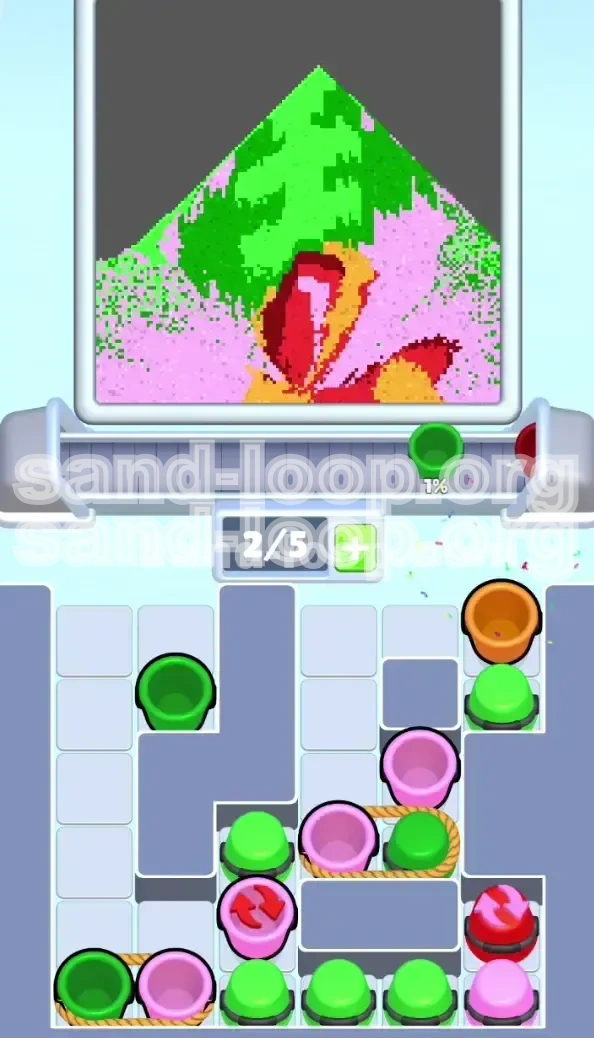
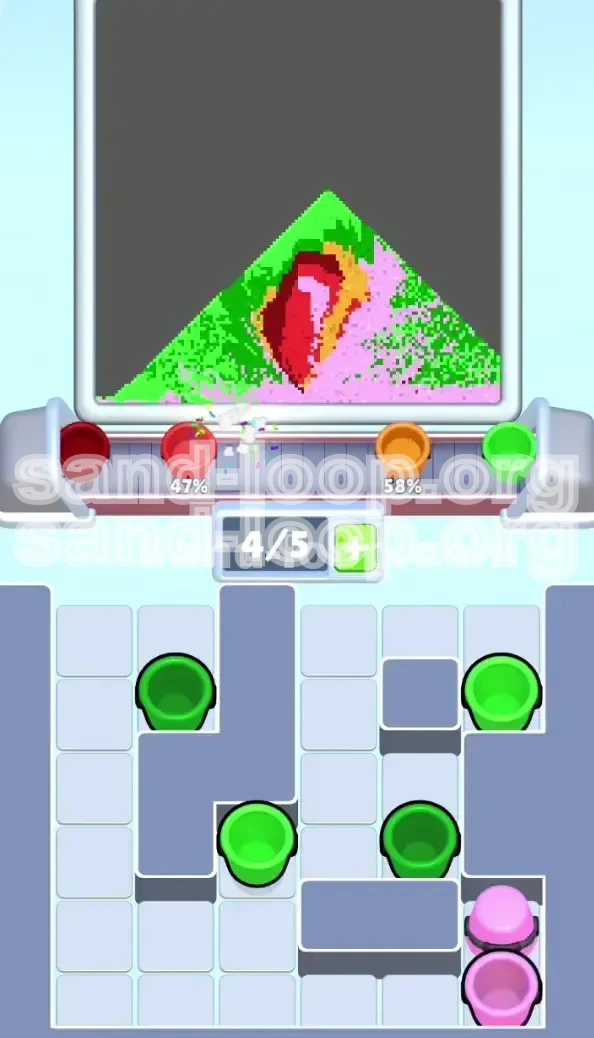
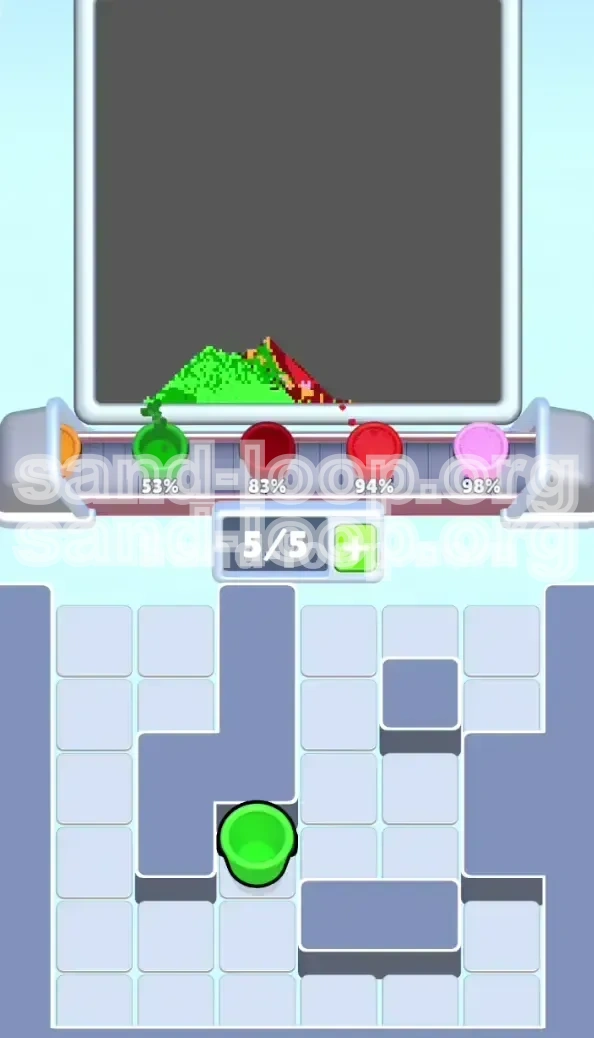
Sand Loop Level Guides
Sand Loop Level 459 Strategy Guide: Mastering the Pixel Beet
Introduction to the Pixel Beet Challenge
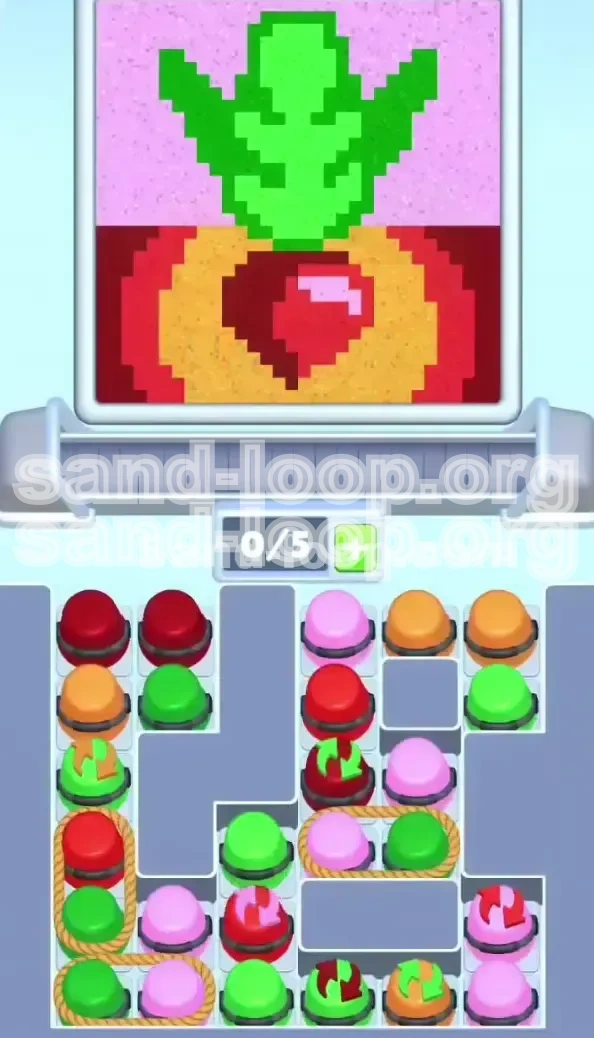
Welcome to Level 459, a stage that shifts the gameplay focus from reflexes to pure logic and inventory management. In this level, you are tasked with filling a canvas depicting a beet root vegetable floating against a pink sandy background. The image features a distinct color palette of Dark Red, Red, Orange, Green, and Pink. Unlike previous levels where you might pour freely, this stage is a logistics puzzle. Your main adversary here is not the timer, but the limited space on your conveyor belt and the restrictive ropes tying your essential color cups together.
Core Mechanics and Constraints
Level 459 introduces a heavy reliance on "Ropes"—mechanical binds that link multiple cups together. When you tap a roped cluster, you unload every cup in that group onto your conveyor belt simultaneously. This presents a massive logistical headache because your conveyor belt has a hard limit of 5 slots. If you mismanage your taps, you will fill the belt with the wrong colors, causing a deadlock that forces you to restart the level. Additionally, the pixel art requires high precision; spilling the background Pink sand into the Green leaves will cost you your three-star rating.
Victory Conditions
To achieve a 100% completion rating on this level, you must fill the pixelated beet image without any color bleeding over the strict zone boundaries. The beet consists of three main zones: the leaves (Green), the body (Red, Dark Red, and Orange rings), and the background (Pink). The challenge lies in the fact that the colors required for the background (Pink) are heavily roped with the colors required for the fine details (Green and Red). You must sequence your pours to ensure you never run out of belt space when you need a specific color.
Why This Level is Difficult
Most players fail Level 459 because they treat the bottom rope cluster too early. The horizontal rope at the bottom contains a mix of Pink, Red, and Green. Triggering this early floods your belt with three cups instantly, leaving you no room to maneuver the remaining cups needed for the core. Furthermore, the "Rotator" cups (cups with directional arrows) in this level change the flow of sand, requiring you to time your taps exactly when the cup is beneath the dispenser nozzle to ensure a vertical stream.
Strategic Overview: The Logic of the Belt
The Slot Economy Problem
Every move in Level 459 must be calculated based on the "Slot Economy." You have 5 available slots on your conveyor belt. To succeed, you must visualize the queue three steps ahead. If you have 3 cups on the belt and you trigger a rope holding 2 cups, you are safe (3 + 2 = 5). However, if you have 4 cups and trigger a rope holding 2, you get an overflow error. This guide uses a "Slot Count" system to ensure you never trigger a belt full error.
Understanding the Rope Clusters
There are two critical rope clusters on the tray. The first is a vertical rope on the left side containing a Red cup and two Green cups. This is your "Detail Cluster." The second is a horizontal rope at the bottom containing Pink, Red, and Green. This is your "Bulk Cluster." You must prioritize clearing the loose cups (unroped) first to generate buffer space in your inventory before you can safely cut these ropes.
Color Priority Hierarchy
Not all colors are created equal in this level. Priority 1 is Dark Red and Red (The Core). Priority 2 is Green (The Leaves). Priority 3 is Orange (The Separator). Priority 4 is Pink (The Background). Failing to follow this hierarchy usually results in "trapping" your Green cups behind a wall of Pink cups on the belt, making it impossible to finish the leaf details without spilling over.
The Timing of the Pour
Sand Loop mechanics require you to tap the cup to dispense the sand. In Level 459, the pixel art is dense. You must tap the cup when it is roughly 80% of the way to the center of the image. If you tap too early, the stream starts before the cup is aligned; if you tap too late, you miss the window. For the rotator cups, aim for the moment the arrow points straight up (12 o'clock position) relative to the belt movement to ensure the sand drops straight down.
Mental Mapping of the Canvas
Before you make a single tap, memorize the zones. The Beet Bulb is the largest contiguous area. It needs to be filled first because it is the center of the image. If you fill the background (Pink) first, you will have a much harder time pouring the inner colors without touching the edges of the completed background pixels. Always work from the inside out (Core -> Shell -> Leaves -> Background).
Phase 1: The Setup and Core Execution
Step 1: Clearing the Top Right Loose Cups
As soon as the level loads, locate the top right quadrant of the tray. You will see two Orange cups that are not tied by ropes. Tap these two Orange cups immediately. Send them to the conveyor belt. Since they are unroped, they enter the queue individually. This is safe. Use these two cups to fill the Orange ring separating the Red core from the Dark Red shell. Filling this ring first creates a "firebreak" that prevents your Red and Dark Red sands from mixing later.
Step 2: Acquiring the Dark Red Shell
After the Orange cups are dispatched, look at the top left quadrant. You will see two Dark Red cups. These are currently unblocked. Tap them now. Your belt should have the two Orange cups finishing their cycle, followed by these two Dark Red cups. Use the Dark Red sand to fill the left-side shading of the beet and the outermost ring of the vegetable. Do not let the belt fill up past 4 slots during this phase.
Step 3: The Bulb Heart (Red)
Now you need the standard Red color for the heart of the beet. Do not touch the ropes yet. Look for any single Red cups available in the tray. If there is a loose Red cup, tap it. If not, you must prepare to cut the bottom horizontal rope. The Red core is crucial because it defines the center point of your image. Ensure you fill this section completely before moving to the Green leaves.
Step 4: Managing the Belt Capacity
At this stage, your belt is likely processing the Dark Red and Orange colors. Watch the exit point on the right. Do not tap any new ropes until you see at least one cup exit the screen. You need to maintain at least 2 empty slots on your 5-slot belt to handle the upcoming rope clusters. Patience here is key; waiting 5 seconds for a cup to clear is better than restarting the whole level.
Step 5: Rotator Cup Handling
You may encounter a Rotator cup (marked with arrows) in the initial loose cups. If this cup is a color you need (like Red), tap it precisely when it aligns with the center of the beet bulb. Because it is rotating, the sand stream will oscillate. You need to time it so the "down" phase of the rotation matches the center of the cup's path. If you miss, the sand will spill onto the Orange ring or the background, ruining the pixel perfection.
Step 6: Establishing the Foundation
By the end of Phase 1, you should have a fully formed beet body (Red center, Orange ring, Dark Red shell) floating in a blank Pink canvas. Your remaining cups should be mostly Green and Pink. The belt should be clear or nearly clear. You have successfully avoided the "Slot Trap" by not cutting the major ropes too early.
Phase 2: Untangling the Rope Trap
Step 1: Assessing the Vertical Rope (Left Side)
Identify the vertical rope on the left side of the tray. It holds a cluster containing 1 Red cup and 2 Green cups. This is your "Leaf Cluster." You need the Green cups here to finish the top of the beet. However, cutting this rope adds 3 cups to your belt instantly. Ensure you have a maximum of 2 cups currently on the belt before cutting this. If you have 3 or more, wait for one to exit.
Step 2: Cutting the Vertical Rope
Tap the vertical rope to release the Red and Green cups. Immediately pause or assess the queue. The Green cups are your priority. Navigate the belt so that the Green cups pour over the three jagged leaf shapes at the top of the beet. Be extremely careful not to pour Green sand into the Pink background gaps between the leaves. The gaps are narrow; a mistimed tap here is fatal to your score.
Step 3: The Horizontal Rope Hazard
Locate the horizontal rope at the bottom of the tray. This is the most dangerous cluster in Level 459. It contains a Pink cup, a Red cup, and a Green cup (3 total cups). This is a "junk" cluster because it mixes the background color (Pink) with detail colors. You must only cut this rope when you have exactly 2 empty slots. If you cut it with 3 slots occupied, you will have a 6/5 overflow and fail.
Step 4: Sorting the Horizontal Cluster
Once the horizontal rope is cut, you will have a mix of cups entering the line. Use the Red cup to touch up any missed spots in the beet core. Use the Green cup to finalize the leaf tips. The Pink cup is the wild card. Ideally, you want the Pink cup to be the last one in the queue of these three, allowing you to finish the details before you start flooding the background.
Step 5: Emergency Belt Management
If you find yourself in a situation where you cut a rope and the belt is full, look for a "Merge" opportunity. If two cups of the same color are next to each other on the belt, they merge into one larger cup, freeing up a slot. However, in Level 459, colors are often distinct, so merging is rare. Your best bet is to stop tapping entirely and let the conveyor belt move the cups to the exit until you have space.
Step 6: Finalizing the Details
After both major ropes are cut and processed, the only cups remaining should be loose Pink cups and perhaps one or two stragglers. Use this time to scrutinize the canvas. Zoom in (if possible) or look closely at the borders between the Green leaves and the beet body. If there are any pixels of color missing, use the remaining cups on the belt to fix them now. Once you start the Pink background flood, it is very hard to fix small mistakes without creating a mess.
Phase 3: The Background Flood and Final Polish
Step 1: The Great Pink Flood
With the beet and leaves perfectly colored, the rest of the level is straightforward. You now have access to the bulk of the Pink cups. Tap them rapidly. Since the background is the largest area by volume (taking up about 70% of the canvas), this will take some time. Ensure the stream covers the empty spaces without hitting the finished beet.
Step 2: Avoiding the "Pink Bleed"
As you pour the Pink sand, be wary of the edges of the beet. The Pink sand acts like a liquid; if you pour it too fast near the Dark Red shell, it might bleed over the edge, turning the shell a muddy purple-brown. Pour steadily but watch the fill level. The pixelated nature of the game means the sand stacks up; don't let the Pink pile get higher than the beet's outline before it spreads out.
Step 3: Utilizing the Rotator for Background
If there are any remaining Rotator cups containing Pink sand, use them to fill the corners of the canvas that are hard to reach. The rotation of the cup helps spread the sand in a wider arc, which is useful for the flat, open background areas. However, keep the rotation away from the Green leaves to maintain sharp edges.
Step 4: Monitoring the Percentage
Keep an eye on the completion percentage in the UI. The background usually jumps from 70% to 90% very quickly, but the last 10% requires filling the nooks and crannies around the leaves. Don't assume the level is over just because the main field is pink. Check specifically the area between the leaf stems and the top of the beet bulb.
Step 5: Clearing the Tray
By this point, your tray should be emptying out. You are simply cycling through the remaining Pink cups. The challenge now is just speed. Tap the remaining cups as soon as they enter the nozzle zone. There are no more logic puzzles to solve, just the mechanical action of filling the void.
Step 6: Victory Lap
Once the meter hits 100%, the level will end immediately. If you managed to keep the Green leaves green, the Orange ring distinct, and the background a solid pink without overflow, you have successfully mastered Level 459. The key to victory was respecting the belt limit and resisting the urge to cut the ropes before you had the infrastructure to handle the output.
Pro-Tips and Speed Run Strategies
The "Tap-Wait" Rhythm
For a speed run, you cannot afford to watch the conveyor belt idle. Develop a rhythm of "Tap, Wait, Tap." Tap the cup to send it to the belt, Wait for it to pass the sensor, Tap the next supply. This prevents the accidental queue buildup that plagues novice players. The goal is to keep the belt moving at a constant speed of roughly 1 cup every 2 seconds.
Pre-Loading the Queue
Advanced players use a technique called "Pre-Loading." Before you cut a rope, mentally visualize the order of the cups in the cluster. For example, if you know the vertical rope drops [Green, Red, Green], you can position your previous cup so that it exits exactly when the first Green cup arrives. This minimizes downtime and prevents the "Belt Full" error by ensuring a slot opens up the exact moment a new cup needs it.
Precision vs. Volume
Do not waste high-value detail colors (Green, Dark Red) on large areas. The game's physics engine often treats "Volume" and "Color" separately. You only need a thin layer of Green to satisfy the "Green Zone" requirement for the leaves. Do not over-pour the Green trying to make it thick; save your cup capacity for the massive amounts of Pink sand required later.
Common Mistake: The Early Rope Cut
The single most common mistake in Level 459 is cutting the bottom horizontal rope (Pink-Red-Green) at the very start of the level. This fills 3/5 of your belt with colors you can't use yet (you can't fill the background before the beet). This effectively reduces your working belt capacity to 2 slots, making it impossible to manage the remaining 10+ cups on the tray. Always cut loose cups first.
Recovering from a Deadlock
If you do trigger a deadlock (belt full, wrong colors queued), you have two options: 1) Restart immediately to save time, or 2) Look for a merge. If you have two Pink cups on the belt, merge them. If you have a Pink and a Green, you are stuck. In a speed run, any deadlock costing more than 5 seconds is a restart. Don't try to force a solution that doesn't exist.
Optimal Color Order for Efficiency
The mathematical optimal order for minimum movement is: Dark Red (Anchor) -> Orange (Separator) -> Red (Core) -> Green (Detail) -> Pink (Fill). Deviating from this usually results in having to "paint over" areas, which wastes sand and time. Stick to the center-out strategy.