
Level 494
HARDHow to solve Sand Loop level 494? Get instant solution for Sand Loop 494 with our step by step solution & video walkthrough. Sand Loop 494 tips and guide.
Play Sand Loop Now
Experience the puzzle challenge firsthand
Game Screenshots
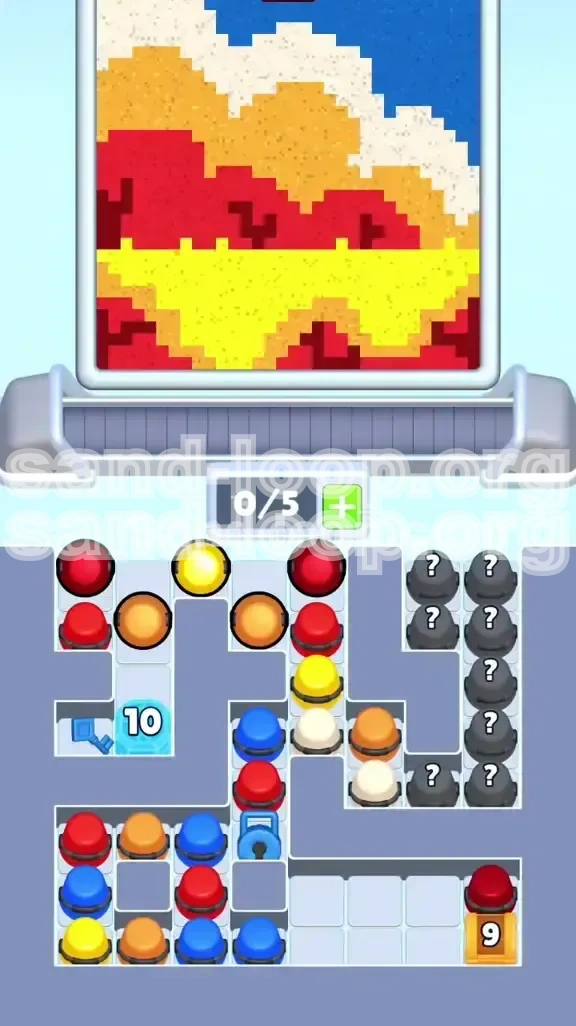
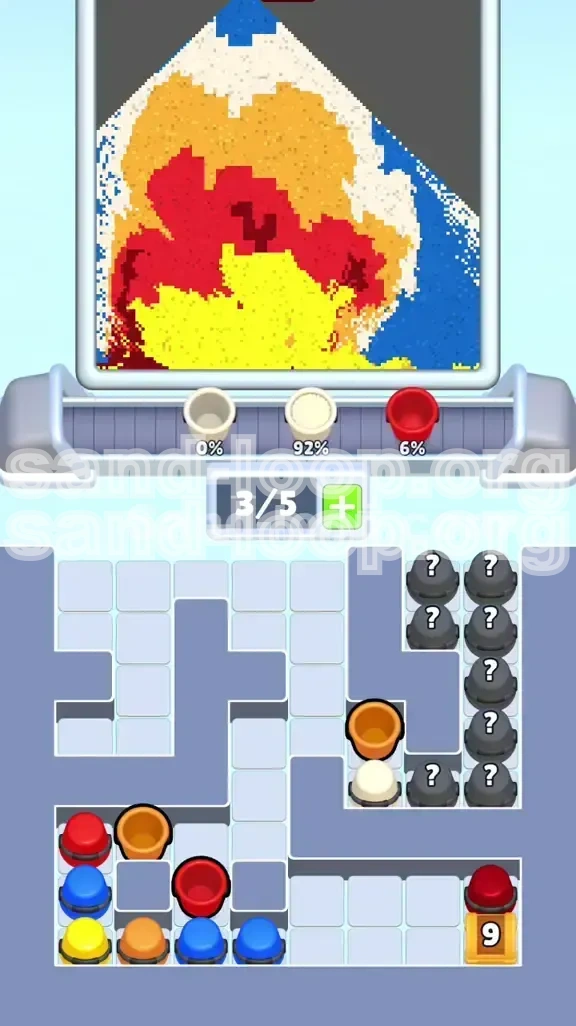
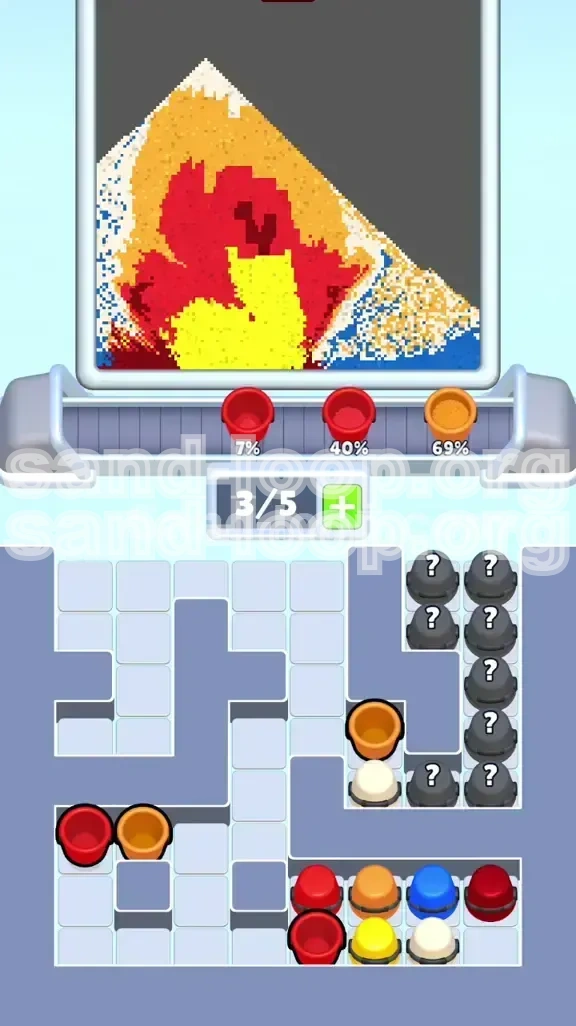
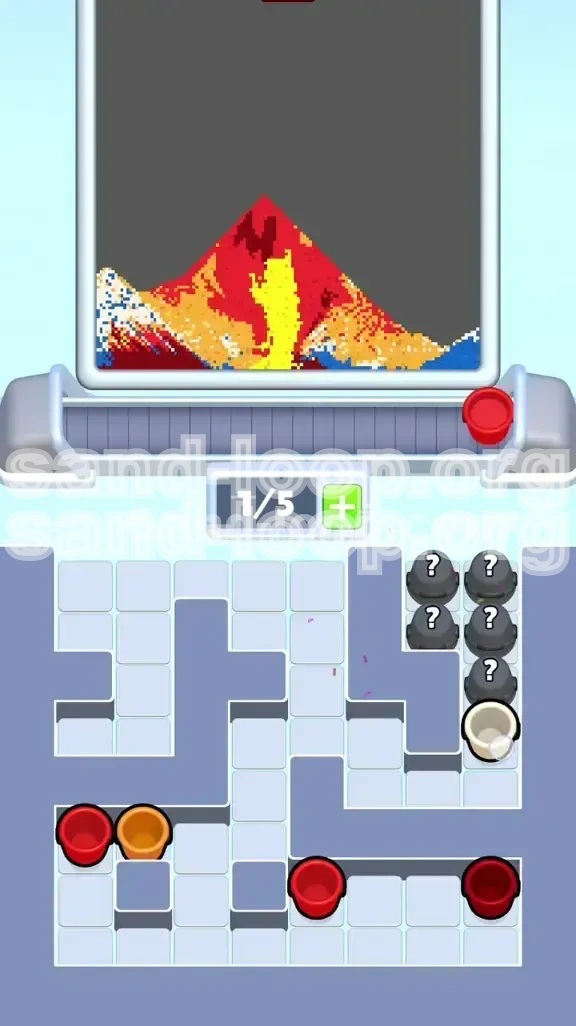
Sand Loop Level Guides
Level Overview: The Pixel Volcano Challenge
Welcome to the definitive walkthrough for Sand Loop Level 494. This stage represents a significant spike in difficulty, moving beyond simple pixel art placement into complex resource management and logic gating. In this level, you are tasked with rendering a majestic, erupting volcano set against a stark sky. However, the game mechanics are designed to actively sabotage your progress through a multi-stage dependency chain involving ice blocks, color-coded locks, and a strict inventory capacity.
The core challenge of Level 494 lies in its "Slot Capacity" limitation. You are restricted to holding only five active cups on your conveyor belt at any one time. If you allow the belt to fill up with five cups that cannot be used immediately—because the required colors are locked behind an ice block—the game will enter a deadlock state, forcing a restart. Therefore, this guide focuses heavily on queue management, prioritization, and the specific sequence required to unlock the board without freezing your supply line.
Core Mechanics and Constraints
Unlike previous levels where you could simply pull cups as they appeared, Level 494 requires a "Two-Slot Buffer" strategy. You must always keep at least two slots on your conveyor belt empty. This buffer is critical because it allows you to cycle through unusable cups (like locked colors) to reach the ones you actually need (ice breakers) without clogging the machine.
The Visual Objective
Your canvas depicts a large, jagged volcano. The composition is divided into three distinct layers: the background (sky/ash), the mid-ground (mountain body), and the foreground (lava flow). The difficulty arises because the colors required for the bottom layers (Blue) are locked behind mechanics that require you to finish the top layers (Red/Yellow) first.
Resource Scarcity
Red and Yellow sand are your most precious resources here. They are needed in high volume for the magma but are also required to break the initial ice block. Wasting these colors on the background early on will leave you stranded halfway through the level. Managing the "flow" of these colors is the primary skill tested here.
Why Players Fail
The vast majority of failed attempts on this level happen within the first 30 moves. Players aggressively tap to dispense sand, filling their conveyor belt with 5 cups. Suddenly, they realize the next 3 cups are locked behind the Ice Block, and the dispenser is blocked by a cup they can't use. They have no moves left. This guide will ensure you never encounter that deadlock.
The "Tax" Mechanic
Be aware of the "Tax Cup" located in the bottom right corner of the tray (a Red Cup with a counter of 9). This is a mechanic designed to drain your resources. You cannot ignore it; you must feed it red sand periodically to keep it from clogging the tray. Treat it as a maintenance task that must be performed alongside your actual painting.
Clear Objectives: Your Mission Checklist
To successfully complete the Pixel Volcano challenge, you must stop thinking like an artist and start thinking like a project manager. Your goal is not just to fill pixels, but to engineer the unlocking of the supply chain. Below are the phased objectives you must follow in strict order.
Phase 1: Break the Ice
Your immediate priority is the Ice Block (10) sitting in the center of the supply tray. This block physically prevents access to the Blue Key, which in turn locks the bottom row of colors. You cannot paint the bottom of the volcano until this ice is gone. You must dedicate your first 10-12 moves exclusively to chipping away at this block using available top-row cups.
Phase 2: Secure the Blue Key
Once the Ice Block counter hits zero, the Blue Key is released. This item automatically travels to the Blue Lock located on the bottom center of the tray. Unlocking this section is critical; it shifts the entire bottom row of cups (primarily Blue and Red) into the active queue. Do not start painting detailed sections until this mechanical unlock is confirmed.
Phase 3: Clear the "Tax" Cup
Simultaneously with your painting, you must keep an eye on the Red Cup with the "9" counter. This cup must be filled and dispensed 9 times before it leaves the tray. If you neglect this, it will eventually block the dispenser, preventing you from accessing other necessary cups. Make filling this cup a secondary action whenever you have a spare moment in your cycle.
Phase 4: Establish the Base Layer
With the tray unlocked, your next objective is the Mountain Body. This requires Tan/Beige sand. This is the largest area of the canvas. Completing this section first provides a stable foundation and clears the majority of the Tan cups from your conveyor belt, making room for the more complex lava colors later.
Phase 5: Execute the Lava Flow
The final phase involves the intricate work of the volcano interior. This requires precise management of Red, Orange, and Yellow. This is the most dangerous part of the level because the margins for error are small. You must switch between broad strokes and pixel-perfect tapping to define the crater without overflowing.
Phase 6: The Final Polish
The last 10% of the level involves cleaning up the background details (White/Blue) and ensuring no stray pixels remain. This is often where players get stuck, looking for that "one last pixel" of Blue hidden in the corners. Patience and cycle management are key here.
Step-by-Step Walkthrough: The Action Plan
This section provides the exact sequence of actions required to beat Level 494. Follow these steps in order. Do not rush. A mistake in the first 5 steps can doom the entire run.
Step 1: Assessment and Buffer Creation
As the level loads, take 3 seconds to scan the tray. Locate the Ice Block (10) and the Blue Lock. Identify the top-row cups that are NOT locked. Pull exactly two cups onto the conveyor belt. Stop. Do not pull a third. You now have a 3/5 capacity. This is your safe zone. If the first two cups are useless colors (like Blue when you need Red), you have space to cycle them to the dispenser without blocking the belt.
Step 2: The Ice Breaking Cycle
Begin tapping the available Red or Yellow cups to dispense sand into the Ice Block. You do not need to paint the canvas yet. Important: Watch the conveyor belt carefully. As you dispense, the cup will move to the exit side. Wait for it to leave the belt before pulling the next cup. If you pull a new cup while the old one is exiting, you risk a collision. Repeat this single-cup cycle until the Ice Block counter is below 5. At this point, the game will start introducing "Mystery Cups" into the mix.
Step 3: Handling Mystery Cups
You will see vertical cups with Question Marks appear. These are wildcards. When you pull one, the game determines its color based on what you currently need. Strategy: Do not use Mystery Cups for the Ice Block. Save them for the Mountain Body (Tan) or the White peaks later. If a Mystery Cup appears and you don't desperately need it, let it pass through the dispenser without pouring to save space on the belt for guaranteed colors.
Step 4: Unlocking the Tray
Once the Ice Block breaks, the Blue Key will trigger a tray animation. The bottom row of cups will slide left. This introduces a fresh set of problems. Immediately pull a Blue cup onto the belt. You don't need to use it yet, but you must get it out of the tray to prevent the "Tax Cup" (Red 9) from blocking the dispenser slot. Keep your belt at 3/5 or 4/5 capacity. Never let it hit 5/5 during this transition phase.
Step 5: Painting the Mountain (Tan Phase)
Now, switch to painting mode. Target the large brown/beige sections of the volcano. Use your Mystery Cups and Tan cups here. Ignore the lava center for now. Why? Because the lava center requires precise tapping, and you don't want to be worried about queue management while doing micro-movements. Clearing the Tan section simplifies the board visually, making it easier to spot the lava pixels later.
Step 6: The Lava Protocol
With the mountain done, focus on the center. You will need Red, Orange, and Yellow. Technique: Use "Tap-Bursts." Instead of holding the screen, tap the cup rapidly for 0.5 seconds, then release. This dispenses a controlled amount of sand. This is crucial for the Yellow center, which is small and surrounded by Red. Over-pouring Yellow into the Red zone creates a mess that is hard to clean up without wasting precious sand.
Step 7: The Final Countdown
At this stage, the Tax Cup (Red 9) should be nearly full. Finish it off. Once it clears, you will have a much clearer view of the remaining cups. The last remaining pixels are usually the White peaks (easy) and the Blue corners (tricky). Use the Blue cups you pulled in Step 4 to finish the bottom corners. If you run out of Blue, you may need to cycle the tray one last time to find a straggler.
Color Order: The Hierarchy of Needs
Not all colors are created equal in Level 494. Processing them in the wrong order is the most common cause of failure. Below is the optimal priority list for this level.
Priority 1: The Enablers (Red/Yellow)
Red and Yellow are your "Tool Colors." You must process them first not because they are the most important part of the art, but because they are your tools for breaking the Ice Block. You cannot access the rest of the level without a healthy supply of these two colors in the early game. Do not waste them on background details until the Ice is gone.
Priority 2: The Foundation (Tan/Beige)
Tan is the "Safe Color." It covers the largest area and is rarely locked behind complex gates. Processing Tan early is efficient because it clears large chunks of the screen and removes large cups from your tray. It creates visual clarity, allowing you to focus on the harder elements.
Priority 3: The Transition (Orange)
Orange is the bridge between the hot lava and the cooler mountain body. It is less abundant than Red but more abundant than Yellow. Process this third. It defines the shape of the volcano.
Priority 4: The Accent (White)
White is used for the snow cap and ash clouds. It is usually found in Mystery Cups late in the game. Treat it as a luxury color. Only process it when you have a stable belt and no urgent mechanical tasks (like breaking ice or feeding the Tax Cup) pending.
Priority 5: The Trap (Blue)
Blue is the lowest priority. It is used for tiny corner pixels and water. Because it is so scarce, it is very easy to overfill. If you process Blue too early, you risk clogging your tray with Blue cups that you can't get rid of because the pixels are already full. Save Blue for the very end to act as the final cleanup color.
The "Overflow" Risk Analysis
Be aware that the game's sand physics can lead to "bleeding," especially with the Red/Yellow boundary. If you pour Red too fast near a Yellow pixel, the physics engine might merge the colors, ruining the contrast. Always pour the darker color (Red) first, let it settle, and then touch up with the lighter color (Yellow) on top.
Key Tips and Common Mistakes
Even with a strategy, the execution can fail. This section highlights the specific pitfalls of Level 494 and provides pro-tips to navigate them.
Tip 1: The "Slot 4" Rule
Never let your conveyor belt reach Slot 5 if Slot 4 contains a cup you don't immediately need. If you have a full belt and the dispenser offers you a useless color, you are stuck. Always keep Slot 5 empty as an emergency trash bin. If a cup comes out that you don't want, pull it to Slot 4, then wait for the dispenser to offer something better before pulling it to Slot 5.
Tip 2: Lag Compensation
There is a roughly 0.5-second delay between tapping the screen and the sand physically hitting the canvas. When filling the jagged edges of the volcano crater, you must "lead your target." Stop tapping 0.5 seconds *before* you think the pixel is full. This prevents overfilling and keeps your edges sharp.
Mistake 1: The Mystery Cup Gamble
Players often pull Mystery Cups hoping for a miracle color. In Level 494, this is dangerous. A Mystery Cup is often filled with a color you already finished, or a color you aren't ready for (like Blue early on). Only pull a Mystery Cup if you have the buffer space to discard it if it turns out to be trash.
Mistake 2: Ignoring the Tax
The Red Cup (9) is easy to forget when you are focused on the lava. However, if you ignore it until the very end, it becomes a roadblock. You will be frantically trying to finish the last pixels, but the dispenser will be blocked by this Cup, forcing you to dump 9 loads of Red sand just to clear the path. Feed it early and often.
Tip 3: Pre-Positioning
Before you break the Ice Block, look at where the Blue Cups are in the tray. Try to ensure that when the lock opens, the Blue Cups are positioned to slide into an accessible slot. Sometimes, strategically wasting a specific cup can shift the row and align the Blues perfectly for the unlock.
Mistake 3: Panic Tapping
When the board looks chaotic (e.g., Ice is breaking, Tax is filling, and Lava needs painting), the instinct is to tap faster. This is wrong. Speed causes collisions and overfills. Slow down. Rhythm is more important than speed. A steady 1-tap-per-second beat is more effective than 5 random taps.
Stuck Solutions and Speed Run Strategies
If you are currently stuck at 90% completion, or if you are looking to optimize your time for a high score, these advanced tactics are for you.
Solution: The "Blue Corner" Deadlock
Are you stuck with 99% completion and the last pixel is Blue, but the game won't give you a Blue cup? This is a common cache error. To fix it, you must "cycle" the tray. Pull any cup and pour it onto a full area of the same color (wasting it). Do this 3-4 times. This forces the game's RNG to regenerate the cup queue. A Blue cup will eventually appear.
Solution: The "Red Tax" Jam
If the Red Tax Cup (9) is blocking the dispenser and you are out of Red sand pixels to fill, you must create a "waste zone." Pour a different color (like Tan) into a Red area temporarily to make a mess, then fill that mess with the Red Tax Cup. It destroys the art, but it clears the cup. You can then fix the art with the correct colors afterwards.
Speed Run Tip: The "Chain Break"
Speed runners don't wait for the Ice Block animation to finish before pulling the next cup. As soon as you tap the final ice-breaking cup, immediately drag the next queued cup onto the belt. The game allows you to queue input during the "unlock" animation. This saves about 2 seconds per cycle.
Speed Run Tip: Bulk Filling
For the Tan Mountain Body, don't use tap-bursts. Use a "slide" method. Press and hold the cup, then slide your finger across the screen to fill large contiguous areas. This is 50% faster than tapping individual pixels. Only switch to tapping for the detailed crater work.
Speed Run Tip: Pre-loading the Belt
Before the level starts (during the countdown), you can sometimes tap the screen to pull the very first cup. If you can pull a Red cup before the timer hits zero, you save a second on the Ice Block phase. Every millisecond counts in a Speed Run.
Speed Run Tip: Ignoring Perfection
For a Speed Run, you can accept 95% accuracy. If a pixel is slightly overfilled into the background, leave it. Fixing it costs time. Only perfect the edges that are adjacent to contrasting colors (like Red vs. White). The Sand vs. Sand edges are more forgiving.