
Level 506
HARDHow to solve Sand Loop level 506? Get instant solution for Sand Loop 506 with our step by step solution & video walkthrough. Sand Loop 506 tips and guide.
Play Sand Loop Now
Experience the puzzle challenge firsthand
Game Screenshots
Sand Loop Level Guides
Level 506 Comprehensive Strategy: The Pineapple Bird Breakdown
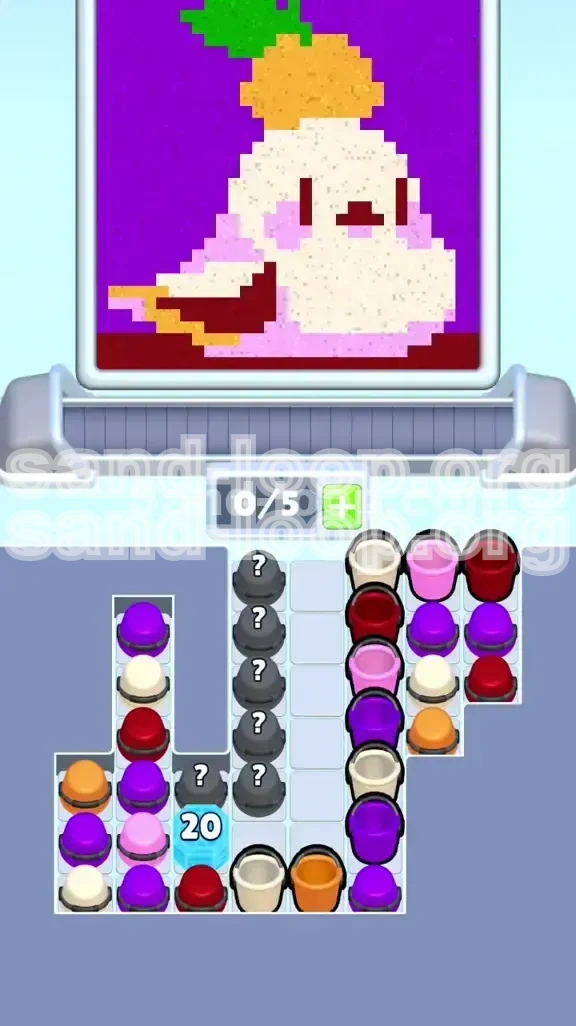
Level 506, often referred to as the "Pineapple Bird" stage, presents a deceptive challenge. While the visual design is whimsical, featuring a bird adorned with a pineapple crown, the underlying mechanics are strictly logical and unforgiving. This level is a test of resource management and spatial reasoning, divided by a massive column of Mystery Cups and a restrictive Ice Block mechanic. The board is split between a large Purple background and the White bird figure, which requires precise isolation to prevent color bleeding. With a strict queue limit and dangerous "lockout" potential, players must execute a specific sequence of operations to clear the stage without overflowing.
Analyzing the Visual Volume
The canvas is dominated by three distinct zones. First, the Purple Background accounts for approximately 40% of the total sand volume. Second, the White Bird Body occupies roughly 35% of the space, serving as the central focal point. The remaining 25% consists of "Accent Colors" (Dark Red, Yellow, Orange, Pink, Green) that define the crown and features. The primary difficulty arises from the fact that the background wraps tightly around the bird's outline. If the Purple background is not contained correctly, it will bleed into the White zones, creating an unfixable mess that prevents completion.
The Ice Block and Queue Constraints
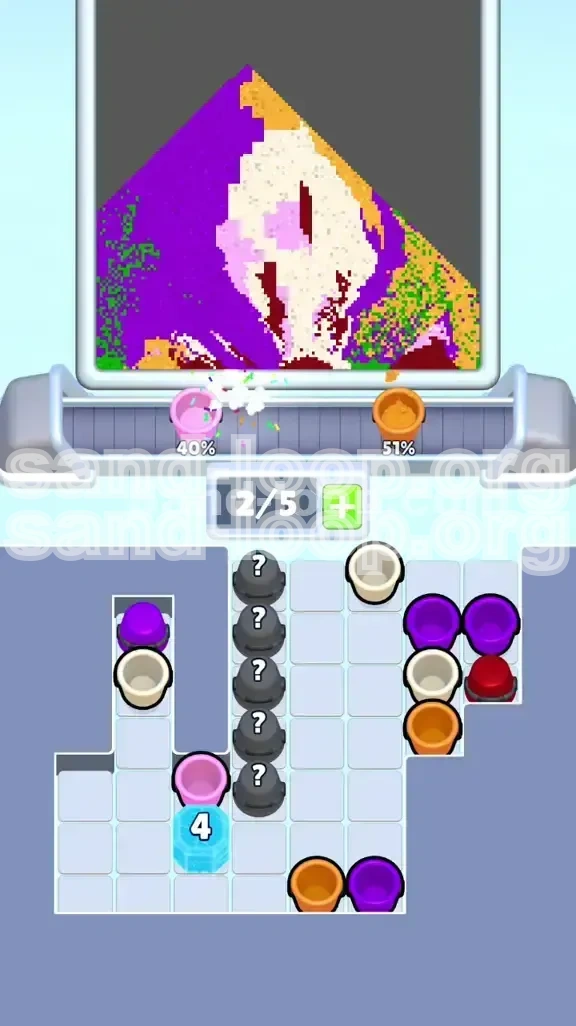
Two mechanics govern the flow of this level: the 20-Count Ice Block and the 5-Slot Queue. The Ice Block, located on the bottom left, locks away essential Dark Red and Purple cups. It requires 20 cups to be dispatched to shatter. The Queue Limit means you cannot hoard colors. You must adopt a "use it or lose it" mentality. If your tray is full of colors you aren't currently using (like holding onto Green for later), you cannot pick up new White cups from the conveyor, leading to a deadlock.
The Mystery Pillar
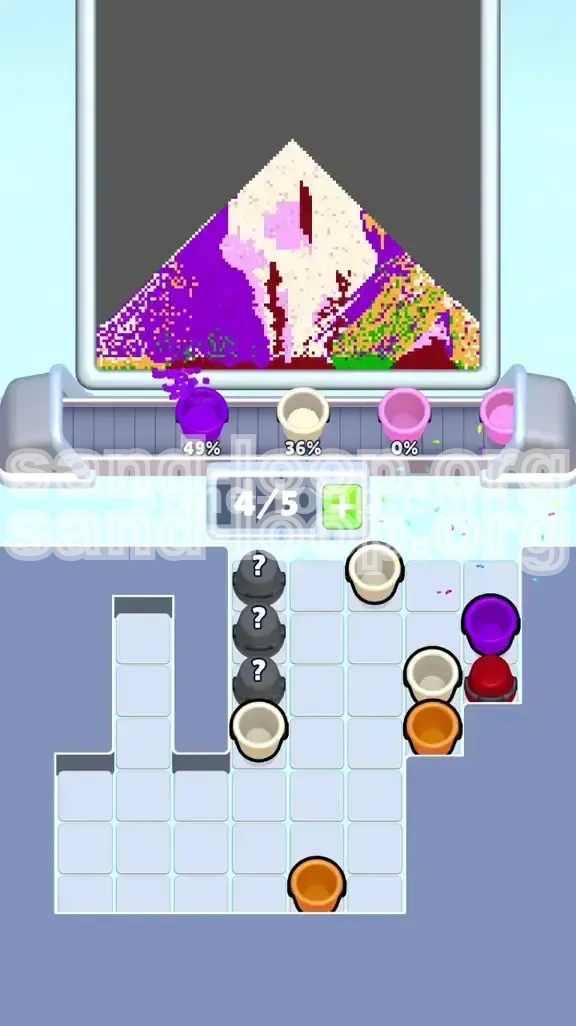
Running vertically through the center of the board is a pillar of Mystery Cups. These act as wildcards, transforming into random colors once tapped. In Level 506, these are not gifts but traps. Tapping them too early can flood your tray with low-volume colors like Green or Pink before you have established the necessary bulk of White and Purple. This pillar must be treated with caution; it is a resource to be mined only when your infrastructure is stable.
The Overflow Risk
Victory requires clearing the board with zero overflows. An overflow occurs when you force sand into a section that is already at capacity, causing it to spill into adjacent zones. Because the bird's shape is irregular (narrow neck, wide belly), sand can pile up unexpectedly in the neck while the belly is still empty. You must pour slowly and strategically, allowing the sand physics to settle the material into the deepest parts of the canvas first before filling the shallow details.
Victory Conditions
To achieve three stars, you must clear the board within the time limit while maintaining color purity. This means no Pink sand in the Purple sky, and no Purple sand in the White belly. The level is designed to force you into a "funnel" strategy: clearing the right side first, breaking the ice, and then systematically addressing the center pillar. There is no room for improvisation; success depends on following the hierarchy of volume.
Optimal Color Processing Hierarchy
The core strategy for Level 506 lies in the order you process your colors. Processing colors randomly leads to a clogged tray and an incomplete canvas. You must prioritize based on volume and dependency.
Phase 1: The Structural Base (White & Purple)
Your absolute priority for the first 40% of the game is White and Purple. These are your high-volume colors, making up nearly 75% of the board. The White bird acts as a dam inside the Purple river. If you pour Purple first, you lose the borders needed to define the bird. Conversely, if you pour White without clearing Purple background space, you will run out of room. You must alternate between these two, carving out the bird's shape while simultaneously clearing the background corners.
Phase 2: The Definition Layer (Dark Red)
Dark Red is your critical bridge color. It serves as the outline for the wing and the base for the pineapple crown. It represents about 15% of the volume but plays a disproportionate role in defining the visual boundaries. You should introduce Dark Red only after the White body is roughly 30% established. Since most Dark Red is locked behind the Ice Block, the level naturally forces you to wait until you have dispatched enough cups to access it. Use this color to "seal" the edges between the White bird and Purple sky.
Phase 3: The Crown Volume (Yellow & Orange)
Yellow and Orange are medium-volume accents (approx. 10% combined). These are the "mid-game" colors. The danger here is introducing them too early. If you pour Yellow onto an empty canvas, it spreads into a thin, unmanageable sheet that contaminates other zones. You must wait until the White body and Dark Red outlines are structurally sound (at least 60% full) before introducing these colors. They need the "walls" of the other colors to keep them contained.
Phase 4: The Final Details (Pink & Green)
Pink (cheeks) and Green (leaves) are "endgame" colors. They are low-volume traps. If you unlock a Green cup in the first 10 moves, it becomes a permanent resident of your tray, wasting a valuable slot. You should only tap these cups when the board is 90% complete and you are specifically looking to fill small gaps. Treat these colors as "finishing touches" rather than building blocks.
Understanding Color Bleeding
In Sand Loop physics, sand seeks its own level. A small amount of water spreads wide; a large amount stays deep. If you pour a small color (like Pink) into a large empty space, it will spread out to cover the entire surface, preventing you from pouring White later without mixing colors. Always pour Bulk before Accents. Fill the cavity with the primary color first, then apply the secondary color on top. This ensures the accent color stays localized and doesn't bleed into the background.
Queue Management Theory
Effective queue management is about maintaining "fluidity." Your tray has 5 slots, but you should aim to keep 1 slot empty as a buffer. This buffer allows you to pick up a new cup immediately after sending one to the conveyor. If you hold 5 specific colors (e.g., White, Purple, Red, Yellow, Green) and a new White cup spawns, you are stuck. Try to operate with a cycle of 3 active colors. Pour, dispatch, and retrieve. Never hold onto a cup "for later" unless you are certain you can use it within the next 10 seconds.
Step-by-Step Walkthrough
This section provides a chronological script for your run. Follow these steps in order to navigate the board safely and efficiently.
Step 1: The Right-Side Focus
Ignore the center pillar and the left side entirely. Your interaction begins on the top right. Locate the exposed White and Purple cups. Tap the White cup first. Immediately follow it with a Dark Red cup found in the same cluster. Send these to the conveyor. Your goal is to start the "20-count" dispatch counter for the Ice Block while simultaneously laying down the first layer of the bird's body. Do not touch the Mystery Cups yet.
Step 2: Farming the Ice Block Toll
Keep a close eye on the Ice Block counter in the lower left. You need 20 dispatched cups to break it. From the top right, move to the right-middle stacks. Here you will find deep reserves of Purple. Pour Purple into the top-right background corners. Alternate between White for the bird and Purple for the background. Every cup you send reduces the Ice count. Maintain this rhythm until the Ice Block counter drops to roughly 5 or 10 remaining.
Step 3: Breaching the Ice
Once the counter hits zero, the Ice Block shatters. This reveals a stack of Dark Red and Purple cups on the bottom left. Do not tap them all at once. Tap one Dark Red cup and send it. This is crucial for defining the bird's bottom outline. By clearing this ice, you also open up physical space on the tray, allowing you to cycle cups faster. Use this newly unlocked Red to secure the borders between the bird and the background.
Step 4: The Controlled Mystery Reveal
Now that the Ice is gone and you have a flow of Red, Purple, and White established, look at the center pillar. Ensure you have at least two empty slots in your tray. Tap the top cup of the Mystery pillar. It will likely turn into Yellow or Orange. If it turns into Green or Pink, do not pour it. Leave it in the tray or ignore it if possible. If it is Yellow/Orange, pour it onto the crown area immediately. The White body structure is now strong enough to support these accents.
Step 5: The Mid-Game Transition
At this stage, your White body should be 50% complete, and the Purple background 30% complete. You will likely have a mix of colors in your queue. Prioritize filling the bottom of the bird. Use the remaining Dark Red cups to finish the base outline. The "chimney" of the bird (the neck) requires a precise vertical stream of White—ensure your aim is true to avoid spilling into the background. Keep dispatching cups to maintain the flow.
Step 6: The Cleanup Phase
Once the main volumes are filled, you will be left with small, awkward gaps. This is where the Pink and Green cups become useful. By now, the Mystery Cups should have revealed themselves. Use the Pink for the cheek blush and Green for the pineapple crown leaves. Since the surrounding colors (White and Yellow) are already dry and settled, these small pours will stay contained. Fill the gaps systematically to clear the board.
Common Mistakes to Avoid
Many players fail Level 506 due to preventable errors. Learn these pitfalls to ensure your run doesn't end prematurely.
Over-Pouring Accent Colors
The most common fail state is spilling Pink or Green sand into the Purple background. This happens when players try to finish the "cute" details first. The accents require very little sand to fill their designated areas. If you tap the Pink cup while the bird's white cheek is only 20% full, the Pink sand will spread out to fill the remaining 80%, leaking into the purple border. Always pour bulk first. Save the cute details for the very end.
The Queue Soft Lock
A "Soft Lock" occurs when your 5 slots are filled with [White, Purple, Red, Green, Yellow], but the canvas needs White. You send White, leaving you with 4 slots. The game gives you a new White cup, but your tray is full of colors you can't use yet (Green/Yellow). You have no space to pick it up. To avoid this, never hold onto Green or Yellow "just in case." Only pick them up when you are ready to pour them immediately.
Ignoring the Ice Block Timer
Some players focus so hard on the bird's face that they forget the Ice Block. They pour 15 cups of White, realize they are out of White, and then notice the Ice Block is still at 15/20. Now they have to grind 5 more cups with limited resources and no space in the tray. Always keep one eye on the Ice Block counter in the bottom left. It is your primary progress bar for the first half of the level.
Tapping Mystery Cups Too Early
The Mystery Cups in the center are tempting because they block your view. However, tapping them early is gambling. If you get unlucky and reveal 3 Green cups in a row, your run is effectively over because you can't use Green until the end. Wait until your economy is stable (Ice broken, White established) before opening the center pillar. Treat the pillar as a "last resort" resource, not a primary one.
Poor Color Segregation
Don't try to pour Dark Red and White simultaneously in tight spaces. The sand physics can sometimes blend colors at the edges if the pour is rapid. Finish the White section completely, let it settle, and then apply the Dark Red outline. Trying to "multitask" complex borders often results in messy edges that require cleanup, wasting sand and valuable time. Precision is better than speed.
Misunderstanding the Overflow
An overflow isn't just a mess; it's a fail state. If you pour sand into a cup that is already full, it spills. In this level, spilling usually means mixing Purple and White. If you see the sand piling up above the rim of the target zone, stop pouring immediately. You can usually "tamp" the sand down by tapping the screen or waiting for it to settle, but if you keep pouring, you will fail.
Solutions When You Are Stuck
Sometimes the level throws a curveball, and you find yourself in a bind. Here is how to recover from specific bad situations.
Stuck with a Full Tray of "Wrong" Colors
Scenario: Your tray has [Green, Yellow, Pink, Red, Purple] but you desperately need White. The White cup is on the belt but you can't pick it up.
Solution: You must sacrifice. Look at your canvas. Is there *any* spot for Pink? Even a tiny pixel? Pour it to clear the slot. If not, check if the Purple background can take just a *little* more sand. Pour a tiny amount to free up the slot and grab the White. Do not be afraid to "overfill" a background area slightly to free up a slot for a critical color.
The Ice Block Won't Break
Scenario: You are at 19/20, but you have no cups left to tap on the right side.
Solution: You likely have a cup in your tray that you think is unusable. Re-evaluate the canvas. Is there a stray pixel of Dark Red you missed? Use that cup. Every cup counts. If you are truly empty, you may have made a selection error earlier. In this specific level, ensure you aren't ignoring the top-right corner; sometimes a new cup spawns there after a short delay.
Mystery Cup Gave End-Game Color
Scenario: You tapped a Mystery Cup, and it turned Green. You can't use it yet.
Solution: Do not panic. Leave the Green cup in your tray. Adjust your play style to operate with 4 slots instead of 5. This is slower, but safe. Only when the bird is 100% complete except for leaves should you pour that Green. Do not tap another Mystery Cup until that Green is poured. You have to play the rest of the level with a handicap.
The "Chimney" Clog
Scenario: The bird's neck (chimney) is full, but the belly is empty. You can't pour more White without it overflowing.
Solution: Tilt your device or use a "shaking" motion if supported to help the sand settle down the neck. If that doesn't work, stop pouring White. Switch to Purple and fill the background. This gives the White sand time to settle. Once the neck level drops, you can resume pouring White. This is a common physics issue in this level.
Board is Deadlocked
Scenario: No moves are possible. The belt is stuck, the tray is full, and the canvas is full.
Solution: This usually means you missed a layer. Check the "feet" or the "top leaves" of the pineapple crown. These are often isolated areas that get forgotten. Zoom in (if possible) or look closely at the borders. There is almost always a tiny pixel gap you missed that is preventing the final pour. Look for the smallest unfilled pixel.
Speed Run Strategies
For players aiming for three stars or leaderboard positions, speed is essential. These strategies sacrifice safety for velocity.
The Rush-Right Opener
Don't think, just tap. Memorize the location of the top-right White and Purple cups. Tap them in a rhythmic sequence: White, Purple, White, Red. You want to clear the right side of the board in under 10 seconds. This rapid firing clears the space needed for the Mystery Cups to fall into manageable positions later. Muscle memory is key here; know exactly where to tap without looking.
Pre-Ice Farming
While the Ice Block is counting down, don't just wait. Actively pour Purple into the background corners. The background is the easiest place to dump sand quickly because it requires less precision than the bird's face. Maximize your Ice Block countdown time by doing the "mindless" background filling during this phase. Don't let the conveyor belt stop moving.
The Mystery Cup Gamble
In a speed run, you don't have time for caution. Tap the Mystery Cups as soon as the Ice Block breaks (around 15 cups in). If you get a Green cup, you might get a bad time, but if you get a Red or Yellow cup, you can use it immediately to fill the crown and wings, saving you the trouble of digging for those colors later. High risk, high reward. If you get lucky, you save 30 seconds.
Batch Processing
Instead of switching colors constantly (White -> Purple -> White), try to batch your pours. If you have 3 White cups in a row, pour them all onto the bird in rapid succession. Even if it overfills slightly, it's faster than alternating. Let the sand pile up; gravity will flatten it out. This reduces the time spent waiting for the belt to cycle colors.
Minimizing Conveyor Travel
Notice where the conveyor belt drops the sand. If you can, prioritize cups on the left side of the tray when the left side of the canvas needs filling, and vice versa. While you can't control the spawn point perfectly, being aware of travel distance saves milliseconds over the course of a 3-minute level. Every millisecond counts in a speed run.