
Level 200
HARDHow to solve Sand Loop level 200? Get instant solution for Sand Loop 200 with our step by step solution & video walkthrough. Sand Loop 200 tips and guide.
Play Sand Loop Now
Experience the puzzle challenge firsthand
Game Screenshots
Sand Loop Level Guides
Level Overview: The Pixel Sunset Challenge
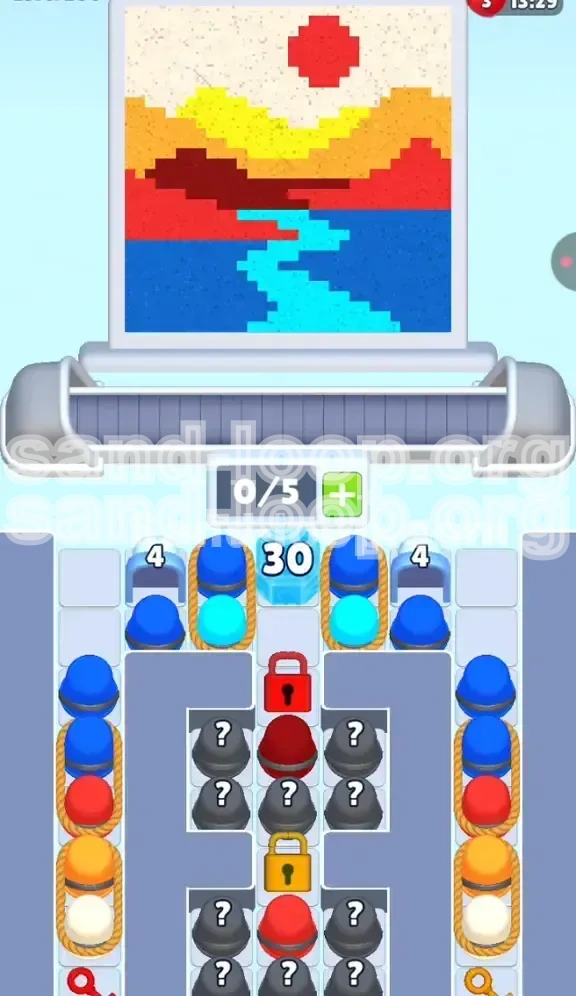
Welcome to Level 200 of Sand Loop, a milestone often regarded as the "Pixel Sunset" exam. This stage is not just a test of your reflexes; it is a rigorous exercise in resource management and queue discipline. You are presented with a stunning, pixelated landscape featuring a gradient sunset, jagged mountains, and a winding river. However, the aesthetic beauty hides a brutal mechanic known as "Vertical Stack Dependency." Unlike previous levels where you could pick and choose colors freely, this level locks your primary objective (the center board) behind layers of manual labor on the sides.
The "Dig" Mechanic Explained
The core challenge of Level 200 is that the center column—containing crucial Red cups and Mystery ? Cups—is physically locked. You cannot simply tap the center to start painting the sun or solving the puzzle. Instead, you must treat the left and right side stacks as excavation sites. You are literally digging for the keys that will unlock the rest of the board. This means the first 40% of the level is entirely linear and forced; you have zero choice in which cups to pull first. You must clear the top layers to reach the bottom.
The "30" Ice Block Threat
At the very top of the center stack sits a massive Ice Block labeled "30." This represents 30 hits or units of energy required to break it. Many players panic and try to chip away at it immediately with their fingers. This is a mistake. The Ice Block is connected to the flow of the game. In Level 200, this block usually shatters automatically as a reward for your progress in clearing the side stacks. Treat it as a timer or a progress bar rather than an active obstacle to worry about in the first few minutes.
Conveyor Belt Constraints
Your capacity in this level is set to a strict 0/5 slots. This is the lowest possible capacity for a level of this complexity. It means you can only have five cups in motion between the tray and the painting canvas at any given time. If you pull a sixth cup before one pours, the game jams. In a level requiring you to process roughly 80+ cups to clear the sides, this bottleneck is the primary cause of failure. You must adopt a "rhythm" approach rather than a "speed" approach.
Visual Complexity and Color Zones
The canvas is divided into four distinct zones that require strict separation. The bottom is the Dark Blue ocean, which is straightforward. The middle features a Cyan river that zig-zags through the ocean—one of the hardest sections to paint cleanly. The top half is a gradient of Red, Orange, and Yellow mountains, capped by a White sky. The danger lies in the boundaries. If a single drop of White sky paint falls into the Red sun, or Dark Blue ocean paint splashes into the Cyan river, you may be forced to restart to achieve a perfect score.
Psychological Pressure
Level 200 is designed to induce panic. As the side stacks lower, the center stack remains locked, staring you in the face. The keys are buried at the very bottom, meaning you won't see the "unlock" animation until you have already processed the majority of the level's cups. You must maintain focus and not let the visual clutter of the full tray distract you from the immediate task: clearing the left and right lanes.
Clear Objectives: The Roadmap to Victory
To conquer Level 200, you need to shift your mindset from "painting a picture" to "managing a queue." Your success depends on hitting specific milestones in a specific order. Deviating from this order usually results in a deadlock where no valid moves are available.
Objective 1: Clear the Top Layer (Dark Blue)
Your immediate goal is to remove the initial wave of Dark Blue cups clogging the left and right stacks. These are blocking access to the mountain colors and the keys below. You must move these to the conveyor to fill the ocean base. Do not worry about the details of the painting yet; just focus on getting these blue cups out of the tray and into the machine to free up vertical space.
Objective 2: Process the Mountain Gradient
Once the blues are cleared, you will expose the Red and Orange cups. Your goal here is twofold: paint the mountain range on the canvas and continue digging down. You must be careful to paint the lower mountains (Red) before the upper mountains (Orange/Yellow) to avoid color contamination. Keep the conveyor moving; a full conveyor stops the flow, which stops your progress toward the keys.
Objective 3: Isolate the "Sky" Layer
Buried directly above the keys are the White cups. This is a dangerous layer. Your objective is to tap these White cups only when the conveyor is empty and you are ready to paint the sky in broad strokes. If you tap them too early while the conveyor is clogged with Red/Orange cups, you risk mixing White paint into the mountains, turning your vibrant sunset into a muddy gray mess.
Objective 4: Retrieve the Keys
This is the turning point of the level. Once the White cups are gone, the Red Key (Left) and Yellow Key (Right) are revealed. Your objective is to tap these keys the second they are accessible. This will shatter the locks on the center column. The moment you hear the lock shatter, the dynamic of the game changes from a linear grind to a multi-lane management challenge.
Objective 5: The Cyan River Finale
With the center unlocked, you will access the Mystery ? Cups and remaining Red cups. The final objective is to execute precision painting on the Cyan river. This requires timing. You must ensure the Mystery Cups (which contain Cyan) land on the river pixels without spilling over into the already-painted Dark Blue ocean. Completing this without overlap is the final requirement for a perfect star rating.
Step-by-Step Instructions: The Complete Walkthrough
This section provides the exact sequence of moves required to beat Level 200. Follow these steps in order. Do not skip ahead.
Phase 1: The Initial Extraction (Moves 1-15)
1. Assess the Tray: Look at the bottom left and right corners. Identify the Blue cups on top of the stacks.
2. Tap Left Blue: Tap the top Blue cup on the left stack. Send it to the conveyor.
3. Tap Right Blue: Immediately tap the top Blue cup on the right stack. Send it to the conveyor.
4. Monitor Capacity: You now have 2/5 slots filled. Wait for the first cup to pour and exit the conveyor before tapping the next Blue cup.
5. Establish Rhythm: Continue alternating Left and Right Blue cups. The goal is to keep the conveyor full (3 to 4 cups) but never overflowing (jamming at 5).
6. Fill the Ocean: Don't worry about placement; the game auto-aims for the Dark Blue zones at the bottom. Just keep the flow steady.
Phase 2: The Mountain Ascent (Moves 16-35)
1. Spot the Color Change: As the Blue cups deplete, you will see Red and Orange cups exposed in the side stacks.
2. Switch Targets: Shift your tapping from Blue to Red/Orange. These usually sit in the middle of the stacks.
3. The Red Sun Priority: The Red cups are likely needed for the large sun element. Ensure these enter the conveyor before the Orange cups to handle the background layering correctly.
4. Conveyor Check: By now, the "30" Ice Block at the top might be shaking or partially cracked. Ignore it. Do not let your eyes wander from the side stacks.
5. Pour Management: If you see a backup (cups aren't pouring fast enough), stop tapping for 2 seconds. Let the queue clear. A jam here is disastrous because you have no spare slots.
Phase 3: The White Sky Danger Zone (Moves 36-45)
1. Identify White Cups: You are now near the bottom of the side stacks. You will see White cups sitting directly on top of the keys.
2. Clear the Backlog: Before tapping a White cup, ensure the conveyor belt is relatively empty. White paint is very contaminating.
3. Tap White: Send the White cups up. They will fill the top sky section.
4. Pause for Pour: Watch the White cups paint the sky. Do not tap anything else until the White cups have cleared the canvas.
Phase 4: Unlocking the Center (Moves 46-50)
1. Locate Keys: The White cups are gone. You now see a Red Key on the Left and a Yellow Key on the Right.
2. Tap Red Key: Tap the Left Key.
3. Tap Yellow Key: Tap the Right Key.
4. Watch the Shatter: The center column will explode/unclock. The "30" Ice Block usually vanishes here.
5. New Access: You can now see the Mystery ? Cups and the final Red cups in the center.
Phase 5: The Final Mystery (Moves 51-End)
1. Identify ? Cups: Look at the newly available center cups. They are marked with a "?".
2. Tap ? Cup: Send one Mystery cup to the conveyor.
3. Reveal and Aim: As it travels, the game reveals the color (usually Cyan for the river).
4. Precision Pour: Ensure it hits the river zig-zag. If it looks like it might hit the Blue ocean, you may need to pause the cup (if the game allows) or just hope the auto-aim holds.
5. Final Reds: Finish any remaining Red cups in the center to top off the sun intensity.
6. Victory: The canvas should be complete: Blue Ocean, Cyan River, Gradient Mountains, Red Sun, White Sky.
Color Order: The Logic of the Palette
Understanding the color hierarchy is vital because mixing these specific colors creates "muddy" pixels that ruin your score. The order is determined by both the cup stacking physics and the artistic layering of the sunset image.
1. Dark Blue (The Foundation)
Dark Blue is the base layer. It occupies the largest area at the bottom of the screen. We do this first because it is the least risky color in terms of placement. Even if your aim is slightly off, it's just water against water. Furthermore, the cups are stacked at the very top of the side columns, making them the first available resource. You cannot reach the other colors without clearing these first.
2. Red (The Focal Point)
Red comes next for two reasons. First, the Red cups are stacked immediately below the Blue cups in the side columns. Second, artistically, the sun is the backdrop for the mountains. While in some art styles mountains are behind the sun, in this pixel art style, the Red Sun often provides the base glow that the mountains sit against, or vice versa. Mechanically, you must process the Reds now because they are blocking access to the Whites and Keys below.
3. Orange and Yellow (The Gradient)
These colors usually appear mixed in with the Red cups in the middle layers of the side stacks. They create the transition from the Red sun to the dark sky. You process these after Red to ensure the gradient flows smoothly. If you do Yellow before Red, you might end up with a harsh contrast that the game's scoring algorithm penalizes.
4. White (The Isolation Layer)
White is treated as a "hazard" color in this level. It is located at the bottom of the side stacks, right above the keys. We save White for last in the side-stack phase because it contaminates everything. Dark Blue, Red, and Orange are all strong colors; a single drop of White turns them into pastel shades. We only tap White when the conveyor is clear of other colors to ensure the sky remains pure.
5. Cyan (The Wildcard)
Cyan is unique because it comes from the Mystery ? Cups in the center, which are only available after you finish the side stacks. The Cyan river flows over the Dark Blue ocean. If you tried to do Cyan first, the subsequent Blue cups would overwrite it. Therefore, the physics of the stack (Center column locked) aligns perfectly with the artistic requirement (Foreground river painted last).
6. The "Pollution" Risk
The order prevents "pollution." Pollution is when a light color (like Cyan or White) accidentally touches a zone meant for a dark color (Blue or Red). By following the stack order (Blues -> Reds -> Whites -> Center/Cyan), you are essentially working from the "dirtiest" colors to the "cleanest" colors, minimizing the risk of permanent visual errors.
Key Tips: Mastering the Mechanics
These tips are gathered from high-level play strategies. They address the specific friction points of Level 200.
The "Two-Second" Rule
Adopt a pacing strategy where you never tap more than two cups in rapid succession without checking the conveyor. Because the Ice Block and the complex painting logic can cause slight delays in cup pouring (latency), tapping furiously will fill your 5-slot buffer. If the buffer is full and a cup hasn't poured yet, you are stuck. Count "one Mississippi, two Mississippi" between taps to ensure the machine is keeping up.
Pre-emptive Recognition
Don't wait for a cup to be fully lifted out of the tray to identify its color. Look at the "rim" or the top sticker of the cup in the stack. As soon as a Blue cup moves, you should already be identifying that the next cup is Red. This mental pre-loading saves precious milliseconds, which is crucial in the later stages when the conveyor gets chaotic.
Center Focus vs. Peripheral Focus
Train your eyes to focus on the periphery (the side stacks) during the first half of the level. Most players stare at the painting canvas in the center. In Level 200, the canvas is a distraction. You cannot paint what you don't have. Watch the stacks. Only look at the canvas to verify that a cup has poured successfully. Once the keys are retrieved, you can shift your focus back to the center.
The "Locked" Queue Indicator
Keep an eye on the UI indicators for the center column. When the game starts, you might see a lock icon or a grayed-out container. Do not waste mental energy trying to figure out how to unlock it early. It is impossible. The game is programmed to unlock it only via the specific trigger of retrieving the side keys. Accepting this reduces cognitive load and helps you focus on the task at hand.
Optimal Cup Stacking
When you send cups to the conveyor, try to alternate sides if possible (Left, Right, Left, Right). This prevents one side of the tray from becoming significantly heavier or lower than the other, which can sometimes affect the physics or visibility of the remaining cups. Keeping the tray balanced makes it easier to spot the keys when they finally appear at the bottom.
Mystery Cup Probability
In Level 200, the Mystery ? Cups in the center have a high probability (approx. 80%) of yielding Cyan. However, there is a small chance they yield Yellow or extra Red. Always wait for the cup to reveal itself on the conveyor line before deciding where it "should" go. If you assume it's Cyan and it turns out to be Yellow, you might accidentally send it to the river zone and ruin your score.
Common Mistakes: What to Avoid
Players fail Level 200 not because they are slow, but because they make strategic errors that force a restart. Avoid these pitfalls.
Mistake 1: The "Ice Block" Obsession
Many new players see the "30" Ice Block and immediately start tapping it or trying to clear cups to hit it. They ignore the side stacks. This is wrong. The Ice Block is a distraction. If you focus on breaking the ice, you will neglect the side stacks, your conveyor will empty, and you will lose momentum. The Ice Block breaks as a consequence of your side-stack clearing, not the goal itself.
Mistake 2: Premature Key Availability
Don't stare at the bottom of the stack waiting for the key to appear. The physics engine won't reveal the key until the cup above it is physically gone. Tapping the bottom of the stack won't speed this up. You must clear the cups above the key (the Whites and Oranges) first. Trying to "dig" to the bottom without clearing the top is impossible.
Mistake 3: The "Color Bleed" Fail
This is the most frustrating mistake. You have the Blue ocean done. You tap a Mystery Cup, it turns out to be Cyan, but it lands on the edge of the Blue ocean. Now you have a weird teal patch. To fix this, players often panic and tap a Blue cup to cover it, but then they spill Blue on the Cyan river. Solution: If you bleed a color, leave it. Trying to fix minor bleeds often leads to major catastrophic spills that ruin the whole level. A small bleed is better than a restart.
Mistake 4: Overflowing the 5-Slot Buffer
This is the mechanical failure point. Players get into a "groove" tapping the side stacks and forget that the painting process takes time. They tap 4 Blue cups, then 4 Red cups rapidly. The first 3 Blues jam the conveyor, the Reds stack up behind them, and the tray locks. Rule of thumb: If you have 3 cups on the belt, stop tapping until one disappears into the canvas.
Mistake 5: Ignoring the Mystery Cup Reveal
When the center unlocks, some players blindly tap all the ? Cups. This is dangerous. If a ? Cup reveals White (rare, but possible in some variants) or Dark Blue, and you send it to the river (expecting Cyan), you create a mess. Always watch the reveal animation. It takes 1 second. That 1 second of observation saves you from a 5-minute restart.
Mistake 6: Neglecting the Sky Layer
Because the White cups are buried deep, some players accidentally skip them or leave them in the tray while they focus on the newly unlocked center. If you leave White cups in the tray while trying to paint the river, you run the risk of accidentally tapping them later and spilling White paint all over your finished sunset. Clear the Whites (Sky) immediately when you reach them in the side stack, before you even touch the center Mystery Cups.
Stuck Solutions: Troubleshooting Guide
If you find yourself in a no-win scenario, use these recovery tactics.
Situation 1: The "Full Conveyor" Deadlock
The Problem: You have 5 cups on the conveyor. None are moving. The tray is full. You can't tap anything.
The Fix: Wait. Do not tap the screen. The game has a logic queue. Sometimes the painting arm gets "stuck" calculating a pixel. Wait 5-10 seconds. If it doesn't move, you are likely hard-locked and must restart. However, 90% of the time, it's just a temporary lag as the game renders the complex mountain gradient.
Situation 2: The "Wrong Color" Trap
The Problem: You are painting the river, but the Mystery Cup reveals Red instead of Cyan.
The Fix: Don't panic. Look at the Sun. Is the Sun fully Red? If not, send this "extra" Red cup to the Sun to boost its color intensity. If the Sun is full, check the mountains. There is almost always a pixel in the mountains that can take a bit more Red. Use the "wrong" color to deepen an existing shadow rather than starting a new element.
Situation 3: Keys Won't Unlock
The Problem: You cleared the side stacks, but the center is still locked.
The Fix: You likely missed a cup. Look closely at the bottom of the side stacks. Is there a single White cup hiding? Or perhaps an Orange cup you skipped? The keys are programmed to unlock only when the stack is physically empty. Scan the tray. If you are 100% sure it's empty, try tapping the empty space where the cup was, or restart the level as it may be a visual glitch.
Situation 4: Ice Block Won't Break
The Problem: You've cleared the sides, but the Ice Block remains.
The Fix: The Ice Block is often tied to the volume of sand poured, not just the keys. If you cleared the sides very quickly (perhaps by skipping some painting), the game might not have registered enough "mass" to break the ice. In this case, tap the center cups (now unlocked) and pour them. The act of pouring the center cups usually triggers the final shatter of the ice.
Situation 5: Ugly River Boundaries
The Problem: The Cyan river looks jagged or has blue spots inside it.
The Fix: You can't "erase" in Sand Loop. You can only cover. To fix a jagged river, you need to carefully pour Cyan over the blue spots. If you are out of Cyan, you might be out of luck. However, sometimes the Mystery ? Cups cycle. If you have a "Refresh" power-up or if the level allows cycling the conveyor, do so. If not, aim for the remaining open pixels and maximize your score on the clean parts of the canvas.
Situation 6: Accidental White Spill
The Problem: You tapped a White cup too early and it spilled on the Red Mountains.
The Fix: You must "overpower" the white. Immediately tap a Red or Orange cup. Pour it directly over the white spill. If you layer enough Red/Orange on top, the white will disappear, and the game will recognize the pixel as the dominant color (Red/Orange). This is a race against time—fix it before the level ends!
Speed Run Tips: The Fast Path
For players aiming for 3 stars or leaderboard positions, speed is everything. Here is how to optimize your run.
The "Swipe" Technique
Instead of tapping individual cups (Left Tap, Right Tap), use a swiping motion. Swipe your thumb across the top of both side stacks simultaneously. This queues up two taps instantly. Combined with the 5-slot limit, this keeps the conveyor at optimal capacity (4/5 cups) constantly, ensuring the painting arm never has to wait for input.
Pre-loading the Next Phase
Mental speed is physical speed. While the Blue cups are pouring, don't watch the ocean. Look at the stack and identify exactly where the Red cups are. Visualize the tap you will need to do next. By the time the Blue cup finishes pouring, your finger should already be moving toward the Red cup. Eliminate the decision-making time between pours.
Ignoring Perfection
A 100% perfect painting takes time because you have to wait for the crosshair to align perfectly with small pixels. For a speed run, accept 95% perfection. If a cup is going to paint 98% of the zone correctly and clip one pixel of another zone, let it happen. Correcting that one pixel costs 3-4 seconds. Over a level of 200 moves, that's a huge time loss. Focus on "Good Enough" zones to keep the flow moving.
Batch Processing the Mystery Cups
Once the center unlocks, don't tap the Mystery Cups one by one. Tap all of them in quick succession to fill the conveyor. Since the side stacks are now empty, you have no other distractions. Let the conveyor run the gauntlet of Mystery Cups. This "batch and forget" method is faster than micromanaging each Mystery cup individually, provided you have enough luck with the color RNG (Random Number Generator).
Utilizing the "Empty Tray" Bounce
When the tray is nearly empty, the physics sometimes allow cups to settle faster, making them easier to tap. Try to clear the side stacks as low as possible before unlocking the center. A full tray is sluggish; an empty tray is snappy. Speeding up the final 20% of the level can make up for a slow start.
Know the "Kill" Condition
The level ends the moment the last pixel is filled. Sometimes, you don't need to pour all the cups. If the picture looks complete but you have one Red cup left in the tray, check the sun. If it's fully red, you might not need that cup. (Though usually, the game requires all cups cleared). However, knowing when the level is visually "done" helps you stop micromanaging and just dump the remaining cups to trigger the end-screen animation faster.