
Level 234
HARDHow to solve Sand Loop level 234? Get instant solution for Sand Loop 234 with our step by step solution & video walkthrough. Sand Loop 234 tips and guide.
Play Sand Loop Now
Experience the puzzle challenge firsthand
Game Screenshots
Sand Loop Level Guides
Level Overview: The Pixelated Avian Challenge
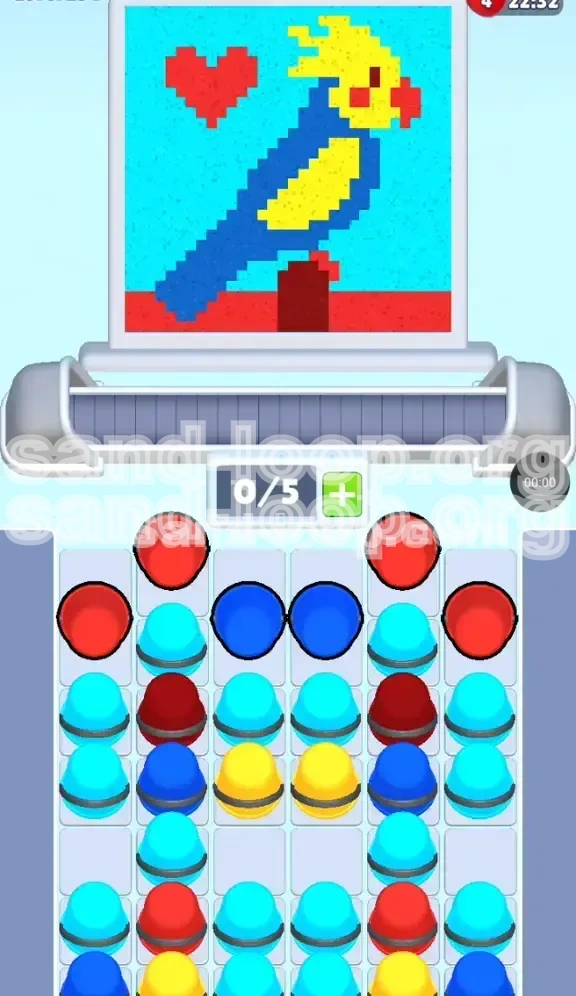
Level 234, often referred to as "The Cockatiel Challenge," presents a unique test of precision within the Sand Loop universe. Unlike the frantic ice-cracking speed stages, this level is a deliberate, strategic digging puzzle. The visual target is a charming, pixel-art Cockatiel (or Parrot) perched on a stand, set against a vast sky. The difficulty here is not about reflex speed but about resource management and color identification. You are given a generous supply tray with a 0/5 slot capacity, meaning you can queue up multiple sand shots. However, the layout is deceptive: the colors required for the bird's face (Yellow) are buried deep within the stack, obstructed by the background colors (Cyan). The primary challenge is avoiding the visual confusion between the Dark Blue bird body and the Cyan sky, ensuring you don't waste your limited Blue capacity on the background.
The Vertical Excavation Layout
The physical structure of the level is defined by a "Central Column Stack." In the supply tray, essential cups are piled vertically. The top layers consist mostly of Cyan (sky) and Dark Red/Brown (perch), while the critical Yellow cups (face) and Dark Blue cups (body) are suppressed at the bottom of the pile. This forces a vertical digging strategy rather than a horizontal sweep. You cannot simply clear the top layer; you must surgically remove the top cups to free the bottom ones without causing a jam on your conveyor belt.
Visual Complexity Analysis
This stage introduces a high degree of visual similarity between functional elements. The Dark Blue used for the bird's wing and body is remarkably similar to the Cyan used for the sky when viewed quickly. Furthermore, the Red cups serve a dual purpose: large areas (ground and heart) and microscopic details (the beak and single cheek pixel). This duality creates a "Danger Zone" where players often accidentally paint the bird's face yellow, obliterating the tiny red beak detail, requiring a complete restart to fix perfectly.
The 0/5 Slot Mechanic
Having a 0/5 slot capacity is a double-edged sword. It allows you to set up a queue of 5 cups to pour automatically, which is excellent for filling large areas like the sky. However, it increases the risk of "Deadlocking." If you queue 5 Cyan cups, but the bird requires a sudden splash of Yellow to prevent an overflow, you cannot intervene until a slot opens up. This level teaches you to keep your queue dynamic—never letting it stay full for too long unless you are 100% sure of the color sequence.
Psychological Challenge Factors
The mental trap of Level 234 is impatience. Because the bird looks "almost done" very quickly, players tend to speed up. However, the level requires a slow, rhythmic pace. The urge to "tap everything" to clear the tray must be resisted. The level rewards players who can pause, assess the queue, and execute a surgical strike on the specific colors needed next, rather than treating it like a standard whack-a-mole game.
Clear Objectives: Strategy and Goals
To conquer Level 234, you must move beyond simple color matching and adopt a layer-by-layer approach. Your primary goal is to clear the obstructing colors (Cyan and Dark Red) to liberate the trapped core colors (Yellow and Dark Blue) without running out of space or ruining the fine details of the bird's face.
Primary Objective: The Sky Clearing
Your first major task is to manage the massive influx of Cyan cups. The sky constitutes approximately 60% of the canvas. You must clear these cups not just to fill the background, but to physically remove them from the supply tray. If you ignore the Cyan cups to focus on the bird, your conveyor belt will clog with unused sky colors, preventing you from accessing the bird's colors buried underneath.
Secondary Objective: The Perch Foundation
Before painting the bird, you must establish the base. The Dark Red/Brown vertical perch must be completed early. Why? Because the perch cups are located in the middle layers of the stack. Clearing them allows you to reach the Dark Blue cups located directly beneath them. Think of the perch as the "bridge" to the main body of the bird.
Tertiary Objective: Surgical Face Painting
The most critical objective is the preservation of the face details. You must fill the Yellow crest and face while leaving a single-pixel gap for the beak and cheek. This requires pausing the flow of sand at exactly the right moment. You cannot simply "fill" the face; you must "sculpt" it. This is the precision test that fails most players.
Final Objective: The Detail Pass
The level is only complete when the tiny details are perfect. This involves waiting for specific single cups to cycle around the conveyor belt to fix the beak or patch a hole in the wing. The objective here is patience—letting the loop complete its rotation rather than forcing a pour that doesn't match.
Step-by-Step Instructions: The Excavation Protocol
This walkthrough breaks the level down into a linear, actionable sequence. Follow these steps in order to ensure a smooth completion.
Phase 1: The Red Corner Initiation
Start the level by immediately targeting the accessible corners.
- Action: Look at the top-left and top-right of the supply tray. You will see Red cups.
- Move: Tap the top-left Red cup and the top-right Red cup.
- Target: These cups correspond to the large red heart at the top left of the canvas and the red ground strip at the bottom.
- Result: Filling these large, simple areas first clears the top layer of the tray, exposing the Cyan cups underneath. It also utilizes your conveyor slots for high-volume fills that don't require pixel-perfect precision.
Phase 2: The Cyan Sky Management
With the corners cleared, you will face a wall of Cyan.
- Action: Identify the Cyan cups. Do not tap all of them at once.
- Move: Tap exactly two Cyan cups.
- Target: The vast empty sky area.
- Result: Two cups provide enough flow to start the background without jamming your belt. While these pour, scan the tray for the Dark Red/Brown cups appearing in the second row. You need to free those up next.
Phase 3: The Perch and Body Liberation
Now you dig for the bird.
- Action: Locate the Dark Red/Brown cups in the tray (likely now visible after clearing the first wave of Cyan).
- Move: Tap the Dark Red cups.
- Target: The vertical perch stand.
- Result: Clearing the perch cups usually unearths the Dark Blue cups needed for the bird's body. Prioritize the Dark Blue next. Pour the body before the head because the body is a large, solid block that sits "behind" the face visually.
Phase 4: The Core Extraction (Yellow)
This is the critical moment.
- Action: The Yellow cups are now exposed in the center-bottom of the tray.
- Move: Tap the Yellow cups as soon as they are accessible.
- Target: The bird's crest and face.
- Result: Since the body is already Blue, pouring Yellow now will define the head. Be ready to stop instantly to save the beak spot.
Color Order: The Processing Sequence
Success in Level 234 depends heavily on the order you process the colors. The game forces you into a specific sequence due to the vertical stacking of the tray.
Priority 1: Red (The Foundation)
Red must be processed first, even though it feels like a background detail. The Red cups for the heart and ground are at the very top of the stack (Rows 1 and 2). Ignoring them to dig for Yellow is impossible because they physically block access to the lower layers. Furthermore, Red has the lowest risk of error. Filling the ground and heart requires zero precision, allowing you to focus on managing your queue slots while these pour.
Priority 2: Cyan (The Obstacle)
Cyan is the most abundant color (60% of the level). It is processed second not because it is the most important, but because it is the most prevalent obstacle. You must process Cyan to lower the stack height. The trick is to process it in "micro-doses"—enough to clear the tray, but not so much that you crowd out the Dark Blue and Yellow cups that are becoming available. You are processing Cyan primarily to "dig" the hole to the bird.
Priority 3: Dark Red/Brown (The Key)
This color acts as the physical key to the next stage. The Dark Red cups form the "bridge" layer between the sky colors and the bird colors. If you delay processing this, the Dark Blue cups remain buried. Processing this color stabilizes the canvas (adding the perch) and unlocks the Blue cups.
Priority 4: Dark Blue (The Structure)
Dark Blue is processed before Yellow. The body of the bird is large and forgiving. By filling the Dark Blue body first, you create a clear visual boundary for the Yellow face. If you do Yellow first, you might accidentally paint outside the lines, and the Blue body won't cover your mistakes effectively. Always paint the "back" layers before the "front" details.
Priority 5: Yellow (The Detail)
Yellow is the final and most critical color. It is buried the deepest, meaning it is naturally the last color you access. This timing actually works in your favor. By the time you process Yellow, the chaotic background (Cyan) and structure (Blue/Red) are finished. You can devote 100% of your attention to the precise pour needed for the face without worrying about the conveyor belt jamming with other colors.
Key Tips: Essential Advice for Success
These tips will help you navigate the specific nuances of the Cockatiel challenge.
Queue Management: The "3-Slot" Rule
Even though you have 5 slots, try to keep your active queue to 3 cups whenever possible. Why? If you have 5 cups queued and you realize you need to stop the flow to save a pixel detail (like the beak), you are powerless to stop the 4 remaining cups. Keeping 2 slots open gives you the flexibility to react instantly if a pour starts to go wrong or if you need to grab a specific color that just popped up on the tray.
Visual Isolation: Squint Technique
The colors can blend together. If you are unsure if a cup is Dark Blue or Cyan, squint at your screen or blur your focus slightly. The Cyan will look like a bright, light sky blue, while the Dark Blue will look like a shadow. This technique helps you quickly grab the correct cup without hesitating. Hesitation leads to queue backups.
The "Tap and Wait" Rhythm
Do not tap multiple cups rapidly in succession during the "excavation" phase (Phase 2 and 3). Tap one cup, watch it fly to the belt, wait a split second, then tap the next. This rhythmic tapping prevents the "conveyor jam" bug where too many items try to enter the belt at once. It also gives your brain time to register if the color you just revealed is the one you actually need.
Focus on the Center
Train your eyes on the center of the supply tray. The edges of the tray are mostly filler (Cyan/Red). The "money" colors (Yellow/Dark Blue) spawn in the center columns. By visually ignoring the edges and only reacting when the center shifts, you save mental energy and react faster to the critical unlocks.
Pre-Planning the Beak
Before you even tap the first Yellow cup, identify exactly where the beak is supposed to go. Visualize the empty spot. Once the Yellow sand starts flowing, your eyes should be locked on that empty spot. If you wait until the sand is flowing to look for the beak, you will be too late.
Common Mistakes: What to Avoid
Learning from the errors of others is the fastest way to beat this level.
Mistake 1: The Cyan Flood
This is the most common error. Players see the 0/5 capacity and think they can load 5 Cyan cups instantly. This floods the screen with sky sand, and while it's pouring, the conveyor is locked. You cannot grab the Yellow cups when they appear because the belt is full of Cyan. By the time the Cyan clears, the Yellow might have despawned or shifted. Fix: Never queue more than 2 Cyan cups back-to-back.
Mistake 2: Ignoring the Tiny Beak
The beak is a tiny detail, maybe 4x4 pixels. Many players treat the face as a solid block of Yellow. They pour the Yellow, fill the face, and then realize they have painted over the beak area. Trying to fix this by dumping a Red cup on top of a wet Yellow face results in a muddy brown mix. Fix: Pause the Yellow flow when the face is 90% full, then use a precise single tap of Red for the beak.
Mistake 3: Confusing Background and Body
In the heat of the moment, players grab a Cyan cup thinking it's Dark Blue (or vice versa). Pouring Cyan onto the bird's body makes it look like a ghost. Pouring Dark Blue into the sky makes it look like a night scene. Fix: Always double-check the cup's shade before tapping. If it looks bright, it's Sky. If it looks deep, it's Body.
Mistake 4: Tunnel Vision
Players focus so hard on digging for the Yellow that they let the conveyor belt run empty. An empty belt is wasted time. Fix: If you are waiting for cups to settle, use the time to grab a Cyan cup and patch a hole in the sky. Never let the belt sit idle.
Stuck Solutions: Troubleshooting the Level
If you find yourself stuck or unable to progress, use these diagnostic solutions.
Problem: The Yellows Won't Appear
You have cleared the top layer, but the tray is just refilling with Cyan and Red. You can't find the Yellow.
Solution: You are likely clearing the wrong rows. Stop tapping the outer edges. Focus exclusively on the center column. You need to remove the Dark Red "perch" cups specifically. The Yellow cups are trapped *under* the Dark Red layer. If you keep taking the side Cyan cups, you are bypassing the Yellow. Tap the center cups until the tray shifts vertically.
Problem: Conveyor Belt Deadlock
Your belt is full, you have 5 cups queued, and none of them match the empty spots on the canvas. You are stuck watching the sand pour uselessly.
Solution: This is the "Inventory Lock." You cannot stop the cups from pouring. However, you can look for a "trash" spot. Is there a tiny corner of the sky that isn't perfectly filled? Use a spare cup to over-fill it slightly just to get the cup off the belt. You must create space to clear the jam.
Problem: Ruined Face Details
You accidentally poured Yellow over the beak area. It looks like a yellow blob now.
Solution: Damage control. Don't try to fix it immediately while the Yellow is wet. Finish the rest of the bird (wings, tail) to clear the queue. Once the level is calm and only the beak is left, wait for a Red cup to come around. Pour a tiny amount of Red onto the tip of the beak area. It might blend slightly, but it will define the shape better than a yellow blob.
Speed Run Tips: Fast Completion Strategies
Once you have mastered the level, use these strategies to improve your time and efficiency.
The "Pre-Load" Technique
As the level starts, the cups are falling into the tray. You can tap the first Red cup before it even settles fully on the stack. By tapping the falling animation, you can shave 0.5 seconds off your start time. This allows you to have the first wave of sand pouring while the tray is still stabilizing.
Bulk Queueing for Sky
Once the bird (Blue/Yellow) is fully painted, the only thing left is the sky. At this point, abandon caution. Tap 4 or 5 Cyan cups in rapid succession. Since the bird is finished, there is no risk of ruining details. Letting the belt run at maximum capacity for the final 20% of the level is the fastest way to clear the remaining timer.
Ignore the Small Holes
Perfectionism kills speed. If you have a 1-pixel hole in the sky or a slightly messy edge on the wing, ignore it until the end. Don't stop your momentum to fix a tiny flaw. Keep the flow moving towards the goal (Yellow face). You can circle back to patch holes after the core mechanics of the level are solved.
Pattern Recognition
Speedrunners memorize the spawn pattern. The tray usually spawns in a predictable rhythm: Red edges, Cyan middle, Red center. Knowing this allows you to tap the next necessary cup before it even becomes fully visible, keeping your flow state uninterrupted.