
Level 258
HARDHow to solve Sand Loop level 258? Get instant solution for Sand Loop 258 with our step by step solution & video walkthrough. Sand Loop 258 tips and guide.
Play Sand Loop Now
Experience the puzzle challenge firsthand
Game Screenshots
Sand Loop Level Guides
Level Overview: The Artistic Precision of Stage 258
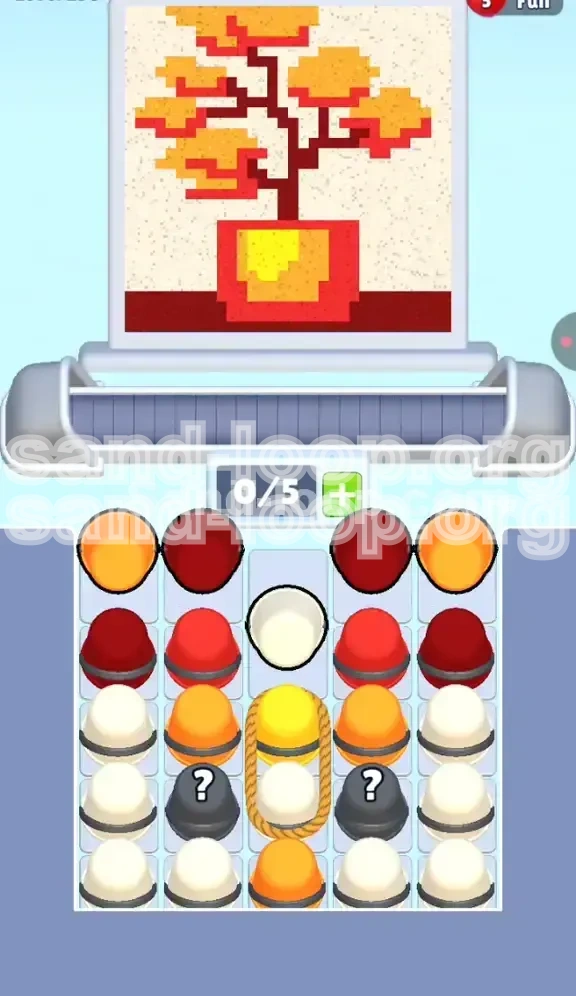
Welcome to Level 258 of Sand Loop, a stage that shifts the gameplay dynamic from frantic puzzle-solving to artistic precision. Unlike previous levels that relied on speed or smashing obstacles, this stage is a test of logic and spatial awareness. The visual goal is to complete a serene, pixel-art Bonsai Tree, but the path to victory is fraught with bottlenecks that require careful planning.
The Visual Challenge: Autumn Aesthetics
The level features a minimalist design dominated by a massive white background. The central subject is a Bonsai tree rendered in pixel art, sitting in a red pot with yellow highlights, resting on a dark red surface. The foliage displays a mix of autumnal orange and yellow. While beautiful, the thin branches of the tree are the primary visual hazard; they are easily obscured if the wrong colors are poured too early.
The Core Mechanic: Logic Over Speed
This is not a race against the clock. There are no ice blocks to smash, and no time limits to stress you out. Instead, the challenge comes from a constrained board layout. The level restricts your moves through a central rope lock and hidden mystery cups. Randomly tapping the top rows will result in an immediate loss due to slot clogging.
The Slot Management Crisis
Players start with 5 available slots on the conveyor belt. This seems generous, but in the context of this level's layout, it is a tight resource. The "Rope Lock" in the center column effectively blocks access to essential colors until specific conditions are met. If you fill your belt with the wrong colors early on, you won't have the space to collect the necessary sand to clear the rope, leading to a deadlock.
The "Mystery" Element
Scattered throughout the upper echelons of the board are "?" cups. These mystery cups are wildcards that can either save the run or doom it. They usually conceal the specific colors needed to bridge the gap between the early game (Red/Orange) and the late game (White), but relying on luck is a strategy that often fails here.
Why This Level Stalls Players
Most players fail Level 258 because they prioritize the background color (White) too early. The white background is visually dominant, tricking players into thinking it is the priority. However, clearing white before the structural elements of the tree are filled leads to a shortage of slots when the complex branch work begins.
Clear Objectives: Your Path to Victory
To beat Stage 258, you must adhere to a strict structural philosophy. Think of yourself as a painter constructing a masterpiece; you cannot paint the background before the subject is defined.
Primary Objective: Establish the Foundation
Your first and most critical goal is to fill the pot and the trunk. This requires a steady stream of Dark Red/Maroon sand. Without this base, the rest of the image cannot hold together. You must prioritize any Red cups you see on the board to ensure the bottom half of the Bonsai is solidified.
Secondary Objective: Foliage Definition
Once the trunk is established, your focus shifts to the canopy. The leaves require a mix of Orange and Yellow. The challenge here is avoiding "color bleeding," where Orange sand spills over into the areas reserved for the branches. You must aim for precision when pouring the foliage colors.
Tertiary Objective: Unlocking the Bottleneck
The central Rope Lock is the gatekeeper of the mid-game. You must clear the cups adjacent to this lock to free the trapped colors inside. Failing to clear this bottleneck quickly enough will stall your progress, leaving you with an incomplete tree and no colors to finish it.
Final Objective: The Great White Wash
Only after the tree is fully rendered—pot, trunk, branches, and leaves—should you attempt to clear the background. This is a "cleanup" phase. You must ensure you have at least 2-3 empty slots available before triggering the massive release of White sand that characterizes the end-game.
Survival Metric: The Progress Bar Balance
Keep a close eye on the progress bars at the top of the screen. If your Red progress hits 100% but your Orange is stuck at 30%, you have prioritized incorrectly. A balanced progression—where all three main colors (Red, Orange, White) rise in tandem—is the key indicator that you are on the right track.
Step-by-Step Instructions: The Phase-by-Phase Strategy
This walkthrough divides Level 258 into four distinct phases. Follow these steps in order to ensure a smooth completion.
Phase 1: The Base Layer (Trunk & Pot)
- Analyze the Top Row: When the level loads, do not tap immediately. Identify the two Dark Red cups and the two Orange cups in the top corners.
- Initiate the Red Pour: Tap the Dark Red cups first. Gravity will pull this sand to the bottom of the image, filling the pot and the trunk base immediately.
- Follow with Orange: Tap the Orange cups next. This will start filling the lower leaves and the pot's yellow highlight.
- Hold the White: There is likely a single White cup visible in the center top row. Do not tap it. Tapping it now will waste a slot on a color you cannot use until the end.
- Monitor Slot Usage: After these initial taps, you should have 4/5 slots filled. Allow the sand to pour and clear before tapping more cups.
Phase 2: The Mystery Cup Reveal
- Identify the Obstruction: Once the top layer is cleared, you will see two Mystery Cups ("?") flanking the central Rope Lock.
- Trigger the Reveal: Tap the cups directly *above* the Mystery Cups. This will activate them and drop them onto the conveyor belt.
- Assess the Result: Watch what color these Mystery Cups become.
- If they turn into Red or Orange: Send them to the belt immediately to boost your tree progress.
- If they turn into White: Leave them on the belt! Do not pour them. Use them as "fillers" to keep the belt moving without pouring white sand.
- Prepare for the Rope: Clearing these cups brings you closer to the central obstacle. Ensure you have at least one empty slot before attempting to cut the rope.
Phase 3: The Rope Lock Break
- Locate the Adjacent Cups: The Rope Lock binds a Yellow and a White cup. To cut it, you must make matches or clear the cups immediately to the left and right of the center column.
- Focus Fire: Tap the cups in the left and right columns exclusively. Avoid the center column until the rope animation starts.
- The Cut: Once the adjacent cups are gone, the rope will slice automatically.
- Capture the Yellow: As soon as the rope breaks, a Yellow cup will be released. Tap it immediately. This Yellow is essential for finishing the pot highlights and specific leaf clusters.
- Slot Check: At this point, your belt might be full. Stop tapping and let the sand drain. You need empty slots for the final push.
Phase 4: The Background Cleanup
- Verify the Tree: Look at the screen. Is the pot red? Is the trunk dark? Are the leaves orange and yellow? If any part of the tree is missing, do not proceed. You will not get another chance to fix it once the background is in.
- Unleash the White: Once the tree is perfect, tap every remaining White cup on the board, including the ones trapped in the center column.
- Rhythm Tapping: Since the background is a single solid block of color, you can tap rapidly. There are no gaps to worry about here.
- Final Completion: Keep pouring white until the level completes. If you followed the previous steps, the progress bar should shoot to 100%.
Color Order: The Logic of the Pour
The specific order in which you process colors is the mathematical solution to this level. Deviating from this sequence creates logical paradoxes where you cannot finish the image.
Priority 1: Dark Red/Maroon (The Structure)
Dark Red is the skeleton of the level. It occupies the bottom of the screen (the table) and rises up through the trunk and branches. Because physics in Sand Loop pulls sand downward, starting with Red ensures that the lower pixels are filled first. If you save Red for last, it will have to "fight" through the Orange leaves to reach the trunk, often resulting in a muddy, unfinished base.
Priority 2: Orange (The Foliage)
Orange acts as the muscle of the level. It fills the broad area of the canopy. However, it is subordinate to the branches. If you pour Orange before the branch structure (Red) is set, the Orange pixels will "bleed" into the branch spaces. When you finally pour Red, it might not be enough to fill those thin lines, leaving you with a tree that has no branches.
Priority 3: Yellow (The Highlight)
Yellow is used sparingly for the pot's rim and leaf accents. Because it is a highlight color, it is less critical than the base Red or the bulk Orange. However, it is often trapped behind the Rope Lock. This makes it a "mid-game" priority—you unlock it when you break the rope, and you pour it immediately to secure those final percentage points for the tree.
Priority 4: White/Cream (The Void)
White is the "eraser" of the level. Its job is to fill the negative space around the tree. In terms of color theory, White represents 100% of the remaining pixels. However, in terms of gameplay logic, it is the lowest priority. Pouring White early is the most common way to lose, as it consumes slot space that is desperately needed for the rare Red and Orange cups.
The Ratio Analysis
A successful run of Level 258 typically follows a rough completion ratio:
- 0-40% Progress: Focus entirely on Red.
- 40-70% Progress: Mix Red and Orange.
- 70-90% Progress: Finish with Yellow and remaining Orange.
- 90-100% Progress: Dump White.
Key Tips & Common Mistakes
Even with a strategy, the devil is in the details. These tips highlight the specific nuances of Level 258 that separate a clear from a restart.
Common Mistake: The "White Noise" Trap
The most frequent error is tapping the White cup visible in the top center at the very start of the level. Players see the large white background and assume they should start filling it. Don't do it. That single White cup takes up 20% of your conveyor capacity. If you tap it, you are reducing your ability to process the critical Red/Orange cups needed to clear the Rope Lock. Wait until the tree is 80% done before touching White.
Key Tip: Slot Conservation
Your 5 slots are your inventory. Treat them like gold. If you have 4 slots filled and the next cup is a color you don't need (like White when you need Red), stop tapping. Wait for the belt to empty. A clogged belt is a death sentence in this level because it prevents you from reacting to the Mystery Cup reveals.
Common Mistake: Ignoring the Rope Lock Adjacency
Some players try to break the rope by tapping the cups *inside* the locked column. This is impossible. The game mechanics require you to clear the cups *next to* the lock (usually in the immediate left or right columns) to trigger the break animation. Tapping inside the center column just wastes moves and fills your slots with locked cups you can't use yet.
Key Tip: The "Pause and Pour" Method
Level 258 is best played in bursts. Tap 2-3 cups, then stop. Watch the sand fall. Check your progress bars. Confirm that the sand landed where you expected it to. Then, tap the next batch. Playing this way prevents the "slot overload" that happens when players tap frantically without looking at the conveyor belt status.
Common Mistake: Branch Bleeding
This is a visual mistake. Players pour a massive amount of Orange sand all at once. The Orange fills the leaf area but also spills into the thin lines of the branches. When they finally pour Red, it isn't enough to push the Orange out of the branch lines. The result is a tree with orange branches that looks messy and can fail the "accuracy" check if the game has strict color overlap tolerances.
Key Tip: Use Mystery Cups as Buffers
If a Mystery Cup turns into a color you don't need (e.g., White early on), you can still use it to your advantage. Tap it to keep the conveyor belt moving. The movement of the belt helps align the cups behind it, potentially bringing a needed Red or Orange cup into a tappable position faster. Think of unwanted Mystery Cups as "fuel" to keep the machine running, not just waste.
Stuck Solutions & Speed Run Strategies
If you find yourself repeating the level or want to optimize your time, these advanced strategies will help you master Stage 258.
Stuck Solution: The "Soft Lock" Scenario
The Problem: Your belt is full of White and Yellow, but the tree still needs Red branches, and no Red cups are visible on the board. The Fix: You are likely "clogged." Stop tapping entirely. Let the belt drain completely. Once the belt is empty, look for any remaining "?" cups. You must gamble on these Mystery cups to spawn the missing Red. If there are no Mystery cups left, you may have prioritized incorrectly earlier. In this case, the only fix is to restart and focus harder on Red in Phase 1.
Stuck Solution: Rope Lock Won't Break
The Problem: You have cleared the cups next to the rope, but it won't cut. The Fix: You likely missed a cup tucked in a corner or obscured by the falling sand animation. Zoom in (if on mobile) or look closely at the two columns immediately flanking the center. There is almost certainly one single pixel cup remaining that you overlooked. Clear it, and the rope will snap.
Speed Run Tip: The "Pre-Load" Tactic
Speed runners know that waiting for the belt to drain is wasted time. To speed up Stage 258, try to predict the Mystery Cup colors. If the level RNG tends to give Red for the first Mystery cup, you can "pre-load" your belt by tapping the top corners before the previous sand has fully settled. This is risky but can shave 10-15 seconds off your time if you have the rhythm down.
Speed Run Tip: Color Grouping
Instead of tapping Red -> Orange -> Red -> Orange, group your taps. Tap every Red cup on the screen in a span of 2 seconds, then stop. Then tap every Orange cup. Grouping colors this way minimizes the amount of "mixing" that happens on the conveyor belt, making it easier to manage your slots and ensuring you get large "chunks" of progress in single bursts.
Speed Run Tip: The End-Game Flood
The final phase (White background) is where speed runs are won or lost. Once the tree is done, don't just tap the White cups one by one. Look for the "clump" of White cups usually located in the bottom center (released by the rope). Tap the entire clump simultaneously. The game engine handles the physics of the fall, and since the background is uniform, you don't need to worry about misplaced pixels.
Advanced Tip: Memory Reset
If you fail Level 258 three times in a row due to bad RNG (e.g., Mystery Cups giving you White when you desperately need Red), force-close the game and reopen it. This can sometimes reset the seed of the level, giving you a more favorable distribution of colors in the Mystery cups. While not a guaranteed fix, it can save your sanity when the game seems determined to give you the wrong colors.