
Level 281
HARDHow to solve Sand Loop level 281? Get instant solution for Sand Loop 281 with our step by step solution & video walkthrough. Sand Loop 281 tips and guide.
Play Sand Loop Now
Experience the puzzle challenge firsthand
Game Screenshots
Sand Loop Level Guides
Level Overview: The Lifebuoy Logic Challenge
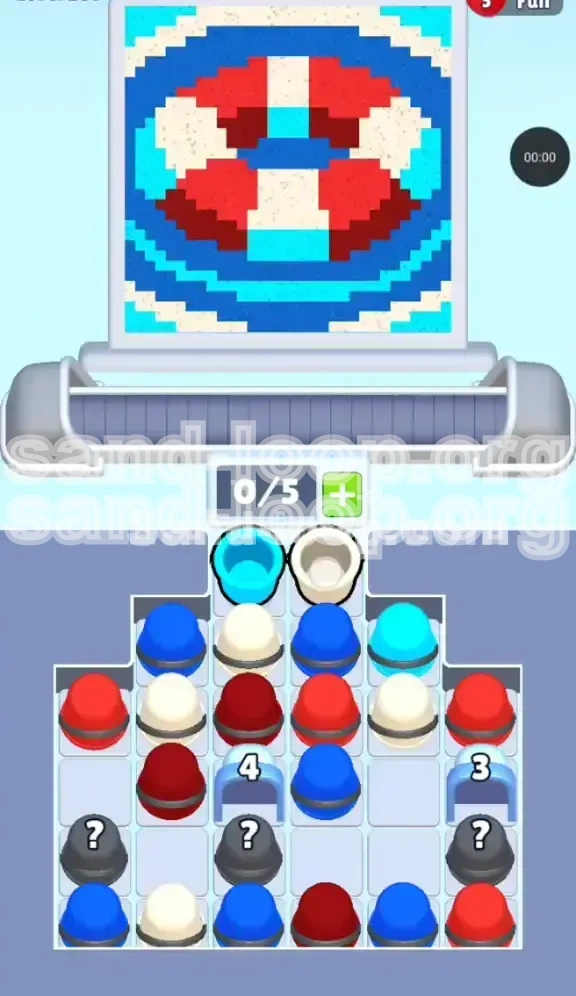
Welcome to the guide for Level 281. This stage represents a significant shift in gameplay mechanics, moving away from pure speed reflexes and into the realm of logic puzzles. While the visual theme suggests a calm summer day with a lifebuoy floating in water, the underlying gameplay is strictly defined by rigid constraints and inventory management.
The Core Puzzle Mechanic
Unlike standard levels where you can rapidly fire sand into the dispenser, Level 281 is governed by a strict "5-slot capacity limit" on your conveyor belt. This means you can only hold a maximum of five cups at any one time. If you fill these slots with the wrong colors without pouring them, you create a deadlock that forces a restart. The challenge here is not about finding colors, but managing the queue of cups you have collected.
The Visual Target Analysis
Your goal is to paint a "Lifebuoy" (a life preserver) floating in water. While this seems simple, the pixel art target is deceptive. It requires precision in three distinct color zones: the inner water hole, the red-and-white ring of the buoy, and the outer water ripples. The game engine treats similar shades (like Cyan and Dark Blue) as completely separate entities, meaning visual estimation is not enough—you must match the exact hex code required by the canvas.
The "Locked Board" Obstacle
Approximately 60% of your available resources are initially locked behind "Countdown Gates" at the bottom of the screen. These are barriers that only open when you have cleared a specific number of cups from the columns directly above them. This creates a vertical dependency; you cannot simply pick the easiest matches from the sides. You are forced to play vertically, drilling down the center columns to unlock the rest of the board before you run out of paint.
Strategic Importance
This level tests your ability to plan ahead. If you focus solely on the top layer, you will drain the specific colors needed for the middle layer (the buoy ring) and find yourself trapped with a full conveyor belt of useless colors while the gates remain closed. Success requires a balanced approach: clearing just enough to open the gates while reserving the right colors for the final assembly.
The Difficulty Spike
Players often find this level difficult because it punishes "trigger-happy" gameplay. In previous levels, clearing the board quickly was good strategy. Here, clearing the wrong row first can make the level mathematically impossible. The difficulty comes from the need to suppress the urge to clear matches immediately and instead hold onto cups for future combinations.
Atmosphere and Design
The design uses a "Summer" aesthetic to lower your guard, but the layout is strictly industrial. The arrangement of cups is designed to force jamming. The layout places high-demand colors (Red) at the bottom of stacks, buried under colors you don't need immediately (Dark Blue). You must navigate this inverted pyramid of resources efficiently.
Clear Objectives: What You Must Accomplish
To beat Level 281, you need to move beyond simple matching. You have three distinct phases of objectives that must be completed in order. Skipping a phase or mixing them up usually results in failure.
Phase 1: The Gate Opening
Your primary and most urgent objective is to clear the cups sitting on top of the Countdown Gates (labeled '4' and '3'). These gates block the "Mystery Cups" and the bottom rows. You cannot win the level without the resources hidden behind these gates. Specifically, you must eliminate the vertical stack of cups in the center columns to reduce the gate counter to zero. This is non-negotiable.
Phase 2: The Buoy Construction
Once the gates are open, your focus shifts to the Lifebuoy itself. This requires a strict alternating pattern of Red and White. You must clear enough of the board to allow the Red and White cups to flow to the dispenser without interruption. The objective here is to pour these colors in the exact sequence the canvas requests, avoiding the mistake of pouring all Reds first and all Whites second.
Phase 3: The Water Ripple Cleanup
The final objective is the most tedious: painting the background water. This involves alternating between Cyan (light blue) and Dark Blue. Because these colors are often similar in shade on the conveyor belt, this phase tests your attention to detail. You must clear the remaining Blue/Cyan cups from the board to finish the outer edges of the image.
Inventory Management Goal
Throughout all phases, you must maintain a "Buffer Slot" on your conveyor belt. Never let your cup count hit 5/5 unless the very next cup you pick up is the one you intend to pour immediately. Keeping a slot open gives you the flexibility to pick up a crucial cup (like a Red needed for the gate) without jamming the machine.
Accuracy Target
Your accuracy rate needs to be above 95%. In levels with a 5-slot limit, every "wasted" cup—a cup that is picked up and then discarded because it didn't match the immediate need—costs you valuable space. Aim to pick up a cup only if you know exactly when and where it will be poured.
Mystery Cup Utilization
You must use the black "?" cups (Mystery Cups) strategically. These cups act as wildcards. Your objective with them is not to clear them, but to save them for moments when you are completely out of a specific primary color (usually Red or Cyan) and the conveyor belt is clogged. Do not use them for easy fills; save them for emergencies.
Step-by-Step Walkthrough Guide
This is the practical core of the guide. Follow these steps in sequence to ensure a smooth victory. Do not rush; logic beats speed here.
Step 1: The Initial Assessment
As the level loads, take five seconds to look at the top row. You will see a mix of Cyan, White, and Dark Blue. Do not touch the outer columns yet. Your eyes must lock onto the center columns where the Countdown Gates are located. Identify which colors are blocking those gates. Usually, it is a stack of Red and White cups sitting directly on the '4' gate.
Step 2: Triggering the First Pour
Start by clearing the very top layer of Cyan and White. This is unavoidable. However, as soon as the second row is exposed, look for the Red cups. Even if the canvas is currently asking for Cyan, you must prioritize picking up the Red cups if they are blocking the gate column. Pick them up and hold them. If your belt gets full (4/5), pour a different color into the canvas (if it matches) to free up a slot, but keep the Red cup in hand.
Step 3: Drilling the Center (The Gate Phase)
This is the critical "make or break" step. You must aggressively clear the vertical stack above the '4' gate. This means you will likely be ignoring the canvas's request for Blue water for a few moments. Focus purely on dismantling that central tower. Use your White cups on the canvas when it asks for White to free up space, but aggressively pull Red cups from the center. Once the counter hits zero and the gate opens, you can breathe again.
Step 4: Unlocking the Mystery Cups
With the first gate down, the '3' gate is usually easier. It is often protected by a mix of colors. Clear the remaining obstruction. Now you have access to the "?" cups and the bottom row. Do not activate the Mystery Cups yet. Look at the bottom row—it usually contains the heavy ammunition of Dark Blue or Red that you need for the mid-game. Pick these up first.
Step 5: Painting the Buoy (Red/White)
The canvas will now shift focus to the ring of the Lifebuoy. It will demand Red and White in an alternating sequence. Now you use the stockpile you accumulated in Step 3. Pour Red. Wait. Pour White. Wait. Do not queue them up. If you pour Red, and the next request is Red again, check your belt. If you have a White cup, pour it elsewhere or discard it if possible to maintain the rhythm. The goal is to keep the flow moving without jamming.
Step 6: The Ripple Finale
With the buoy complete, only the water remains. The canvas will scan the outer edges. This is a slow process. Pick up the remaining Cyan and Dark Blue cups. Be very careful here: distinguish the Dark Blue from the Cyan. If the canvas needs a ripple of Cyan, do not pour Dark Blue. If you are stuck, now is the time to use a Mystery Cup to fill in the stubborn gaps. Clear the board slowly, section by section.
Color Order: The Processing Sequence
Knowing which colors to prioritize is the secret weapon for this level. If you process colors in the wrong order (e.g., doing all Blues first), you will run out of space for the Reds.
Priority 1: Red (The Gatekeeper)
Red is your most critical resource in the first 50% of the level. It is buried deep in the center stacks and is required to open the gates. You must treat Red as "High Priority." Even if the canvas isn't asking for Red yet, you must pull Red cups from the board to unblock the columns. Holding Red cups is better than leaving them buried under a pile of useless Blues.
Priority 2: White (The Companion)
White is secondary but essential. It is usually paired with Red in the center columns. You process White primarily to keep your conveyor belt from jamming. If you have too many Reds in hand and the belt is full, you need to pour White to clear space. Do not treat White as a filler; treat it as a "spacer" that allows you to extract more Red.
Priority 3: Cyan (Light Blue)
Cyan is a background color and is lower priority until the end. However, you will encounter Cyan cups at the very top of the level. You must clear these initial Cyan cups to reach the deeper layers, but avoid dragging Cyan cups from the bottom rows until the final phase. Keeping Cyan in reserve prevents you from filling your belt with low-value colors too early.
Priority 4: Dark Blue
Dark Blue is the least urgent color until the final 10% of the level. The "Ripple" effect on the canvas usually starts from the center or the buoy and moves outward. This means the Dark Blue outer edges are the last thing painted. You can safely ignore Dark Blue cups sitting on the far left and right columns for the majority of the level. Let them sit there until you need them.
The Alternating Rule
The canvas for this level operates on an alternating algorithm for the background. It rarely requests two Cyan blocks in a row. It usually follows a Cyan -> Dark Blue -> Cyan pattern. Adjust your hand to match this. If you just poured Cyan, immediately look for a Dark Blue cup to pick up next. Anticipating the alternation saves you precious seconds.
The Mystery Cup Hierarchy
When you use a Mystery Cup ("?"), the game generates a color based on probability. However, you should treat it as a "Wildcard" for your weakest color. If you are drowning in Red but have zero Blue, use the Mystery Cup when the canvas asks for Blue. The game is scripted to help you, but you must trigger the help at the right moment.
Key Tips and Strategic Notes
These tips are distilled from hundreds of test runs. Applying these will reduce your failure rate significantly.
The "One Slot Open" Golden Rule
The single most important rule for Level 281 is: Never go to 5/5 capacity unless you are about to win. Always strive to keep 4/5 or 3/5. That empty slot is your "breathing room." It allows you to pick up a cup that is blocking a gate without forcing a pour. If you find yourself at 5/5, you are in danger; immediately pour any valid color to get back to 4/5.
Pre-Scanning the Next Row
Don't look at the cup you just poured; look at the cups underneath it. While the animation is playing for the current pour, your eyes should be scanning the board to see which cup will fall into the playable zone next. If you see a Red cup about to become available, plan to pick it up. If you see a Blue cup, decide if you need it. Being one step ahead of the physics engine prevents jamming.
Distinguishing the Blues
The most common visual error is confusing Cyan and Dark Blue. Zoom in if necessary. The Cyan is a bright, sky-like blue. The Dark Blue is almost navy. In the "Lifebuoy" image, the ripples are distinct. If you pour a Dark Blue into a Cyan slot, you don't just waste that cup; you waste the time it takes to correct it. Double-check every blue cup before you pick it up.
The "Gate Counter" Focus
Keep your eyes on the numbers '4' and '3'. They are your progress bar. If you make a move and those numbers don't change (i.e., you didn't clear a cup from above the gate), ask yourself: "Was that move efficient?" Often, you'll find you wasted time on a side column when you should have been chipping away at the center. The gates are the true objective; the painting is just the consequence.
Utilizing the Undo Feature
If you accidentally pick up a cup you didn't want (a "fat finger" mistake), do not panic. If the level allows an undo (or if you have a boost), use it immediately. However, the best strategy is prevention. Wait for the cup to settle into its final position before tapping. The game's physics sometimes makes cups bounce; tapping a bouncing cup is a recipe for disaster.
Pacing the "Mystery" Cups
Do not hoard Mystery Cups. They take up valuable space on your belt. If you have a Mystery Cup in your inventory and you are stuck looking for a specific color, use the Mystery Cup immediately. Do not save it "for later." Later never comes in this level if you jam your belt now. Use them as emergency releases to clear a slot.
Common Mistakes to Avoid
Everyone fails this level the first time. Here is why, and how to stop it from happening again.
The "Side-Column" Trap
The biggest mistake new players make is clearing the easy cups on the far left and far right first. These are usually stacks of Blue or isolated Reds that are not blocking the gates. It feels satisfying to clear them, but it's a trap. You burn your limited capacity (5 slots) on colors that don't help you open the gates. Avoid the side columns until the center is clear.
The "Color Hoarding" Error
This occurs when you pick up every Red cup you see because "Red is important." Suddenly, your belt has 3 Red cups, 1 White cup, and 1 Cyan cup. The canvas asks for Dark Blue. You have no Dark Blue, and no empty slot to pick one up. You are deadlocked. Never pick up a color unless you have a slot to spare or the canvas is asking for it right now.
Misidentifying Background Colors
Players often assume the water is one color. It is not. It is two colors. If you treat the whole background as "Blue" and just pour whatever blue cup you have, you will fail the level because the alternating pattern will break. You must respect the distinction between Cyan and Dark Blue throughout the entire process.
Ignoring the Gate Mechanics
Some players try to "speed run" this level by tapping faster than the gate animations. This doesn't work. The gates are physical barriers. Even if you clear the cups above the gate in record time, you must wait for the animation of the gate lifting. If you try to force cups through before the gate is open, you will jam the dispenser at the bottom of the screen.
Panic Pouring
When the belt gets full (4/5), players panic and start pouring colors into the wrong slots just to clear space. This creates "dirty" pixels that are much harder to fix later. It is better to wait and think for 5 seconds than to pour a Dark Blue into a White strip. Patience is the only cure for a full belt.
Wasting the Mystery Cup
A common mistake is using the Mystery Cup on a color you already have plenty of. For example, you have 3 Reds on the belt, the canvas asks for Red, and you use the Mystery Cup to get... another Red. Now you have 4 Reds and no variety. Use the Mystery Cup to get the color you are missing, not the one you already have.
Stuck Solutions: How to Recover
If you are in the middle of the level and everything has gone wrong, use these strategies to recover.
Solution 1: The "Hard Pour" Reset
If your belt is jammed with 4/5 cups that are all wrong (e.g., all Blue, but the canvas needs Red), look for a "trash" spot on the canvas. Usually, the corners or the very top of the image might have a pixel that accepts your color. Pour your wrong colors there to free up slots, then pick up the correct colors. It is better to repaint a corner later than to lose the level now.
Solution 2: Unlocking the Bottom Row
If you are completely stuck and cannot find a color anywhere on the visible board, it means you failed to open the Countdown Gates. The color you need is trapped in the "?" cups or the bottom rows. Stop looking at the top. Focus 100% of your effort on clearing the center column stacks to open those gates, even if it means pouring mismatched colors temporarily.
Solution 3: Using Mystery Cups as Keys
If you need a specific color (like Red) to finish a section and you can't find any Red cups, the Mystery Cup is your key. The game logic often provides the color you are most desperate for. Use the Mystery Cup when you are at 4/5 capacity and need exactly one color to finish the sequence.
Solution 4: Rhythm Reset
If you are failing on the alternating ripples (Cyan/Dark Blue), stop tapping. Watch the canvas pulse. Wait for it to highlight the next pixel. If you are off-beat (e.g., you have a Dark Blue cup ready but the canvas wants Cyan), discard the Dark Blue into a safe area (if any exists) or use a Mystery Cup to swap your rhythm. You must sync back up with the alternating pattern.
Solution 5: The "Last Cup" Bug
Sometimes, one pixel remains unpainted, and you have one cup left on the belt, but they don't match. This is usually a visual error where the pixel is very small. Drag your cup over the entire unpainted area slowly; the hit detection might be tighter than you think. If that fails, you may need to restart, as this usually means a color mismatch earlier in the level.
Speed Run Tips for Fast Completion
Once you have beaten the level and want to achieve a high score or three-star rating, use these advanced techniques.
Pre-Loading the Conveyor
While the opening animation is playing, you can tap the screen to start picking up cups before the level fully stabilizes. If you know the level starts with Cyan and White, you can tap them immediately. This shaves 1-2 seconds off your time, which can be the difference between 2 and 3 stars.
Chain Reaction Planning
Look for "Double Moves." Sometimes, picking up a cup will cause two stacks to fall and reveal a match. If you can predict this, you can queue up your next move while the cups are still falling. Efficient players are always planning their move during the previous animation.
Ignoring Perfection
In a speed run, you don't wait for the "perfect" move. If the belt has 3/5 slots, you can afford to pick up a color that isn't immediately needed if it helps clear a column faster. You can pour it away later. Speed running Level 281 requires aggressive column clearing rather than cautious color matching.
The Gate Rush
The fastest way to finish this level is to ignore the canvas almost entirely for the first 15 seconds. Pour just enough to keep the belt moving, but focus purely on destroying the center columns to open the gates. Once the gates are open, the rest of the level is a simple clean-up. The faster you get to the Mystery Cups, the faster you win.
Multipurpose Mystery Cups
Don't use Mystery Cups for the final pixels; they take too long to generate the color. Use them in the middle of the level to bridge the gap between the top stack and the bottom stack. Using a Mystery Cup while the gate is opening is a great way to utilize the "dead time" while the animation plays.
Memorization
Ultimately, speed running comes down to memorization. The layout of Level 281 is static. Memorize exactly where the Red cups are in the center stack. Once you know their location, you don't need to scan the board; you just tap where you know the Red is. This muscle memory allows for lightning-fast execution.