
Level 298
HARDHow to solve Sand Loop level 298? Get instant solution for Sand Loop 298 with our step by step solution & video walkthrough. Sand Loop 298 tips and guide.
Play Sand Loop Now
Experience the puzzle challenge firsthand
Game Screenshots
Sand Loop Level Guides
Level 298: The Yellow Submarine - Complete Strategy & Walkthrough
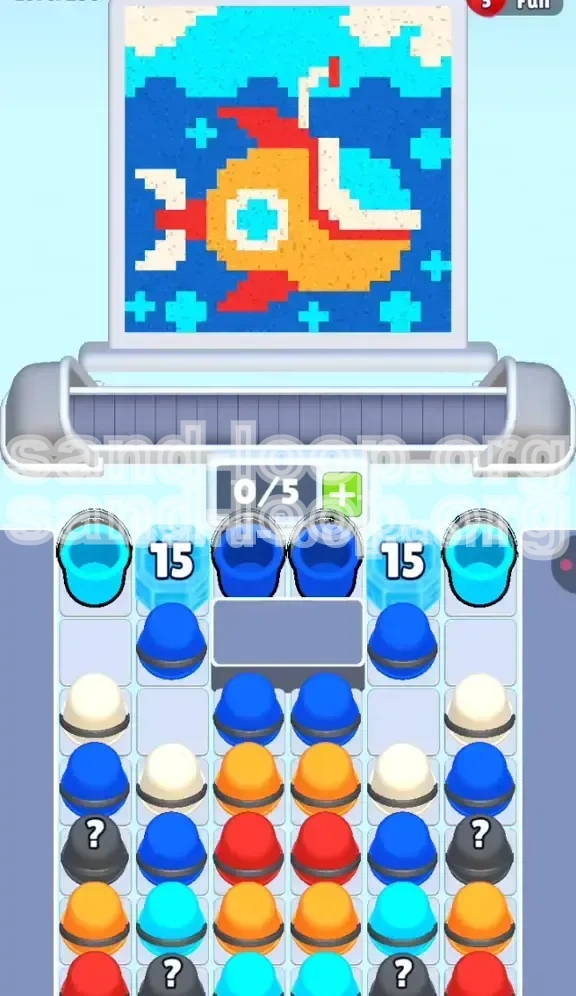
Welcome to the deep end of the pool. Level 298 in Sand Loop, titled "The Yellow Submarine," is a classic example of an "Ice Gate" bottleneck stage. This level is not about testing your artistic flair; it is a strict test of resource management and queue control. You are presented with a charming pixel-art depiction of a submarine, but the game board underneath is rigged to force you into a specific, tight opening sequence. If you mismanage your colors early, you will face a deadlock before the ice even melts. This guide will take you through every pixel, every pour, and every strategy you need to secure that three-star victory.
The "Ice Gate" Mechanic Explained
The defining feature of this level is the pair of Ice Blocks labeled "15" located on the far left and right columns of the second row. These act as hard barriers. Unlike standard breakable blocks in match-3 games, these do not break by adjacency; they require a "pixel tax." You must successfully fill 15 pixels on your canvas using the *available* cups before these blocks will shatter. This means for the first 20% of the level, you are restricted to a maximum of 3 usable columns in the center of the tray. If you run out of moves in these center columns before the counter hits 15, you lose.
Visual Analysis & Color Distribution
Understanding the canvas is crucial for prioritization. The image is split into three distinct zones:
- The Deep Ocean (40%): This is the largest area. It acts as your "dumping ground" for excess sand early in the level.
- The Submarine Hull (35%): A massive, solid block of Orange. This is your secondary reliable target.
- The Accents (25%): This includes Cyan bubbles (+ shapes), Red fins, and White clouds. These are small, isolated targets that are dangerous to fill early.
Primary Objectives
To beat Level 298, you must adhere to a strict set of goals rather than just "filling the picture."
- Break the Ice: Your first and only priority for the first 30 seconds is reducing the "15" counters to zero.
- Manage the Queue: You must keep the central conveyor belt moving without clogging the nozzle.
- Preserve Small Colors: Do not waste Red or White sand early on; you need those cups for the final precision cleanup.
Phase 1: The Ice Gate Strategy
This phase is the most dangerous part of the level. The game restricts your access to the side columns, creating a funnel. Panic tapping here will result in a clogged belt and a "Game Over." We need a calculated approach to melt that ice efficiently.
Step 1: The Dark Blue Flood
Start the level by immediately identifying the Dark Blue cups. In 90% of starting layouts for this level, Dark Blue is available in the center two columns.
Action: Tap the Dark Blue cups immediately. Do not wait.
Why: Dark Blue covers the background. Because it covers 40% of the canvas, it is the most forgiving color. You cannot miss. Every grain of sand that hits the canvas counts toward the "15" pixel debt. Using Dark Blue is the fastest way to chip away at the Ice Blocks without risking a precision error.
Step 2: The Orange Interchange
Once the initial Dark Blue cups are activated, look at the center stack again. You will likely see Orange cups rising to the top.
Action: Alternate between Dark Blue and Orange.
The Rhythm: While the Dark Blue is pouring (which takes a while), queue up an Orange cup. The submarine's hull is a giant rectangular block. It accepts sand very quickly. By alternating these two "big" colors, you ensure a constant stream of successful pixels, driving the Ice Block counter down rapidly.
Step 3: Avoiding the "Precision Trap"
You might see Red or Cyan cups in the accessible center columns during Phase 1.
Action: Ignore them if possible. If you must use them to keep the belt moving, only tap them if the corresponding target on the canvas is already partially filled or very large.
Warning: Attempting to hit the tiny Red propeller or the small Cyan cross-bubbles while the belt is moving fast is a bad idea. A miss costs you time and does not count toward the ice breaking. Stick to the bulk fills (Blue/Orange) to guarantee safety.
Step 4: Monitoring the Counter
Keep one eye on the "15" counter etched into the ice blocks.
Action: If your counter is at 13 or 14, stop tapping new cups immediately.
Reasoning: You want the ice to break *between* pours, not while you are flooding the belt. If you have 5 cups queued and the ice breaks, the sudden expansion of the board might shift the timing, causing a cascade of unwanted colors to hit the nozzle at once. Clear your queue before the final shatter.
Phase 2: Post-Ice Management
Once the "15" counters hit zero, the blocks shatter. The board physically expands, and the side columns shoot up, revealing new colors and the dreaded Mystery Cups. This is where many players lose their progress.
Dealing with the Board Expansion
When the ice breaks, the layout changes. Cups that were buried at the bottom are now active.
Action: Pause for a split second. Look at the newly revealed cups in the left and right columns.
Tip: Do not reflexively tap the new cups. Your previous queue (from Phase 1) is still moving. If you tap 3 new cups immediately, you will have 6 cups in a 5-slot queue, causing an automatic clog or forcing a waste.
The Mystery Cup (?) Protocol
The sides usually contain Gray cups with question marks. In Level 298, these are almost exclusively White (Clouds) or Cyan (Sky/Bubbles).
Action: Treat these as "Wild Cards." Tap ONE mystery cup. Wait for it to reach the nozzle and reveal its color.
- If it's White: Let it pour. The clouds are large and forgiving.
- If it's Cyan: Be careful. Cyan is for the bubbles. You might want to save this for later if you have other moves.
- If it's a duplicate (e.g., more Dark Blue when the ocean is done): This is wasted space. Use the trash can icon if you have it, or let it pour into a finished area (waste) to clear the slot.
Preventing Queue Clogs
With the board open, it is tempting to tap everything in sight. Resist this.
The 3-Slot Rule: Always try to keep at least 2 slots in your conveyor belt empty. This gives you the flexibility to maneuver cups and prevents a "lock" where you need a specific color (like Red for the last fin) but it's stuck behind three useless Mystery Cups.
Phase 3: Precision Cleanup
The ocean is filled. The submarine is painted. Now you are in the "Endgame." This phase requires patience and precision, not speed. The margin for error is now zero.
Mastering the "Burst Pour"
The most difficult part of Level 298 is the Cyan bubbles. These are "+ shaped" pixels floating in the water. They are surrounded by Dark Blue.
The Mistake: Holding down the pour. If you pour Cyan continuously, the stream will touch the Dark Blue water between the bubbles. The game sees this as "wrong color" and cuts your flow, wasting the cup.
The Solution (Burst Pouring):
- Tap the Cyan cup to start the flow.
- The moment the stream hits the first bubble, watch the fill meter.
- As soon as the bubble is full, tap the cup again or swipe it away to stop the flow.
- Wait for the nozzle to align with the next bubble.
- Repeat.
Handling the Red Fins
The Red fins and propeller are small targets.
Action: Do not queue Red cups until you are ready to watch them. If you send a Red cup while you are looking at Mystery Cups, the nozzle might spray Red sand onto the Orange hull. This creates "pollution" which requires extra sand to fix, wasting your precious resources.
Filling the Clouds (White)
The White clouds are at the very top of the image.
Action: These should be your second-to-last fill. Because they are at the top, the sand stream has to travel the farthest. Ensure your queue is empty before sending the White cups. You don't want a stream of White sand to be interrupted by a sudden Red cup popping into the nozzle mid-pour.
Advanced Speed Run & Tips
For players looking to achieve the maximum time bonus or simply master the level, here are the pro strategies.
The "Pre-Load" Technique
Advanced players know the layout before the level starts.
Tip: As soon as the level loads, memorize where the first Orange cup is. If it is in the center, tap Dark Blue immediately. If it is buried, tap the center Dark Blue, then be ready to swipe the tray to bring the Orange up faster. Minimizing the time between pours is the key to a speed run.
Trash Management
You have a limited number of Trash Can uses (if unlocked or via power-ups).
Strategy: Do not use trash on Dark Blue or Orange in Phase 1. Save your Trash power-ups for Phase 3. If you get a Mystery Cup that turns out to be a color you don't need (like a 5th Dark Blue cup when the ocean is full), Trash it immediately. Keeping the belt clean is more valuable than the sand itself.
Common Mistakes to Avoid
Most failures in Level 298 come from three specific errors. Avoid these, and your win rate will skyrocket.
- Over-tapping Cyan: Trying to fill the bubbles with a continuous stream. Always use the burst method.
- Ignoring the Queue: Tapping 5 cups instantly after the ice breaks. This creates a traffic jam that takes 20 seconds to undo.
- Early Precision: Trying to fill the Red propeller before the Ice is broken. It's too risky. Stick to the big blocks (Orange/Blue) until the board opens up.
What to Do If You're Stuck
Sometimes the RNG (Random Number Generation) gives you a bad cup order.
Solution: If you are stuck with no legal moves (e.g., you have a Red cup ready, but the Red area is full and blocked), you must look for the smallest available area of any color on the board. Even if it's a single pixel of Dark Blue, you must fill it to clear the cup and advance the belt. If absolutely no moves are possible, use a Shuffle (if available) or restart the level—sometimes the layout is mathematically impossible due to bad RNG.
By following this structured approach—breaking the ice first, managing the queue second, and polishing with precision last—Level 298 becomes a manageable logic puzzle rather than a chaotic sandbox. Good luck, captain!