
Level 321
HARDHow to solve Sand Loop level 321? Get instant solution for Sand Loop 321 with our step by step solution & video walkthrough. Sand Loop 321 tips and guide.
Play Sand Loop Now
Experience the puzzle challenge firsthand
Game Screenshots
Sand Loop Level Guides
Level Overview: The Desert Cactus Challenge
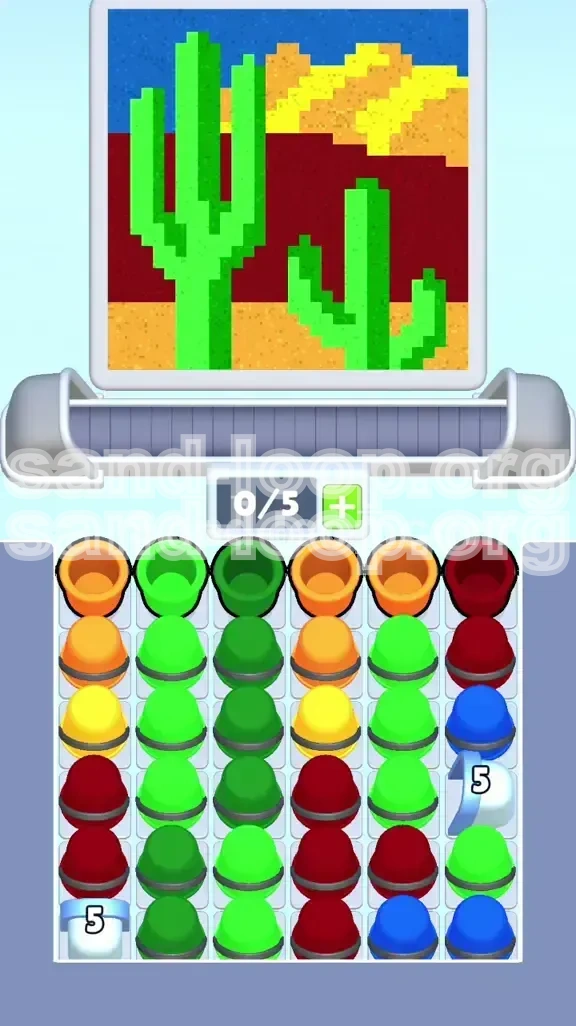
Welcome to Level 321, a stage that tests your ability to manage vertical layering within a confined space. Unlike standard levels where you can simply pour colors from left to right, this "Sand Loop" stage presents a classic landscape puzzle: a desert sunset featuring two towering cacti, distant mesas, and a vibrant sky.
The primary difficulty here lies in the strict order of operations. The background elements (sky and mountains) sit behind the foreground elements (cacti and sand). If you paint the bright green cactus tips before the background sky is fully rendered, you risk "bleeding" colors together, which results in a failed level. Furthermore, the level introduces a logistical nightmare in the form of Ice Blocks trapping essential Blue cups in the bottom corners.
The Visual Composition
Before you tap a single cup, analyze the target image. It is divided into three horizontal strips:
- Top Strip (Sky & Sun): The upper 30% of the canvas. This requires Blue and Yellow cups.
- Middle Strip (Mesas): A horizontal band of Maroon/Dark Red acting as a backdrop for the cactus bases.
- Bottom Strip (Sand & Cacti): The largest area, dominated by Orange (sand) and two shades of Green (Bright and Dark).
The Conveyor Belt Limitation
You are strictly limited to a 5-slot capacity on your conveyor belt. This is your most critical resource. Filling these slots with the wrong colors at the wrong time will cause a deadlock, forcing you to waste precious seconds shuffling cups back into the tray or, worse, forcing a game over.
The Ice Block Obstacle
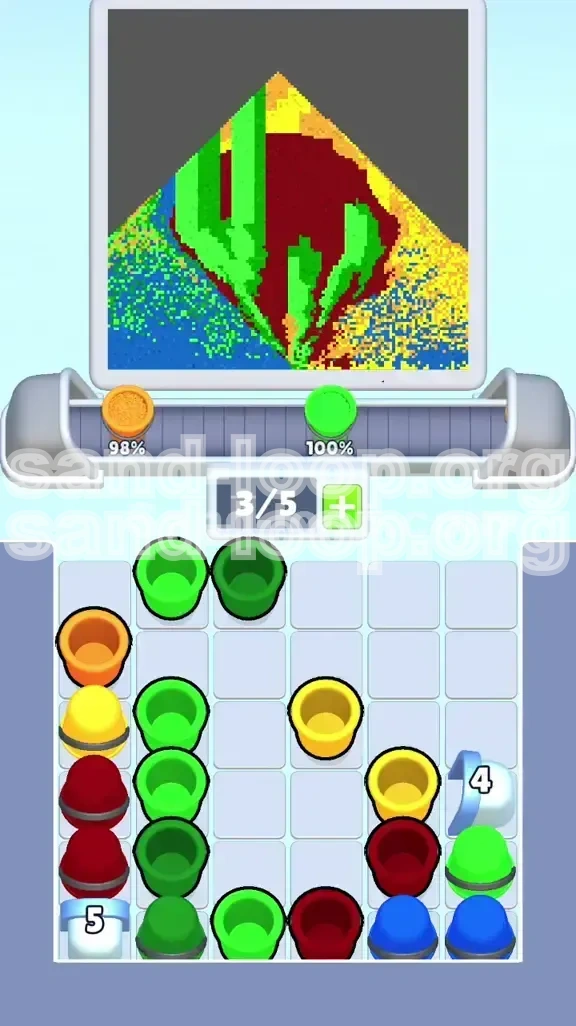
Scattered in the bottom-left and bottom-right corners are Ice Blocks marked with a '5'. These act as hard locks on specific color supplies. The Bottom-Right block is particularly dangerous as it seals away the Blue cups required for the sky. You cannot break these immediately; you must clear the columns above them first.
Why Logic Beats Speed
While the timer is ticking, this level is not about tapping speed. It is about "Cadence." If you rush and tap the Green cups too early, you will paint the foreground before the background is ready, leading to pixelated errors. You must suppress the urge to clear the screen quickly and focus on the rhythm of the pour.
Winning Condition
To achieve three stars, you must complete the painting with zero smudges. This means that every background pixel must be filled before any foreground pixel overlaps it. Efficiency comes from keeping your conveyor belt flowing with exactly the color you need for the next 3 seconds, not the next 30 seconds.
Clear Objectives: Your Mission Checklist
Your goal is to render a multi-layered desert landscape by managing a chaotic color tray. The objectives evolve as the canvas scrolls upward. Here is what you need to achieve to conquer Level 321.
Unlock the Blue Supply
The most urgent objective is not to paint, but to clear the path to the Blue cups. The sky constitutes the top 30% of the level. If you reach the top of the canvas and the Blue cups are still trapped under the Right-Side Ice Block, you will fail. Your primary early-game objective is to clear the right-hand columns to shatter that ice.
Master the "Weave" Technique
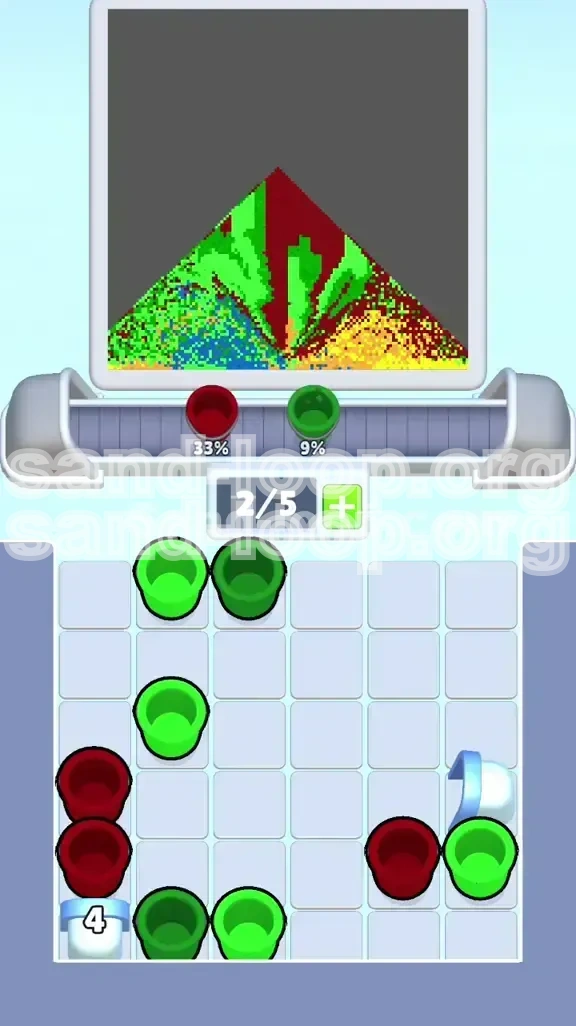
You are dealing with vertical objects (cacti) and horizontal environments (mesas/sky). You must learn to "weave" your pours. You cannot finish the cactus in one go. You must pour the background Maroon, then immediately switch to Green for the cactus, then back to Maroon. Doing this smoothly is your main gameplay objective.
Maintain Slot Fluidity
Keep your 5-slot belt dynamic. Never let it sit full. If you have 5 slots filled and the next required color is buried at the bottom of the stack, you are stuck. A key objective is to always have at least one empty slot (or a "trash" slot you can quickly discard) to keep the cups moving from the tray to the canvas.
Prevent Color Bleeding
Ensure that the Blue sky is 100% finished before you paint the upper tips of the cactus. Similarly, ensure the Maroon mesa is finished before the main body of the cactus rises above it. Any overlap results in a messy edge and a lost star rating.
Efficient Tray Management
The tray is a minefield of wrong choices. Your objective is to ignore the 40% of cups that are "distractors." If the current canvas section is Orange sand, ignore the Green cups sitting right next to it. Discipline in selection is the difference between a smooth run and a stressful panic.
Step-by-Step Instructions: The Complete Walkthrough
Follow this exact sequence to navigate Level 321 without error. This guide assumes a standard playthrough with average speed upgrades.
Phase 1: The Foundation (Bottom of Canvas)
Action: As the level begins, the canvas is positioned at the bottom, displaying the sandy dunes.
Step 1: Immediately scan the top-left and top-right of the tray. You are looking for Orange cups.
Step 2: Tap the Orange cups to fill the sand layer at the very bottom. Do not overfill; stop as soon as the sand base is established.
Step 3: Locate Bright Green cups. The main body of the large cactus starts immediately above the sand. Load 2-3 Green cups.
Step 4: Pour the Green to build the trunk of the main cactus. Stop pouring before the trunk hits the "mid-ground" line where the mountains start.
Phase 2: Breaking the Right Ice Block
Action: While you are painting the initial sand and cactus base, keep an eye on the right side of the tray.
Step 1: Identify the rightmost column of the tray. It likely contains a mix of Green and Orange cups above the Ice Block.
Step 2: Prioritize tapping the cups in this specific right-hand column. Your goal is to clear the vertical stack above the Ice Block.
Step 3: Once the column is clear, the Ice Block logic triggers. The block will shatter, revealing the Blue cups hidden underneath.
Step 4: Crucial: Do not load the Blue cups yet! They are for the end of the level. Just let them sit in the tray so you know they are available.
Phase 3: The Mesa Layer (The Middle Ground)
Action: The canvas will scroll up to reveal the horizontal strip of Dark Red (Maroon) mesas.
Step 1: Quickly scan for Dark Red (Maroon) cups. These are usually clustered in the middle-left of the tray.
Step 2: Fill your belt with Dark Red. Pour this to create the mountain range background. Ensure you fill behind where the cactus arms will be.
Step 3: The Cactus Interruption. As you pour Red, the canvas will demand Green for the arms of the cactus.
Step 4: The Weave: Tap Red (pour background) -> immediately tap Green (pour arm) -> immediately tap Red (finish background). Do not wait until the background is fully done to grab the green, or you'll miss the window.
Phase 4: The Sky and Sun (The Final Stretch)
Action: The canvas reaches the top 20%. The sky is Blue, and the sun is Yellow.
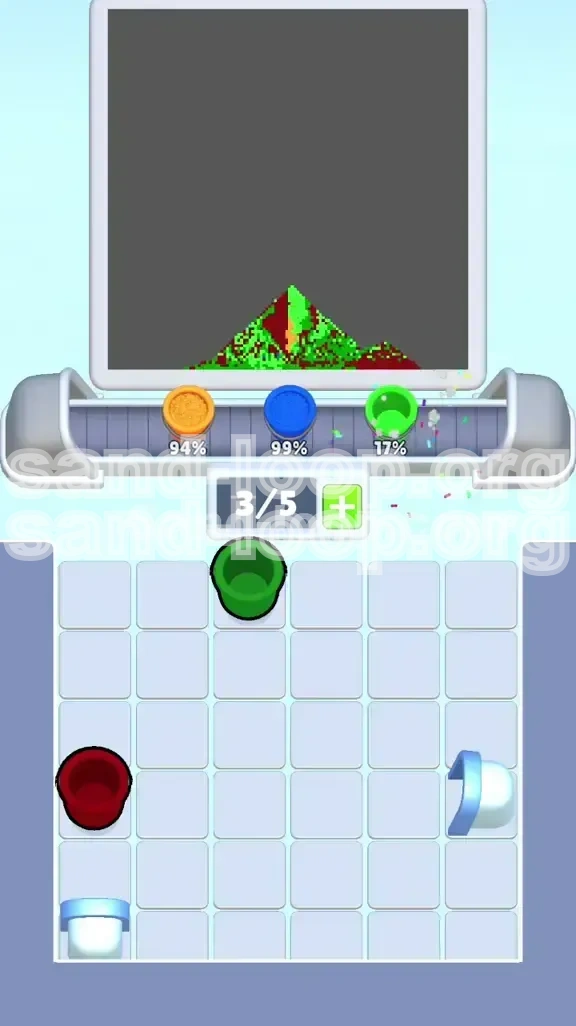
Step 1: Now you retrieve the Blue cups you uncovered in Phase 2. Fill your belt entirely with Blue if possible.
Step 2: Pour the Blue sky. You must be aggressive here. The sky is the background for the top tips of the cactus.
Step 3: Locate Yellow cups for the sun. These are often found in the top-right corner. Pour Yellow to complete the sun rays.
Step 4: Final Polish. Look for Dark Green cups. The tips of the cactus arms usually require this darker shade for shading. Pour these last touches to complete the pixel art.
Phase 5: Clearing the Remnants
Action: The painting is done, but cups may remain.
Step 1: Check the tray for any remaining Green or Dark Green cups. If the cactus tips aren't fully colored, tap these now.
Step 2: If you have leftover cups that don't match the remaining unpainted pixels (if any), simply shuffle them off the belt to make space.
Step 3: Final verification: Ensure no white pixels remain in the sky or behind the cactus arms. Level Complete.
Color Order: Processing the Palette
Success in Level 321 depends on processing colors in a specific sequence based on the canvas layers. Do not treat this as a free-for-all.
1. Primary: Orange (Sand)
Priority Level: Highest (Start).
Reasoning: The canvas starts at the bottom. The sand dunes are the foundation. You must clear the Orange cups first to open up the tray for the Green cactus colors. Ignoring Orange to chase Green early will clog your belt.
2. Secondary: Bright Green (Cactus Trunk)
Priority Level: High.
Reasoning: The main cactus trunk is a vertical pillar that cuts through the bottom half of the image. You need to establish this early, but pause before it hits the mid-section.
3. Tertiary: Dark Red / Maroon (Mesa)
Priority Level: Medium.
Reasoning: This is a horizontal layer. It acts as the backdrop for the middle of the screen. You must process this *before* the cactus arms fully extend, or you will paint over the background.
4. Quaternary: Dark Green (Shading)
Priority Level: Medium.
Reasoning: This color is used for the sides of the cactus arms and the tips. It is usually interspersed with the Bright Green. Treat it as the same category as Green but use it specifically for the detailed edges.
5. Quinary: Blue (Sky)
Priority Level: Late Game.
Reasoning: The sky is at the very top of the image. If you process Blue too early, it takes up a slot on your belt for 80% of the level. Only load Blue when the canvas is physically scrolling to the top section.
6. Final: Yellow (Sun)
Priority Level: Lowest (End).
Reasoning: The sun is a small, distinct feature usually located in the corner. It is the final splash of color. Save this for the very last seconds to maximize your belt efficiency for the larger areas like the sky and cactus.
Key Tips: Mastering the Mechanics
These tips are designed to help you manage the unique constraints of Level 321, specifically the Ice Blocks and Slot Management.
The "Top-Down" Tray Strategy
When you are frantically looking for a color, focus your eyes on the top row of the supply tray. Cups in the top row can be tapped instantly. Cups at the bottom require you to clear the ones above them. If you need Red and it's at the bottom, don't tap the Green cup on top of it unless you plan to use that Green immediately.
Pre-Loading for the Ice Break
As you approach the moment where the Right-Side Ice Block breaks, try to have an empty slot on your belt. When the block breaks, new Blue cups flood the tray. If your belt is full (5/5), you cannot pick up these Blues, and they might get shuffled or buried by falling cups from higher rows. Keep a slot open!
Recognizing the "Cactus Arm" Pattern
The cactus arms are the hardest part. They stick out into the red background. The game will show you the outline of the arm before you need to fill it. Anticipate this. If you see a green outline appear over the red mesa area, immediately drop your current Red cup and grab a Green one. This split-second reaction saves your painting.
Use of the "Trash" Slot
Sometimes you are forced to pick up a cup you don't need (e.g., to uncover a cup underneath). If you have 4 slots filled with useful colors and need to pick up a "Trash" cup to clear a column, do it. Pour that trash cup into a blank space or a completed area immediately to free the slot back up. Never hold onto a trash cup.
The 50% Rule
Keep a mental timer. When you are roughly 50% up the canvas (the end of the Red Mesa layer), stop worrying about Orange and Yellow. You are in the "Green and Red Zone." Discard any remaining Orange or Yellow cups from your belt to make room for the incoming Blue and Dark Green rush.
Visualizing the Layers
Think of the painting as three separate glass sheets stacked on top of each other. 1. Back Sheet: Sky (Blue) & Sun (Yellow). 2. Middle Sheet: Mesas (Dark Red). 3. Front Sheet: Cacti (Green) & Sand (Orange). You must paint the back sheets first. If you paint the front sheet (Green) first, you can't slide the back sheets behind it!
Common Mistakes: What to Avoid
Players often fail Level 321 due to impatience or misunderstanding the layering system. Learn from these common errors.
Mistake 1: Painting the Cactus Too Early
This is the #1 cause of failure. Players see the Green cups and immediately fill the entire cactus from bottom to top. Why it fails: The middle of the cactus overlaps with the Mesa (Dark Red). If you fill the middle cactus section first, you can't paint the Mesa behind it. You must paint the Mesa first, then the middle section of the cactus.
Mistake 2: Ignoring the Ice Block Until the End
Players get caught up painting the bottom half and forget to clear the right-hand column. Why it fails: You reach the top of the level, the sky is ready to be painted, and the Blue cups are still trapped under ice. You spend 30 seconds panic-clicking, but it's too late. The level ends before you can break the ice.
Mistake 3: The "Full Belt" Deadlock
Filling all 5 slots with the first color you see (usually Orange). Why it fails: You have 5 Orange cups, but the canvas now needs Green. You have to dump the Oranges one by one to get to the Greens. This wastes massive amounts of time. Keep your belt diverse (2 Orange, 2 Green, 1 Empty).
Mistake 4: Smudging the Sky
Starting the Blue sky section while the tips of the cactus are still unpainted. Why it fails: If you paint the Blue sky, and then realize the top pixel of the cactus is missing, you have to "paint over" the sky with Green. This leaves a ugly blue halo around the green pixel, failing the "Crisp Edge" requirement.
Mistake 5: Misidentifying Dark Green vs Bright Green
Using Bright Green for the shaded side of the cactus. Why it fails: The game is picky about pixel art logic. It requires specific shades for shading. Using Bright Green where Dark Green is needed counts as an error. Pay close attention to the specific shade of the outline on the canvas.
Stuck Solutions: Troubleshooting
Did the canvas stop moving? Are you out of moves? Use these solutions to get unstuck.
Solution: "I have no Blue cups!"
Diagnosis: You are at the top of the level, but the tray is empty of Blue. Fix: Look at the bottom-right corner. Is the Ice Block still there? If yes, look at the column directly above it. You need to clear whatever cups are in that column (even if you don't need them) to trigger the ice breaking. Tap those upper cups, clear the column, and the Blue will appear.
Solution: "My belt is full of junk!"
Diagnosis: You have 5 cups of colors you don't need (e.g., all Orange when you need Green). Fix: Find a safe spot on the canvas that is already correctly painted or is a single color. Pour your "junk" cups there to dispose of them. Do not wait for them to disappear; they won't. You must actively dump them.
Solution: "I can't reach the Red cups!"
Diagnosis: The Maroon cups are buried under a stack of Green or Yellow. Fix: You have to "burn" moves. Use the cups on top (the Green/Yellow ones) on the canvas, even if you have to over-paint a slightly finished area, just to clear the stack and reach the Red underneath. It is better to waste 2 seconds over-painting than to get stuck for 20 seconds.
Solution: "The cactus arm disappeared!"
Diagnosis: You painted the arm, but now it's gone or the wrong color. Fix: You likely painted the Background (Red) over the Foreground (Green arm). You cannot fix this by painting over it. You must restart the level, but this time, ensure you stop painting the Red background the instant the cactus arm outline appears. Switch to Green immediately.
Solution: "The game is too fast!"
Diagnosis: The canvas scrolls up before you can finish the bottom section. Fix: You are being too precise with the bottom sand. You don't need to fill every single pixel of the sand perfectly. Focus on the main blocks. The game allows some margin for error. Prioritize getting the Cactus and Sky sections perfect, as those are the visual focal points.
Speed Run Tips: Optimizing Your Time
Want to finish Level 321 in under 60 seconds? Use these advanced shortcuts.
Pre-Game Calculation
During the 3-second countdown before the level starts, locate the Ice Blocks. Immediately identify the two columns above the blocks. Your brain should already be planning to clear those specific columns first, regardless of what color is at the very bottom of the screen.
The "Tap-Click" Rhythm
Develop a rhythm for the "Weave" section (Red/Green switching). Don't look at the cup you are currently holding. Look at the next cup you need. As you are pouring Red, your eyes should be scanning the tray for the Green cup. By the time the Red cup is empty, your finger should already be hovering over the Green cup.
Batch Processing
Don't switch colors one cup at a time. If you have a large area of Blue sky, load 3 Blue cups at once. Pour them back-to-back. This avoids the travel time of going back and forth to the tray between every single pour. Only switch when the canvas demands a different color.
Ignore the Small Details
The pixel art has tiny details (like a 1-pixel highlight on the cactus). In a speed run, ignore these until the very end. If you finish the main body of the cactus and the sky, come back at the last 10 seconds to place the 1-pixel details. Don't let them break your flow during the main painting phase.
Break Ice with Purpose
Don't just clear the column above the Ice Block randomly. Try to sync it with your painting needs. If you need to clear the right column to break ice, but that column has Green cups, wait until you actually need to paint the cactus. This way, you are breaking the ice and progressing the painting simultaneously, doubling your efficiency.