
Level 342
HARDHow to solve Sand Loop level 342? Get instant solution for Sand Loop 342 with our step by step solution & video walkthrough. Sand Loop 342 tips and guide.
Play Sand Loop Now
Experience the puzzle challenge firsthand
Game Screenshots
Sand Loop Level Guides
Level Overview: The Resource Management Puzzle
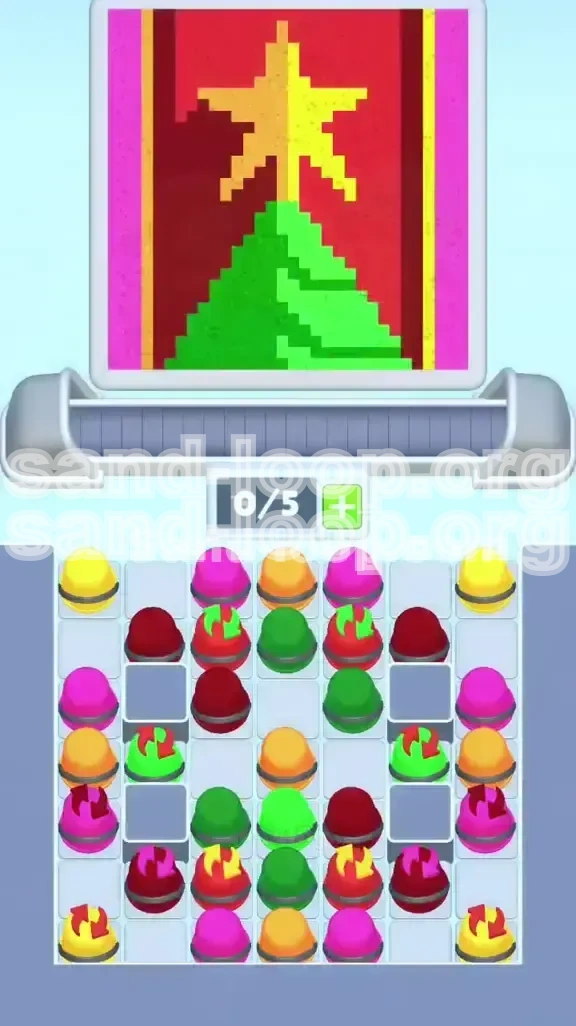
Welcome to the ultimate breakdown of Level 342, a stage that masquerades as a simple festive painting but operates purely on complex resource logic. In this level, you are tasked with recreating a pixel-perfect Christmas scene: a vibrant neon tree, a stark red background, a guiding yellow star, and framing pink borders. However, unlike standard stages where resources are plentiful, Level 342 is a "Scarcity & Transformation" challenge. You begin with a distinct deficit of the primary background color (Red) and must rely on a specific mechanic—recycling Green cups—to generate the supply needed to finish the level. This guide will dissect the flow of resources, ensuring you never hit a deadlock.
The Canvas Layout
The level is divided into four distinct color zones that must be filled in a specific order to prevent contamination. The central feature is the Neon Green Tree, which occupies roughly 30% of the canvas. Surrounding this is the Deep Red Background, the largest area at approximately 50% coverage. On the periphery, you have Pink Borders (vertical columns on the far left and right) and Yellow Stripes (thin vertical lines separating the borders from the center). The layout suggests a layering order: background first, then details, but the resource logic dictates the exact opposite approach.
The Core Mechanic: Arrow Recycling
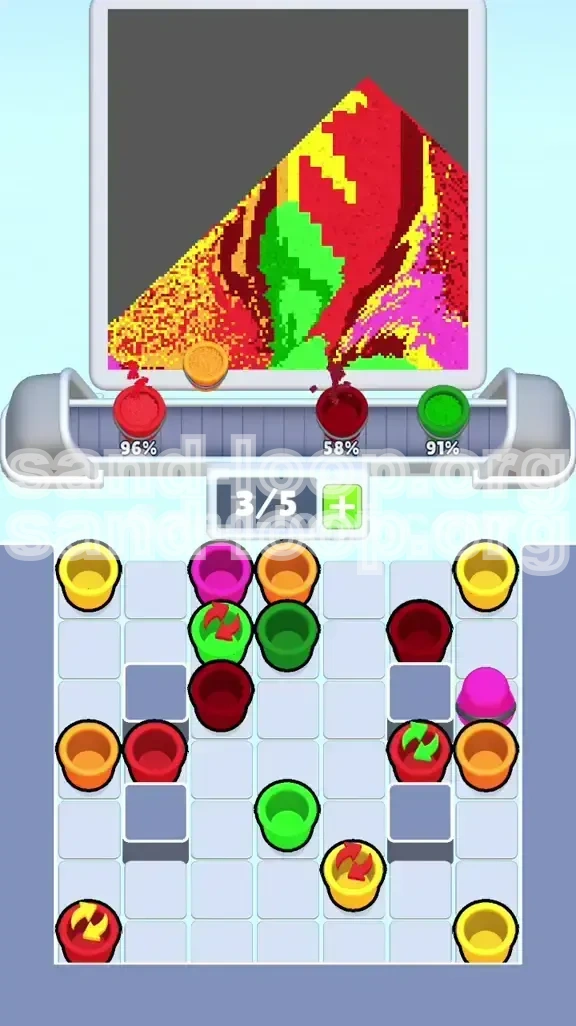
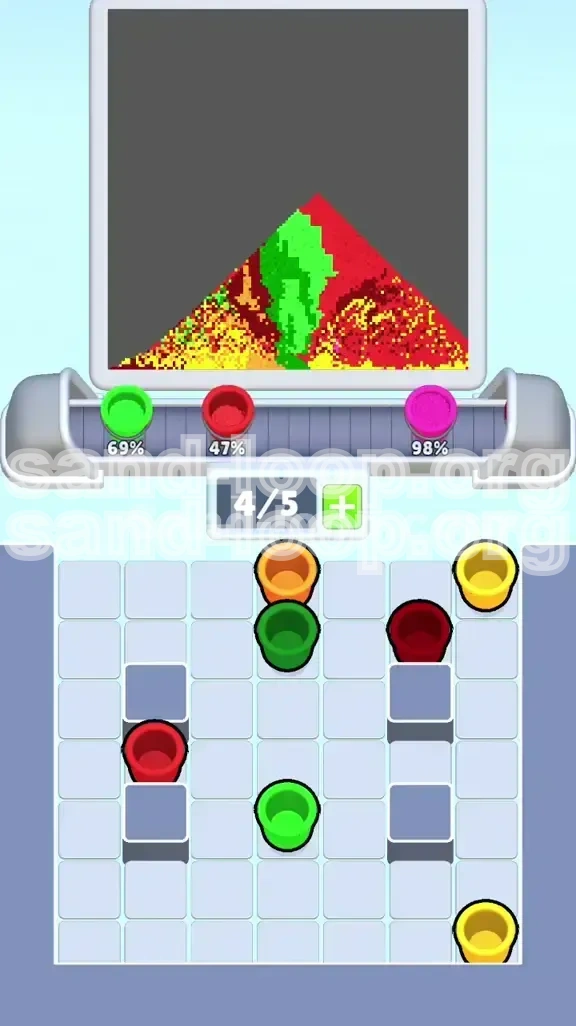
This level introduces the Recycling Cup mechanic, visually identified by circular arrows stamped on the glass. In standard levels, using a cup removes it from your inventory. In Level 342, using specific cups—particularly the Green ones—triggers a transformation event. When you empty a Green Arrow Cup, it does not vanish; instead, it cycles back into your supply tray as a Red Cup. This is the key to the level. You do not start with enough Red sand to fill the background; you must manufacture it by "spending" your Green inventory on the tree first.
The Resource Scarcity Problem
At the start of the game, inspect your tray. You will notice a massive pile of Green cups, a moderate amount of Pink and Yellow, and a critically low number of Red cups—likely less than 10% of your total inventory. If you attempt to paint the background immediately upon spawning, you will run out of Red sand in seconds, leaving you with a half-finished canvas and no way to generate more Red because you haven't processed the Green cups yet. Understanding this supply chain is the difference between failure and success.
Visual Interference Risks
The greatest challenge in Level 342 is preventing "color bleeding." The Yellow Stripes are thin (only 1-2 pixels wide) and sit directly between the large Pink borders and the massive Red background. If you flood the background with Red before establishing the Yellow lines, the Red physics engine will naturally bleed into the Yellow zones, turning them orange or obliterating them completely. Similarly, the Yellow Star at the top of the tree is vulnerable to being swallowed if the Red background is filled before the Star is secured.
Clear Objectives and Strategic Goals
To conquer Level 342, you must abandon the instinct to fill the largest area first. Your primary objective is to manage the conversion rate of colors. You are not just painting; you are refining your inventory. Every action you take should serve the dual purpose of filling the canvas and setting up your next color supply. Below are the specific goals you need to achieve to secure the win.
Objective 1: Clear the Static Inventory
Your first goal is to clear the "Dead Weight" from your tray. The Pink cups are generally static; they don't transform into other colors. By prioritizing the Pink borders early, you clear space on your conveyor belt (which has a limit of 5 slots) and remove clutter that could otherwise block the arrival of crucial Green or transforming cups. You want the Pink borders done first to define the "safe zones" of the canvas, ensuring you never accidentally splash Green tree sand onto the edges.
Objective 2: Initiate the Green-to-Red Chain Reaction
This is the most critical objective. You must aggressively use the Green Arrow Cups to paint the tree. This serves two purposes: obviously, it completes the central art object, but more importantly, it acts as a factory. Every Green cup you consume will eventually return to the tray as a Red cup. You need to cycle through approximately 80-90% of your Green inventory to generate enough Red supply to finish the background. Do not hoard Green; spend it.
Objective 3: Secure the Yellow Details
You must establish the Yellow Stripes and the Star before the "Great Red Flood." Yellow is a fragile color in this level's physics engine. Because the Yellow areas are thin lines and small shapes, they are easily overwritten by the heavier liquid physics of the Red background. Your objective is to form these yellow barriers so that when you eventually unleash the Red sand, it hits a "wall" at the yellow lines rather than bleeding over them.
Objective 4: Execute the Background Fill
The final objective is a cleanup operation. Once the tree is green, the borders are pink, and the lines are yellow, your tray should be almost exclusively composed of the recycled Red cups. At this point, the level shifts from a logic puzzle to a relaxing filling game. You simply need to pour the Red sand into the remaining empty spaces without splashing over your hard-earned details.
Step-by-Step Walkthrough Instructions
This section provides the exact sequence of moves required to beat the level. Follow these steps in order. Do not skip ahead, and do not try to combine steps prematurely. The margin for error is slim, so patience is your best tool.
Phase 1: The Pink Setup (Opening Moves)
As soon as the level starts, ignore the tree and the background. Look immediately to the left and right sides of your cup tray. Identify the Pink Cups.
- Step 1.1: Tap and drag the Pink cups to the far left and right columns of the canvas. Fill these vertical columns completely.
- Step 1.2: Do not worry about being neat inside the lines, but ensure no Pink touches the inner Red zone.
- Step 1.3: As you clear these cups, watch your tray. Removing them allows the remaining cups to shift, bringing the Green Arrow Cups forward into accessible positions.
- Step 1.4: If you have non-arrow Pink cups, use them immediately. If you have Arrow-Pink cups (rare in this level), check if they are needed for recycling, but usually, Pink is safe to dump.
Phase 2: The Green Tree Engine (Mid-Game)
With the borders defined, shift your entire focus to the center. This is the "Engine Room" of the level.
- Step 2.1: Locate the clump of Green Arrow Cups. They are usually centralized in the tray.
- Step 2.2: Begin pouring the Green sand into the tree area. Start from the bottom of the tree and work your way up. This prevents the sand from piling unevenly at the top.
- Step 2.3: Watch the Recycle Bin/Tray closely. As you empty the Green cups, notice them popping back up as Red Cups. DO NOT USE THESE RED CUPS YET.
- Step 2.4: Continue pouring Green until the tree is 100% complete. Even if you see the background tempting you, resist the urge. You must force the Green-to-Red conversion to maximize your ammo.
Phase 3: Inserting the Yellow Linework
While you are processing the Green cups, you will encounter Yellow cups. You cannot ignore them, or you will clog your tray.
- Step 3.1: Periodically pause your Green pouring to address the Yellow Cups.
- Step 3.2: Pour the Yellow sand into the vertical stripes located between the Pink border and the empty Red background.
- Step 3.3: Pour the top-most Yellow cup into the Star shape at the very top of the tree. This acts as the anchor for your tree.
- Step 3.4: Resume Green pouring immediately. The rhythm should be: Green (Tree) -> Yellow (Stripe) -> Green (Tree).
Phase 4: The Red Flood (Endgame)
This is the payoff. Once the last Green cup is poured and the tree is solid, your tray should be a sea of Red.
- Step 4.1: Verify the tree and stripes are perfect. You cannot fix them once you start this step.
- Step 4.2: Take the converted Red Cups and begin filling the large background void.
- Step 4.3: Pour carefully along the edges of the Yellow stripes. The Red sand will try to push over. Use short, controlled taps to settle the sand rather than heavy pours.
- Step 4.4: Fill the top corners of the background last, ensuring the Yellow Star remains distinct and isn't buried by the background color.
The Correct Processing Order
Why does the order matter so much? In Sand Loop, physics and inventory management are intertwined. If you process the colors in the wrong order, you create a deadlock where you have the wrong paint for the remaining areas. The "Golden Rule" of Level 342 is: Process the Generator Color before the Dependent Color.
The Dependency Chain
Think of the colors as a linked list. Green is the parent of Red. Pink and Yellow are independent variables. If you consume Red before Green, you break the chain. The game gives you just enough Red to maybe fill 10% of the background. If you use that starter Red on the background, you have zero Red left. You still have the Green cups, but if you paint the Green tree now, you will generate Red cups that you have no use for (since the background is half-done and messy). The math only works if you generate the Red *before* you need to use it in bulk.
Contamination Prevention
Ordering prevents color mixing. Red is the heaviest, most aggressive liquid in this specific level's physics engine. Yellow is light. If you pour Yellow *after* Red, the Yellow sand sits on top of the Red, looking like a messy smear. It does not blend correctly; it looks like contamination. By painting Yellow first, you create a "dam" in the pixel grid. When you pour Red later, it hits the Yellow pixels and stops, creating a crisp, sharp line.
Inventory Flow Management
Your tray holds 5 slots. If you paint in the wrong order, your tray will jam with useless cups. Imagine you have 4 Pink cups and 1 Green cup. If you focus on Green, you use the 1 Green, it turns into Red. Now you have 4 Pink, 1 Red. You use the Red? No, you don't have enough. You have to clear the Pink first. Therefore, Pink must always be the first step to free up inventory slots for the heavy lifting of the Green cycle.
Visual Clarity Hierarchy
Painting in the correct order ensures the visual hierarchy of the image is respected. The "Foreground" (Tree, Star) must exist before the "Background" (Red Void). If you paint the background first, you lose your reference points for where the tree should go. By painting the Tree first, you essentially cut a hole in the canvas that the Red background simply fills in around. It is much easier to fill the negative space around an object than to paint an object perfectly on top of a wet background.
Key Tips and Strategic Notes
Mastery of Level 342 comes from attention to detail. These tips cover the small nuances that can save you from restarting.
Conveyor Belt Management
Always keep at least one slot empty on your conveyor belt (the bottom row). The game automatically feeds you new cups or recycled cups into this slot. If you have 5 cups sitting there and you use a Green Arrow Cup that transforms, the game might glitch or delay the return of the Red cup because there is no room for it. Keeping an empty slot ensures the "recycling" mechanic happens instantly and smoothly.
Recognizing Arrow Symbols
Don't just glance at the color; look at the icon. In some tricky variations of this level, not every Green cup has an arrow. Standard Green cups might vanish, while Arrow Green cups return. You must prioritize the Arrow Green Cups over the standard ones to ensure your Red supply is growing. If you have a choice between a plain Green cup and an Arrow Green cup, use the Arrow one first to trigger the generation mechanics.
The "Tap" vs "Drag" Technique
For the Yellow Stripes, do not drag the cup all the way down in one motion. This often leads to splashing. Instead, use the "Tap and Drop" method. Tap the stripe zone in small segments (top, middle, bottom). This allows the sand to settle pixel-perfectly into the narrow grid without overflowing into the adjacent Red or Pink zones. This is crucial for maintaining the sharpness of the image.
Predicting the Return Cycle
There is a slight delay (usually 1-2 seconds) between when you empty a cup and when it reappears in the tray as a new color. Use this time window. If you have just emptied the last Green cup and you are waiting for the Red cups to spawn, use that downtime to organize your remaining Yellow or Pink cups. Don't stare at the screen; keep the flow moving.
Common Mistakes to Avoid
90% of failed attempts on Level 342 are caused by one of these three errors. Learn them so you don't repeat them.
Mistake 1: The Premature Red Pour
This is the number one killer. You see a little bit of Red background showing at the start, and you instinctively want to fill it. Don't. If you use your starter Red cups, you will have zero Red when the tree is finished. You will be left staring at a Green tree in a white void, with a tray full of cups you can't use. You must be strong and leave the background empty until the very end.
Mistake 2: Ignoring the Top Star
Players often get so focused on the big Green tree that they forget the Yellow Star at the very top. Once the tree is done, they realize the Yellow cups are gone (used on stripes) or buried under the new Red cups. Always prioritize the Star early in the "Yellow Phase" (Step 3). If the Star isn't placed, you can't fill the background around it without messing up the tree's top.
Mistake 3: Overfilling the Pink Borders
The Pink borders act as a container for the rest of the image. If you accidentally splash Pink into the Red zone or the Yellow zone, it creates a permanent stain that cannot be covered by Red or Yellow (since Pink is often lighter or creates a muddy mix). Be precise with your Pink pouring and treat the border lines as strict walls that must not be crossed.
Mistake 4: Tray Deadlock
This happens when you have 5 cups in your tray, none of which are useful for the current step. For example, you have 5 Red cups, but you haven't finished the Green Tree yet. You are stuck. This happens if you didn't manage your recycling rhythm well. The only fix is to restart, as you cannot "delete" cups to make space.
Solutions for When You Are Stuck
Hit a wall? Here is the troubleshooting guide for specific scenarios you might encounter.
Scenario: "I ran out of Green and the tree isn't done."
This means you were likely using the wrong cups or made a mess. If you run out of Green completely, check the canvas. Did you accidentally pour Green into the background area? This is wasted Green. Unfortunately, there is no "Undo" button for wasted resources. If you are short on Green, you cannot finish the level because you can't generate the Red needed for the rest. Solution: Restart and be extra careful not to spill Green outside the tree zone.
Scenario: "The Red background looks muddy/orange near the lines."
This indicates that your Yellow and Red mixed. This usually happens if you filled the background first and then tried to add Yellow details, or if the Yellow line was too thin. Solution: You can try to overfill the Red to push the mix out, but usually, once mixed, it stays mixed. It is better to restart and ensure the Yellow lines are thick and solid before introducing the Red flood.
Scenario: "My tray is full of Red but I still have the Star to paint."
You processed the Green too fast and forgot the Star. You now have a tray of Red (Background color) but a canvas that still needs Yellow (Star color). You are in a "Color Lock." Solution: Look very closely at your tray. Is there a single Yellow cup buried at the bottom or behind a Red cup? If not, check the conveyor belt for incoming supplies. If absolutely no Yellow is available, the level is unbeatable from this state. Restart and remember: Yellow Star before the final Green push.
Scenario: "I can't fit the new cups in the tray."
Your conveyor is clogged. Solution: You must use a cup, any cup. Even if it's not the perfect color, you might need to use a Red cup on a small corner of the background just to free up a slot so the game can feed you the Green or Yellow cup you actually need. Prioritize clearing the jam over painting perfectly.
Speed Run and Pro Tips
Once you understand the logic, you can optimize your movements to finish this level in under 60 seconds.
Pre-Loading the Conveyor
As you are pouring the final bits of the Pink border, look ahead to the tray. Identify where the Green Arrow Cups are. Before you even finish the Pink, you can drag a Green cup to the "loading dock" (the active slot). This saves precious seconds. As soon as the Pink is done, you are already holding the Green, ready to strike.
Bulk Pouring Strategy
For the Green Tree, don't tap pixel-by-pixel. Once the outline is established, you can perform a "Bulk Pour." Drag the Green cup in a circular motion or a fast zigzag over the tree area. The physics engine is forgiving for the Green tree because it's a large, solid block. Save your precision for the Yellow stripes.
The "Reverse" Fill Trick
For the final Red background, start pouring from the center-out or from the bottom-up. Since the top contains the fragile Star, avoid pouring Red at the very top until the very last second. Fill the bottom half of the background first, then move to the sides, and finish with the top corners. This minimizes the risk of accidentally over-splashing the Star.
Congratulations! By following this guide, you have not only beaten Level 342 but also mastered the fundamental mechanics of Resource Transformation in Sand Loop. Apply this logic of "Generator First, Consumer Last" to other levels with Arrow Cups, and you will find yourself navigating the toughest puzzles with ease.