
Level 345
HARDHow to solve Sand Loop level 345? Get instant solution for Sand Loop 345 with our step by step solution & video walkthrough. Sand Loop 345 tips and guide.
Play Sand Loop Now
Experience the puzzle challenge firsthand
Game Screenshots
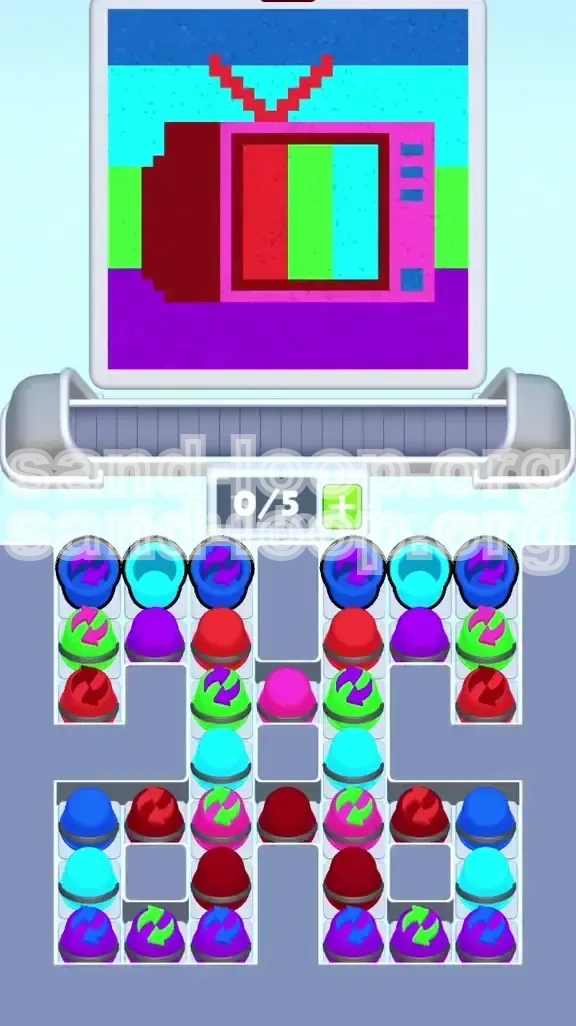
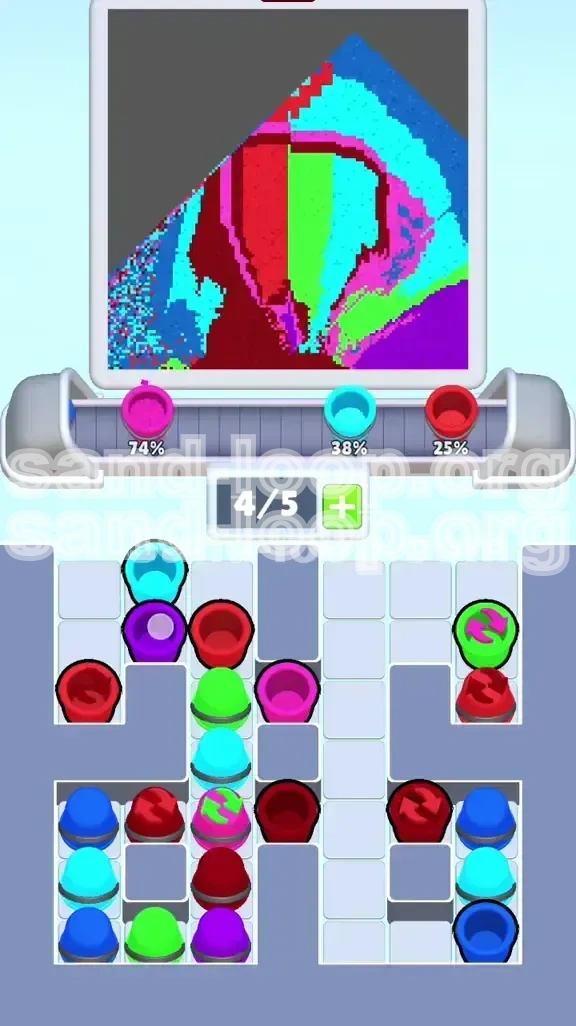
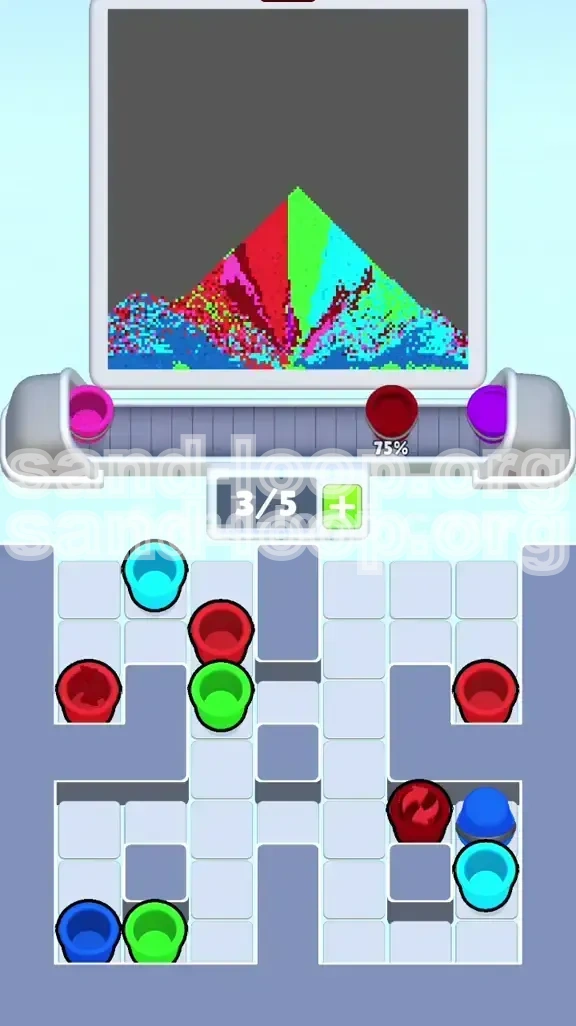
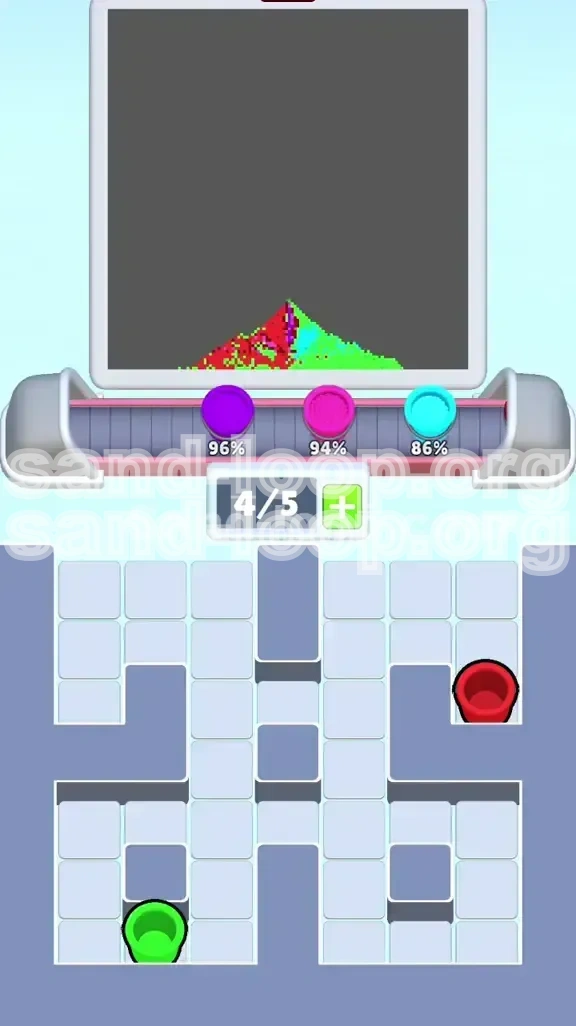
Sand Loop Level Guides
Comprehensive Level Overview: The Retro TV Challenge
Welcome to the nostalgic and pixel-perfect world of Sand Loop Level 345. This stage is a unique hybrid that blends high-speed reflexes with strict logic puzzles. Unlike standard levels where you can simply pour colors continuously, this level demands you pause and think. The visual theme is a tribute to the 1980s and 90s CRT technology, featuring a bulky television set sitting on a stand, complete with "bunny ear" antennas and classic SMPTE color test bars on the screen.
The CRT Aesthetic Challenge
The visual complexity of Level 345 lies in its use of high-contrast, neon-like colors against a dark background. The TV set itself is rendered in Hot Pink and Maroon, which stand out aggressively against the Cyan and Blue background. This high contrast means that even a single pixel of misplaced sand will look like a glaring error. The design is not just aesthetic; it is functional. The "screen" area requires vertical precision that is much tighter than the broad strokes used for the floor or the sky.
Hybrid Mechanics: Speed vs. Logic
This level is classified as a "Hybrid Stage." Approximately 60% of the level requires logic and planning (managing the Swap Cups and resource allocation), while the remaining 40% is pure execution speed. The "Speed" element comes into play during the background filling (Blue/Cyan) and the floor (Purple), where you can tap rapidly. However, the moment you touch the TV screen or the antennas, you must shift into a "Micro-Management" mode. Failing to switch mental gears here is the number one reason players fail this stage.
The Resource Scarcity Problem
A critical feature of this level is the artificial scarcity of specific colors. While the board may look colorful, usable "pure" cups of Dark Red, Green, and Pink are actually quite rare. The supply tray is cluttered with "Swap Cups" (indicated by green recycling arrows). This forces you to constantly convert cups rather than simply pouring what you see. If you waste your pure Pink cups on the floor or background, you will not have enough left to finish the TV casing, leading to a soft lock where you cannot complete the image.
The Antenna Precision Test
The most difficult physical challenge of Level 345 is the antenna drawing. These are two thin, pixel-wide lines of Red that extend upward into the Cyan sky. Because the canvas moves horizontally, drawing vertical lines requires you to tap the Red cup at the exact moment the canvas is centered. If your timing is off by even a fraction of a second, you will get a diagonal red smear or a detached floating dot. This requires you to leave empty slots in your conveyor belt to time the drops perfectly.
Why This Level Stalls Players
Most players get stuck in the middle of the level, specifically when starting the TV casing. They tend to clear the easy colors (Blue and Cyan) first, leaving the tray clogged with unusable Swap Cups and no way to generate the needed Pink or Dark Red. The key to beating Level 345 is ignoring the temptation to clear the "easy" background first and instead focusing on surgically extracting the difficult colors from the bottom of the tray immediately.
Primary Objectives and Strategy
To achieve a three-star rating and complete Level 345, you must accomplish specific goals beyond just filling the canvas. Your strategy needs to be proactive rather than reactive.
Objective 1: Secure the "Floor" Foundation
Your first immediate goal is to isolate and deposit the Purple sand to create the floor/stand that the TV rests on. This seems simple, but it is complicated by the fact that the Purple cups are located in the bottom corners of the tray, blocked by columns of Blue and Swap Cups. You must clear the vertical blockers in the top-left and top-right to allow the Purple cups to slide into the tapping zone. If you fail to plan this, the Purple cups will remain trapped at the bottom of the screen.
Objective 2: Manage the "Swap Cup" Ratio
Approximately 40% of your starting supply consists of Swap Cups. Your primary strategic objective is to reduce this number to below 10% before you start painting the detailed TV elements. Every Swap Cup you tap must be immediately followed by a specific color tap to "lock in" that color. A common mistake is tapping a Swap Cup and then tapping another Swap Cup, which wastes a turn and leaves you with an empty cup. Your strategy must be: Swap -> Target -> Swap -> Target.
Objective 3: Isolate Vertical Screen Elements
The TV screen consists of Red, Green, and Cyan vertical bars. The objective here is not just to fill them, but to keep them separate. There should be zero bleeding between the Red bar, the Green bar, and the Cyan bar. To achieve this, you must queue these colors in a specific alternating sequence and leave gaps (empty slots) in your 5-slot conveyor belt. You cannot rely on the conveyor's natural speed; you must manually create pauses.
Objective 4: The Antenna Timing Execution
You must finish the level with the antennas drawn correctly. This requires saving at least one Red cup (or one Swap Cup capable of becoming Red) until the very end of the level. The objective is to paint the antennas after the sky is finished. If you paint the antennas first, the subsequent Blue/Cyan background pours will cover them up. Timing the antenna drop requires the canvas to be in the perfect horizontal position.
Objective 5: Resource Conservation (Pink & Maroon)
Pink and Dark Red (Maroon) are your most valuable resources. You need roughly 30% more Pink sand than is immediately visible in the tray to finish the TV casing. Therefore, you must use Swap Cups aggressively to duplicate Pink. Do not use Pink on the background or floor. Similarly, Dark Red is needed for both the TV's shadow/back and the antennas. Prioritize Dark Red for the shadow first, and save a tiny amount for the antennas at the end.
Step-by-Step Walkthrough Instructions
Follow this exact sequence to navigate the supply tray and complete the painting without getting stuck.
Phase 1: Clearing the Path (Top Layer Management)
The level starts with the conveyor belt full and the tray cluttered. Do not start pouring immediately.
- Step 1: Pause and assess the top row of the supply tray. You will see a mix of Cyan, Blue, and Swap Cups.
- Step 2: Your goal is to reach the Purple cups in the bottom corners. Tap the top-left Cyan and Blue cups to clear them out. This is purely "trash clearing" to unblock the column.
- Step 3: Once the top-left column is lowered, identify the Swap Cup there. Tap it. It is now ready to copy.
- Step 4: Quickly look for a Purple cup in the tapping row. If there isn't one, tap a Blue cup to waste the Swap (or hold off). Ideally, you want to tap the Swap Cup followed immediately by a Purple cup to generate a secondary Purple source.
- Step 5: Repeat this process for the top-right corner. Clear the top blockers to drop the right-side Purple cups into reach.
Phase 2: The Purple Foundation (Flooring)
Now that you have access to Purple, you must build the base of the level.
- Step 1: Load your conveyor belt with 2 or 3 Purple cups.
- Step 2: Pour the Purple sand immediately. The target area is the bottom 15% of the canvas (the floor/table).
- Step 3: Do not overfill. Stop pouring the moment the purple floor is solid.
- Step 4: Clear any remaining Purple cups from the tray. You do not need Purple anymore. Getting rid of them now prevents them from clogging your conveyor belt when you need Pink and Red later.
Phase 3: Constructing the TV Body (Casing & Shadow)
This is the largest area of color. Focus on the Hot Pink and Dark Red.
- Step 1: Look at the center of the supply tray. You will see a column of Pink cups flanked by Swap Cups.
- Step 2: Start tapping Pink cups to fill the conveyor. You need a lot of Pink, so aim to fill 3 slots in your belt.
- Step 3: Locate the Dark Red (Maroon) cups. They are usually in the middle-left "arm" of the tray grid.
- Step 4: Critical Layering: You must pour the Dark Red shadow before you finish the Pink casing edge, or the shadow will look like it's floating. Tap a Dark Red cup immediately after a Pink cup.
- Step 5: Pour the Pink and Dark Red simultaneously to build the main block of the TV. The Pink covers the majority, while the Dark Red creates the side shadow depth.
Phase 4: The Screen Bars (Precision Pouring)
This is the hardest part. You need Red, Green, and Cyan.
- Step 1: Stop pouring. Let your conveyor belt empty out completely or leave 2 empty slots.
- Step 2: Locate the Green cups. They are likely trapped behind Swap Cups in the 3rd column. Use a Swap Cup to clone a Green cup if necessary.
- Step 3: Tap Red. Wait 1 second. Tap Green. Wait 1 second. Tap Cyan.
- Step 4: This spacing ensures the sand falls in vertical stripes on the screen area. If you tap them too fast, they will mix into a brown/black mess in the center of the TV.
- Step 5: Pour carefully. Watch the canvas move. You want the Red to hit the left side of the screen, Green in the middle, Cyan on the right.
Phase 5: Background and Finishing Touches
The final phase cleans up the sky and adds the details.
- Step 1: Fill the remaining top area (sky/wall) with Blue and Cyan. You can alternate these rapidly; the background is forgiving.
- Step 2: Leave the antennas for the very last second.
- Step 3: Save one Swap Cup or one Red Cup.
- Step 4: Wait for the canvas to center the "head" of the TV antenna.
- Step 5: Tap the Red cup rapidly twice (or use two cups) to draw the V-shape lines extending upwards. Since the background is already dry, this Red will sit perfectly on top.
Color Order and Logic Breakdown
The logic of Sand Loop 345 relies on a strict dependency tree. Processing colors in the wrong order will result in a failure state.
The "Bottom-Up" Dependency Rule
Why do we start with Purple? In pixel art, background elements must be layered before foreground elements. The TV sits on the floor. If you paint the TV first, and then try to paint the purple floor underneath, the sand physics will cause the Purple to overlay the bottom of the TV, ruining the shape. Therefore, Purple is strictly Phase 1.
The Casing vs. Screen Conflict
The TV Screen (Red/Green/Cyan) must be painted after the Pink Casing but before the Background Sky. If you paint the sky first, the screen colors will blend into the sky colors because the canvas edge is soft. You must paint the dense, bright screen colors while the "mask" of the TV casing is still fresh. This creates a visual boundary that keeps the screen sand contained.
Red: The Split Resource
Red is the only color used in three completely different areas with different requirements. 1. Screen Bar: Requires a medium flow. 2. Shadow: Requires a heavy flow (Dark Red). 3. Antenna: Requires a micro-droplet. This split nature makes Red the hardest color to manage. You must prioritize the heavy flow (Shadow/Screen) first, because those require volume. The Antenna requires precision, which you can only do when the conveyor is less cluttered at the end of the level.
Blue and Cyan: The Fillers
Blue and Cyan are your "garbage disposal" colors. When you have a Swap Cup you don't know what to do with, turn it into Blue or Cyan. You have a massive amount of sky to fill (approx 40% of the canvas). It is impossible to have "too much" Blue or Cyan. If you are unsure which color to generate from a Swap Cup, always default to Cyan. It matches the sky and the right-side screen bar.
The "Swap Cup" Conversion Priority
When you tap a Swap Cup, what should it become? Follow this priority list: 1. Pink: (If < 50% full) - Always needed. 2. Green: (If screen is empty) - Scarce resource. 3. Dark Red: (If shadow is missing) - Very scarce. 4. Cyan/Blue: - Default filler. Never convert a Swap Cup into Purple unless you have zero Purple cups left, because it is inefficient compared to converting for Pink.
Key Tips and Common Mistakes
Mastery of Level 345 comes from avoiding the pitfalls that trap casual players.
Tip 1: Conveyor Belt Discipline
Do not let your 5-slot conveyor belt get full. If all 5 slots are filled with sand, you lose the ability to manipulate timing. Always keep at least 1 slot empty, preferably 2. This empty space acts as a "buffer" that allows you to wait for the canvas to align perfectly before the next cup pours automatically. This is essential for the Antennas and the Screen Bars.
Tip 2: The "Tap-Swap-Tap" Rhythm
When dealing with the grid of Swap Cups in the tray, establish a rhythm. Do not look at the canvas; look at the tray. Tap a Swap Cup (look at target color), Tap Target. Pause. Tap Swap Cup (look at target), Tap Target. If you break this rhythm to look at the canvas, you might lose track of which Swap Cup is currently active, leading to accidental color conversions.
Tip 3: Pre-Loading the Antennas
A pro strat for the antennas is to "pre-load" them. About 10 seconds before you actually finish the background, pause your background pouring. Tap a Red cup so it enters the conveyor. Let it sit in the slot. Go back to pouring Blue/Cyan. When you are finally ready for the antennas, the Red is already queued up and waiting, ensuring you don't miss the timing window trying to tap the tray frantically.
Mistake 1: The "Muddy Screen" Error
This happens when you tap Red, Green, and Cyan in rapid succession with no pause. The sand lands on the screen while the previous color is still wet, and they swirl together to form a dark brown/black sludge. Correction: You must force a delay. Either manually tap slower, or use the "empty slot" method in the conveyor belt to create a physical time gap between the pours.
Mistake 2: Early Antenna Drawing
Players often try to "get it out of the way" by drawing the antennas early. This is fatal. The antennas are thin Red lines. If you paint them, and then continue to pour heavy streams of Blue and Cyan for the background, the heavy sand will push the thin Red lines sideways or bury them entirely. Correction: Patience. The antennas are the absolute last thing you paint.
Mistake 3: Ignoring the Dark Red Shadow
The TV looks "flat" without the Dark Red shadow on the left side. Many players focus so hard on the Pink casing that they use up all their Dark Red on the screen bar or antennas, leaving the TV body flat. Correction: The Dark Red shadow is the first thing you should paint regarding the TV body, even before you finish the Pink details. It sets the depth for the whole object.
Speed Run and Stuck Solutions
For those looking to optimize their time or those who have hit a wall, here are the advanced tactics.
Stuck Solution: The "Clogged Tray" Fix
If you are mid-level and the tray is full of Swap Cups and no colors you need: 1. Stop tapping the Swap Cups. 2. Look at the very bottom row of the tray (usually hidden). 3. There are often "Pure" cups wedged at the bottom corners. 4. You must clear the vertical column above them. Tap the top cups of the problematic column to drop the bottom cups into the active tapping row. 5. If you absolutely cannot get a color, use a Swap Cup on a Blue cup, pour it, and repeat. This cycles the tray faster than waiting.
Speed Run Tip: The "Blue Flush"
Speed runners treat Blue and Cyan as "flush" mechanisms. Instead of carefully placing every pixel of Blue, they tap Blue cups rapidly to fill the conveyor and pour massive streams to finish the background in seconds. This frees up time to focus on the slow, careful pouring of the Antennas and Screen Bars. Don't be afraid to "overfill" the background slightly; the game is usually forgiving if you bleed a little Blue into the edge of the TV casing, but not forgiving of bleeding Red into the Green screen bar.
Speed Run Tip: Pre-Planning the Screen
Before you even pour the first drop of Purple, look at where the Green cups are. If they are buried deep, start clearing that column immediately while you are waiting for the Purple cups to slide into position. Multitasking your tray management is the key to breaking the 2-minute mark. Never watch the sand pour; always be looking at the tray to find your next color.
Stuck Solution: Antenna Miss
Did you miss the antenna draw and now have a red streak across the sky? 1. Don't restart immediately. 2. You can sometimes "fix" it by pouring a very thin line of Cyan/Blue directly over the red streak. 3. This requires a steady hand and a mostly empty conveyor belt to control the flow. 4. If that fails, immediately restart the level; the antennas are a high-visibility failure point that cannot be hidden.