
Level 50
HARDHow to solve Sand Loop level 50? Get instant solution for Sand Loop 50 with our step by step solution & video walkthrough. Sand Loop 50 tips and guide.
Play Sand Loop Now
Experience the puzzle challenge firsthand
Game Screenshots
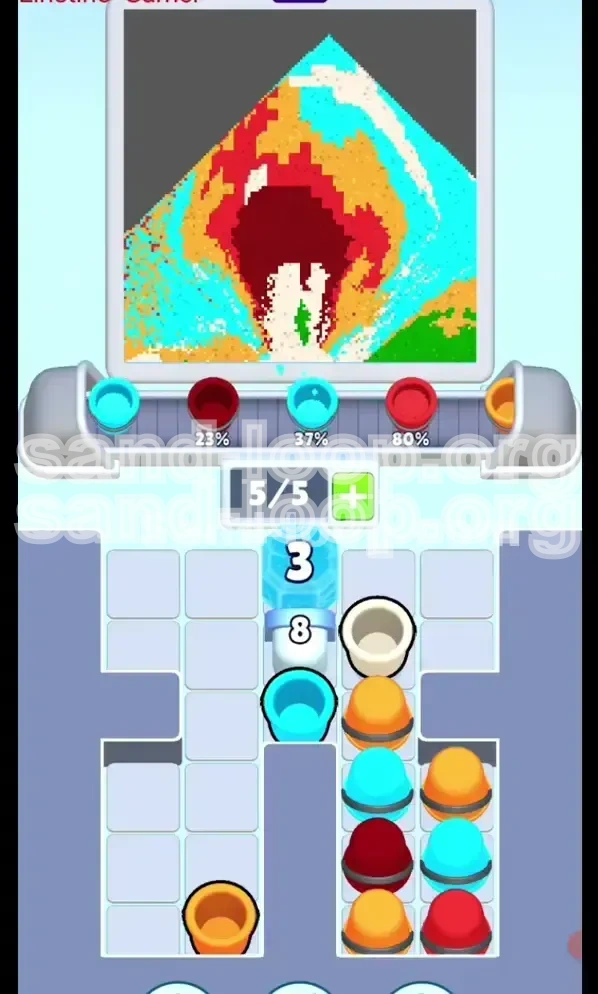
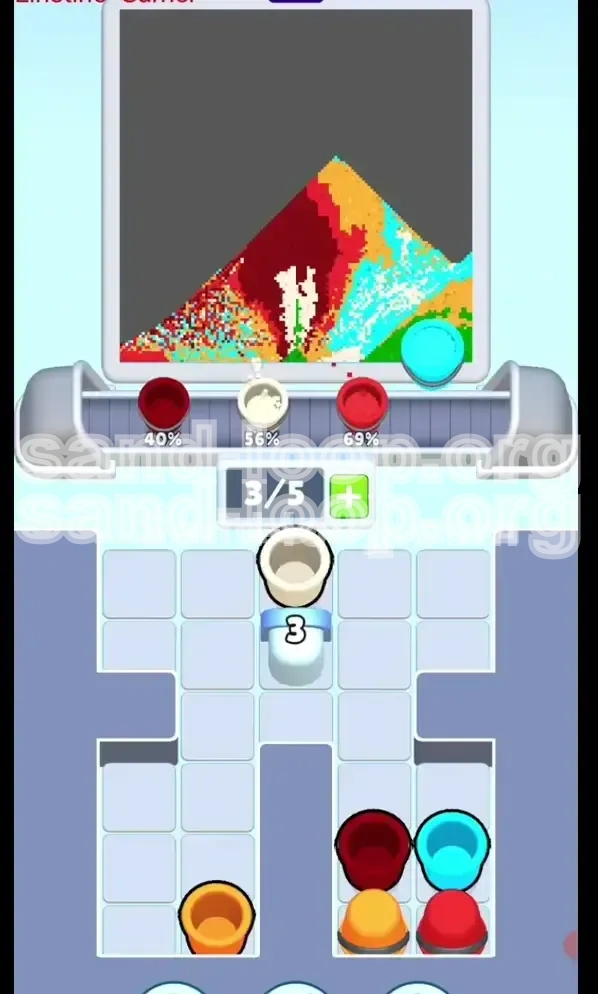
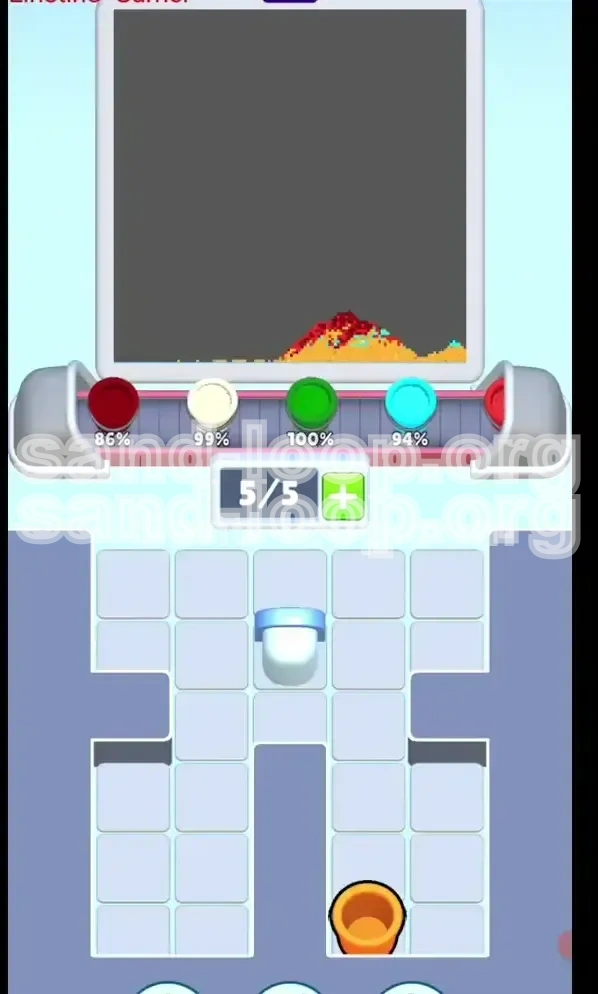
Sand Loop Level Guides
Level 50 Complete Walkthrough: Mastering the Cozy Cottage
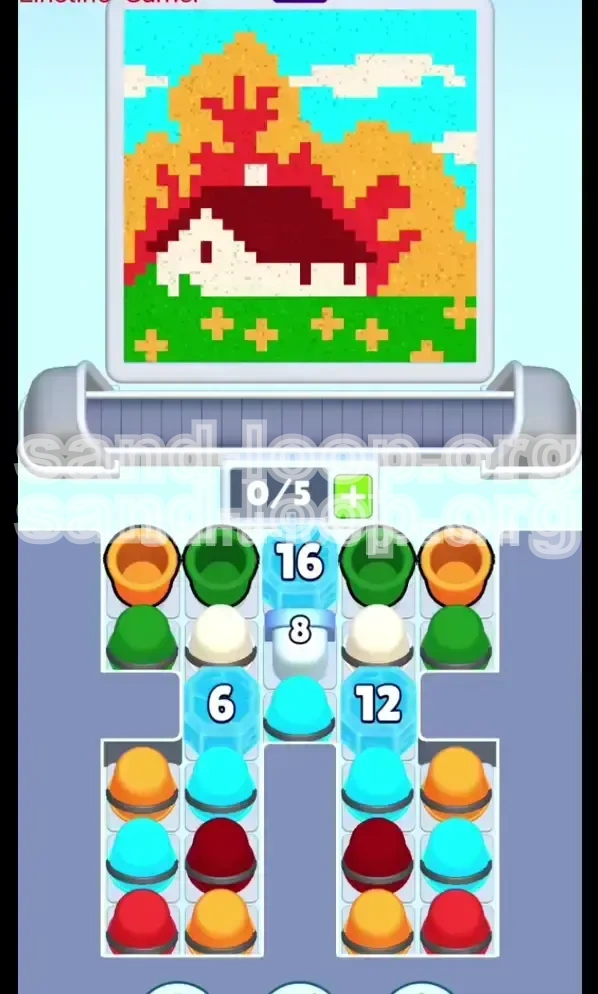
Welcome to the fiftieth milestone of your Sand Loop journey. Level 50, titled "The Cozy Cottage," is a significant difficulty spike that tests your logic rather than your reflexes. Unlike previous stages where the conveyor belt moves relentlessly, this level is a static puzzle defined by the "Vertical Lock." You are presented with a picturesque scene—a red-roofed house, green grass, and a blue sky—but your path to creating it is blocked by massive ice fortifications in the center of your supply tray.
This guide breaks down exactly how to dismantle the defenses, manage your limited inventory slots, and paint the perfect pixel art masterpiece without getting stuck.
The "Vertical Lock" Mechanism
The defining feature of Level 50 is the giant wall of ice occupying the center of your tray. You cannot access the primary colors (White and Cyan) needed for the house and sky until this barrier is destroyed. The game forces you to play the edges first. Attempting to dig into the center prematurely is impossible; the physics engine simply will not allow you to select those frozen cups.
Inventory Constraints
You only have 5 active slots on your conveyor loading dock. In this level, inventory management is tighter than ever. Because you must clear the outer columns to break the center locks, you cannot afford to clog your belt with unusable colors. Every slot must contribute to lowering the "Countdown" numbers on the ice blocks.
The Palette Analysis
Understanding the color distribution is key to victory. The target image consists of five primary colors. Red is the dominant hue, covering approximately 30% of the canvas (the roof). White covers the house body, Green makes up the grass, Cyan forms the sky, and Orange is used for accents and trees. The massive amount of Red required is your biggest logistical challenge because Red is buried deep at the bottom of the tray.
The "Countdown" Strategy
This level introduces "Countdown Blockers." The ice blocks have numbers (16, 8, 6, 12) floating on them. These numbers represent how many cups you must clear from the board to break them. You cannot chip away at these blocks directly; you must clear other cups to trigger their destruction. This creates a "Flank Clearing" strategy where you ignore the middle 50% of the screen until the very end.
Why Speed is Not the Priority
Do not treat this as a speed run. If you rush and load random cups to keep the belt moving, you will fill your slots with colors you don't need (like Orange when you only have the roof left). The belt here is slow and steady, giving you time to plan. Use this pause. A slow, calculated approach is the only way to solve the inventory deadlock that traps many players here.
Level Overview: The Cozy Cottage Challenge
Level 50 is a logic puzzle disguised as an art game. The peaceful image of a cottage belies the strict mathematical requirements needed to clear it. The challenge is not about artistic flair; it is about resource management. You have a limited supply of "actions" (cup clearances) that must be spent in a specific order to unlock the rest of the board.
The Danger Zones
The most critical part of this level is the interface between the Red Roof and the White Walls. The roof has a jagged, pixelated edge that dips down into the white area of the house. If you pour Red sand while the White layer is unstable, or if you paint the sky before the roof is sealed, you will create "color bleeding" that is incredibly difficult to fix later. Precision at the borders is non-negotiable.
Resource Scarcity
Unlike earlier levels where cups were abundant, Level 50 restricts your access. The White and Cyan cups are held behind the "16" and "8" ice blocks. If you waste the early Green and Orange cups, you won't have enough "clearance actions" to break the ice. You cannot grind for more cups; you have exactly what is on the screen. Efficiency is mandatory.
The Ice Block Layout
Your supply tray is divided into three sections: Left (Green/Orange), Center (Frozen White/Cyan), and Right (Green/Orange/Deep Red). The central column is dominated by a stack of ice blocks labeled 16 (top), 8 (middle), and 6/12 (bottom). The "16" block is the gatekeeper. Nothing happens until that number hits zero.
The Fill Order
Standard painting logic suggests painting background to foreground (Sky -> House -> Roof). However, due to the ice locks, you must paint foreground to background initially. You will start with the Grass (bottom), move to the House and Roof (middle), and finish with the Sky (top). This reverse-order painting is counter-intuitive and is the main reason players get stuck.
Winning Conditions
To achieve 100% completion, you must have zero cups left on the tray and the image must be perfectly filled with no overflow. The game ends when the final Cyan cup is poured to complete the sky. Your goal is to reach that state with your inventory slots empty and your sanity intact.
Time and Patience
Expect this level to take 3-5 minutes on your first attempt. It is a marathon, not a sprint. There will be moments where you stare at the screen, waiting for the right combination of cups to spawn. Patience is your best tool here. Do not force moves that don't make sense.
Step-by-Step Instructions: The Phase One Breakout
The beginning of the level is purely mechanical. You have no choice in your actions. You must break the "16" Ice Block to access the rest of the level. This phase is called "The Flank Clearing."
Step 1: Ignore the Center
When the level starts, look at the center column. See the White and Cyan cups buried under the number 16? Forget they exist. Do not click them. Do not hover over them. Treat the center of the screen as a dead zone. Clicking them is wasted effort; they are hardcoded to be unselectable until the counter drops.
Step 2: Clear the Left Flank (Green)
Start by looking at the far-left column. You will see Green cups. Load the Green cups onto your conveyor belt immediately. The grass at the bottom of the picture is your canvas. Pouring Green is safe because it is the bottom layer; nothing covers it, and it doesn't border any sensitive areas yet. Clear the entire left stack of Green cups.
Step 3: Clear the Right Flank (Orange and Green)
Move to the right column. You will find a mix of Orange and Green cups. Load these onto your belt. Use the Green to finish the grass areas. Use the Orange to start filling in the tree accents or the sunset hues in the corners. It does not matter if you paint Orange over Green or vice versa in the early stages, as long as you are removing cups from the tray.
Step 4: Watch the Counter
Every time you clear a cup from the left or right, look at the "16" block in the center. It should decrease by 1. This is your progress bar. Do not stop clearing the sides until that number hits 0. If you have 3 slots left, do not fill them with random center cups if the sides aren't clear. Always prioritize the side columns.
Step 5: Managing the 5 Slots
During this phase, keep your slots rotating. Load 3 Green, pour them. Load 2 Orange, pour them. Never let your belt get full. If you have 4 cups on the belt and 3 of them are colors you don't need right now (like Red when you are still clearing ice), you are in a "deadlock." You must pour them off (wasting sand) to free up the slot. It is better to waste a little sand early than to be stuck with no moves later.
Step 6: The Ice Shatters
Once you have cleared roughly 16 cups, the large "16" block will shatter. This is a pivotal moment. The screen will shake, and the block will disappear. This reveals the "8" block underneath it, along with a fresh supply of White cups. You have now successfully opened the board. Do not celebrate yet; the hard part is just beginning.
Color Order and Logic: The Phase Two Strategy
With the center open, the game changes from a logic puzzle to a resource management game. You now have access to White, but you are still gated by the "8" and "6" blocks. The order in which you paint the remaining sections determines your success.
The Priority of White
The moment the "16" block breaks, you gain access to the White cups. White is the color of the house walls. This must be your next highest priority. Why? Because the walls sit directly below the Red roof. If you paint the Red roof first, you will inevitably drip Red onto the unfinished White walls, creating a mess that is hard to clean. Paint the White body of the house first.
The "8" Block Dynamics
The new obstacle is the "8" block guarding the lower center. This block usually breaks after clearing 8 more cups. However, sometimes it is tied to the specific usage of the cups adjacent to it. The most reliable way to break this is to continue using the cups from the upper-left and upper-right that have now fallen down, or to start utilizing the newly available White cups.
Don't Touch the Cyan (Sky)
You might see Cyan cups (Sky) becoming available. Do not load them. Do not pour them. The sky is the top layer. If you fill the sky now, you will likely splash Cyan onto the Red roof or White house later. Keep the Cyan cups sitting in the tray. They serve as a buffer. Let them sit there until the very end of the level.
Preparing for the Red Roof
While you are painting the White walls, keep an eye on the bottom of the tray. You should see Red cups starting to become accessible or visible as the upper layers clear out. The Red Roof is the biggest color block in the game (approx. 30%). You need a steady stream of Red, but you don't want to load it until your White walls are 90% done.
The Burst Method
Once the White walls are finished, and the "8" block is gone, shift gears to Red. The "Burst Method" involves loading 2 or 3 Red cups onto your belt in quick succession. Since the roof is a large area, you can pour aggressively. Pouring Red is safer than pouring White because the Red area is large and contiguous. Don't be shy with the Red; fill that roof up.
The Final Cleanup
After the roof is done, you are left with the "6" and "12" blocks at the very bottom. These are the final gates. They usually block the last few Cyan cups or any remaining touch-up colors you need. By this point, your tray should be mostly empty except for the Sky color. The logic is simple: finish the roof, clear the tray, finish the sky.
Key Tips and Common Mistakes to Avoid
Even with a strategy, things can go wrong. Here are the pro-tips that will save you from restarting the level, and the common pitfalls that trap 90% of players.
Tip: Keep One Slot Open
This is the "Golden Rule" of Sand Loop Level 50. Always try to keep at least one of your 5 conveyor slots empty. Why? Because when an ice block breaks, new cups flood in. If your belt is full (5/5), and a new cup spawns that you desperately need, you have no room to pick it up. You are forced to waste a cup clearing a slot. Keeping 1 slot open gives you the flexibility to adapt to the changing board state.
Mistake: Premature Sky Filling
The number one mistake players make is filling the Cyan sky too early. They see a Cyan cup, get excited, and pour it. Then, 5 minutes later, they are trying to fix the Red roof and they keep dripping Red into the already-perfect Blue sky. The sky is the "lid" on the jar. You put the lid on last. Wait until the House (White) and Roof (Red) are 100% complete before you touch the Cyan.
Tip: Use "Wasted" Sand Strategically
Sometimes, you have a cup on your belt that you don't need, and you need to get rid of it to make space for a color you do need. Don't just pour it randomly onto your canvas (which ruins the art). Instead, pour it into a corner of the screen that has already been filled with that color, or pour it over an area that you know you will repaint later (like pouring extra Green on the grass before you paint the house over it). This minimizes the mess.
Mistake: Ignoring the Side Columns
Players often get fixated on the center ice blocks and try to "dig" through them. This is impossible. If you find yourself clicking the center and nothing is happening, you have forgotten the mechanics. Stop clicking the center. Look to the far left and far right. The answer is always in the side columns during Phase One.
Tip: The "Save" Feature
Don't be afraid to pause the game (if your version allows it) or just take your hand off the mouse between pours. Level 50 has no time limit. If you feel overwhelmed by the number of cups on screen, take a breath. Identify the single most important color you need right now (e.g., White for the walls). Find all the White cups. Plan how to get them to the belt. Then execute.
Mistake: Border Bleeding
The jagged edge between the Red roof and the White house is a trap. When you are filling the Red roof, be very careful not to over-pour the bottom edge. The "sand physics" in the game can cause a pile-up at the bottom of a container. If you pour too fast, the Red sand will slide under the White wall area. Pour slowly, and let the sand settle before lifting your finger/mouse.
Stuck Solutions and Speed Run Strategies
So, you followed the guide, but you are still stuck with a weird board state? Or maybe you want to show off your skills to your friends. This section covers advanced troubleshooting and optimization.
Solution: The "Deadlock" Fix
The Problem: Your conveyor has 5 slots. You have 1 Red, 1 Green, and 3 Orange cups. You need White. No White cups are spawning because the ice won't break until you clear cups, but you can't clear the cups because they are the wrong colors.
The Fix: You must sacrifice. Identify the color that you have the most of (e.g., Orange). Pour that Orange into a safe area (like the grass or trees) to get it off the belt. Do this even if you don't "need" more Orange there. You are creating space. Once you have an empty slot, the game logic can cycle the tray, and hopefully, a useful cup (or a cup that helps break the ice) will slide into position.
Solution: What to Do if White Runs Out
Sometimes, you break the "16" block, get the White, but you run out of White before the house is finished. The house looks grey and patchy. Don't panic. Finish the Red Roof first. The contrast between the Red Roof and the unfinished White walls might actually help you see where you need to fill in later. Often, breaking the deeper ice blocks (like the "6") reveals a hidden cache of White cups at the very bottom of the tray.
Solution: The "Cyan" Glitch
Sometimes players report that the Cyan cups never seem to end. The game keeps giving them Cyan when they need Red. This usually happens because you haven't cleared enough of the *other* colors. The game's algorithm tries to balance the tray. If you are ignoring Orange and Green, the tray fills with Cyan. Go back and clear out the "trash" colors (Orange/Green) to rebalance the RNG and force the Red cups to spawn.
Speed Run Tip: The Pre-Load
If you are trying to set a time record, you can "pre-load" your mental queue. While the game is animating the breaking of an ice block, you should already be hovering your mouse over the next column you want to pull from. Don't wait for the animation to finish before you decide your next move. The moment the screen stabilizes, click.
Speed Run Tip: Aggressive Pouring
For a speed run, forget about "perfect" borders. Pour the Red Roof as fast as you can. If a little bit bleeds into the White area, that's okay; you can patch it up with a quick dab of White later. It is faster to patch a mistake than to pour slowly and perfectly. Speed requires a bit of controlled chaos.
Speed Run Tip: Slot Cycling
Never let the belt stop moving. A moving belt is a productive belt. Even if you are just cycling cups on and off the belt (picking them up and putting them down in a different pile), it keeps the game physics active and can sometimes help "shake loose" the ice counters faster. Keep the flow dynamic.