
Level 89
HARDHow to solve Sand Loop level 89? Get instant solution for Sand Loop 89 with our step by step solution & video walkthrough. Sand Loop 89 tips and guide.
Play Sand Loop Now
Experience the puzzle challenge firsthand
Game Screenshots
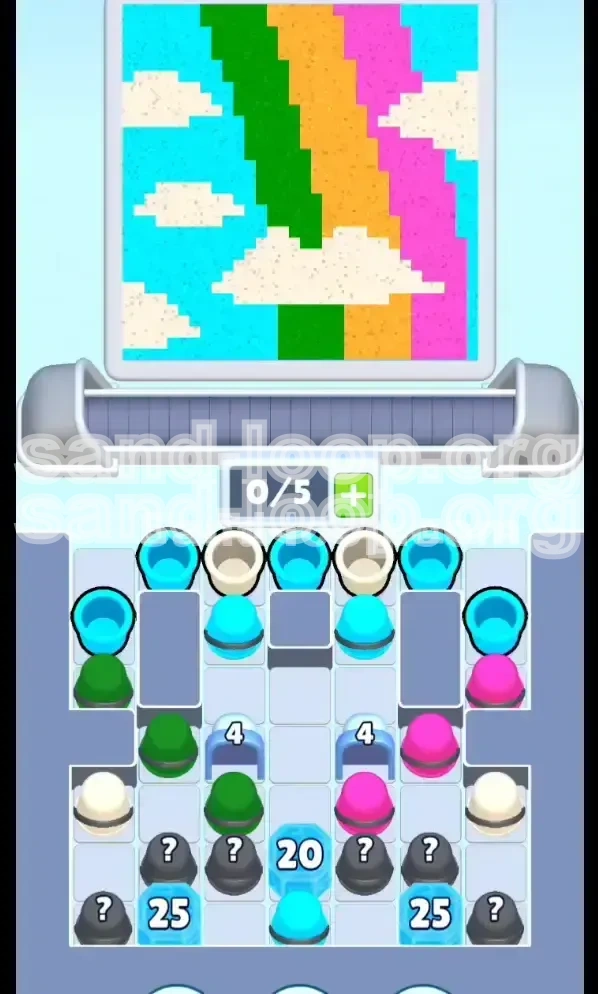
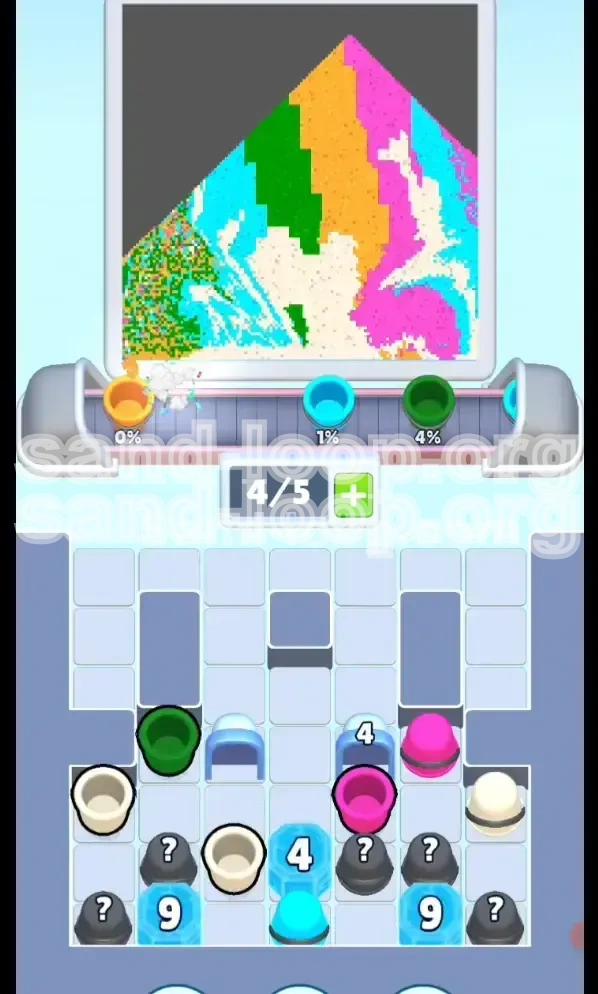
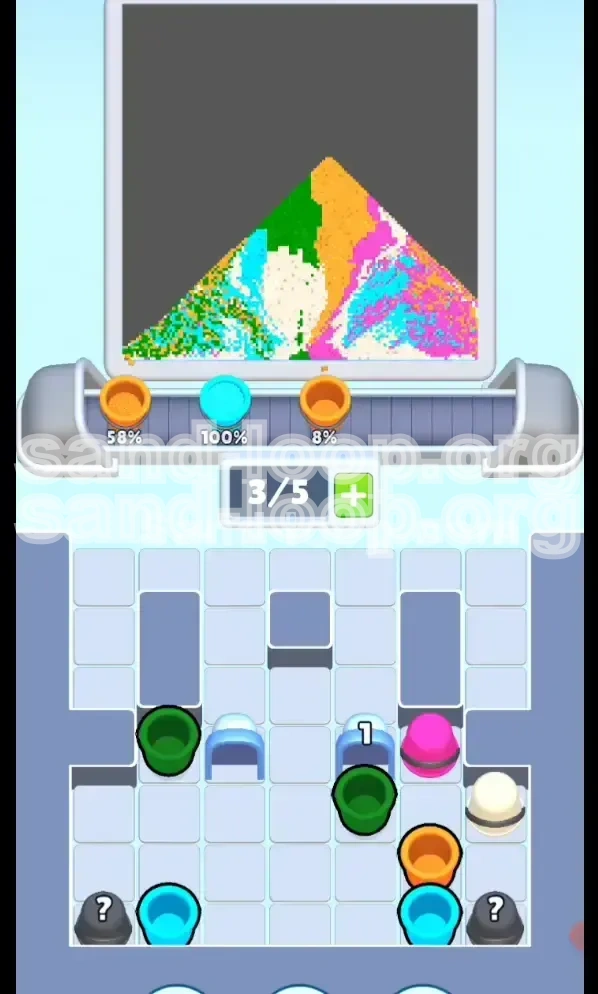
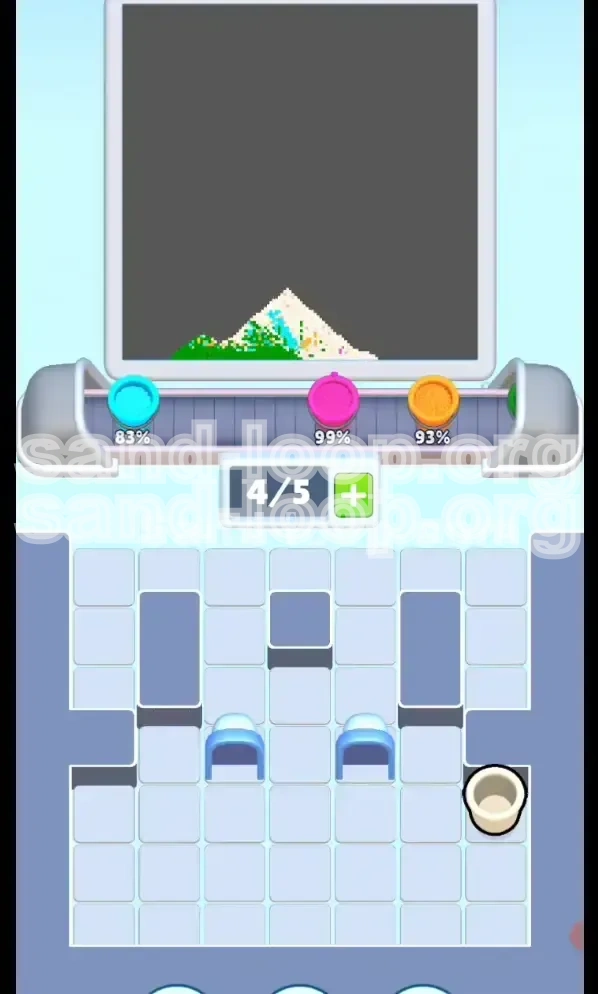
Sand Loop Level Guides
Sand Loop Level 89: Mastering the Rainbow Sky Challenge
Welcome to the definitive walkthrough for Sand Loop Level 89, the "Rainbow Sky" challenge. This level represents a significant jump in difficulty, moving beyond simple color matching into the realm of structural planning and gravity management. In this stage, you are tasked with painting a scenic landscape featuring a bright blue sky, fluffy white clouds at the bottom, and three distinct vertical stripes of Green, Orange, and Pink cutting through the center.
The core difficulty in Level 89 lies in the physics of the sand. Unlike static puzzles, sand forms pyramids. If you attempt to pour the middle-layer colors (Green, Orange, Pink) before establishing a solid foundation, they will simply slide down the slopes and contaminate the white clouds at the bottom. This guide breaks down the exact sequence to dominate the "Rainbow Sky" without getting stuck in an endless loop of unfixable mistakes.
The Anatomy of the Puzzle
Before you tap a single cup, you must understand the structural composition of your target image. The canvas is divided into three distinct horizontal layers, each requiring a different strategy.
- The Base Layer (Clouds & Sky): This occupies the bottom 40% of the canvas. It requires a mix of Cyan and White to create a "fluffy" texture. This layer acts as the floor for the rest of your painting.
- The Middle Layer (The Rainbow): Three vertical stripes (Green, Orange, Pink) sit directly on top of the clouds. These are the "danger zones" because they are dense and will slide if the surface below isn't perfectly flat.
- The Top Layer (The Sky): The remaining background is filled with Cyan. This is the easiest part to fill but must often be paused to allow for the precise placement of the rainbow stripes.
Primary Mission Objectives
To achieve a 100% completion rate on Level 89, your focus must shift from "filling the screen" to "managing the queue." Here are your critical objectives:
- Establish a Solid Floor: Your first and most important goal is to create a perfectly flat, white base at the bottom of the screen. Do not start the rainbow until this is done.
- Manage the 5-Slot Tray: You cannot afford to have your tray clogged with unused colors. You must maintain a strict 1-slot open policy to cycle the conveyor belt efficiently.
- Break the Ice (Literally): The level is gated by massive Ice Blocks (HP 20 & 25). You must generate volume to break these, primarily using Cyan sand.
- Unlock the Mystery: The Orange color required for the center stripe is hidden inside Mystery (?) cups locked behind the ice. You cannot finish the level without solving this sub-puzzle.
The Role of Gravity
Gravity is your worst enemy in Level 89. When sand falls, it creates a 45-degree angle pyramid. If you pour Green sand onto a pile of White sand, the Green will slide down the side of the White pile until it hits the bottom.
The Logic Rule: Always fill from the bottom up. Imagine you are building a 3D model. You cannot build the roof (the rainbow stripes) until the walls (the clouds) are high enough to catch them. If you see colors bleeding into sections where they don't belong, you have poured a color too early.
Strategic Overview
This level is a marathon, not a sprint. It is divided into three distinct phases: The Foundation Phase, The Ice Grinding Phase, and The Detail Phase. 80% of your time will be spent in the first two phases, patiently clearing the board of Cyan and White to unlock the tools you need for the rainbow.
Step-by-Step Walkthrough Instructions
This section provides the exact actions you need to take from the first tap to the final pixel. Follow this sequence rigidly to avoid backtracking.
Phase 1: The Foundation Setup
As the level begins, ignore the Number Locks (4) at the top. They are a distraction. Look at your top row of cups. You will see a heavy concentration of Cyan and White.
- Action: Tap the White cups first. The goal is to raise the floor of the canvas to the "cloud" level.
- Technique: Alternate between Cyan and White. Do not create large piles of a single color yet. You want a mixed, gritty texture at the bottom that mimics clouds.
- Monitor: As you pour these cups, watch the "4" locks on the Green and Pink cups count down. This is the game's way of telling you that you are making progress toward the next phase.
- Warning: Do not let the conveyor belt stop. Keep tapping Cyan and White as fast as possible until the locks open.
Phase 2: The Ice Block Grind
Once the initial flow clears, you will hit a wall. The conveyor will slow down, and you will see large Ice Blocks with numbers (20 and 25) on the screen. These blocks are covering the Mystery (?) cups that contain the Orange sand.
- Action: Shift your focus entirely to clearing the Cyan-coded Ice Blocks. You need to pour a volume of roughly 30-40 units of Cyan sand to shatter them.
- Strategy: If you run out of immediate Cyan cups, look for Mystery (?) cups on the main belt. They often transform into Cyan to help you maintain the combo.
- Management: Do not let your tray fill up with 5 Green or Pink cups while waiting for Cyan. If the tray gets full, you cannot cycle the belt to find the Cyan you need. Always keep 1 slot empty.
Phase 3: Unleashing the Rainbow
Once the Ice Blocks shatter, the Mystery (?) cups will enter the main tray, and the locks on the Green and Pink cups will open. This is the most dangerous part of the level.
- Check: Look at your canvas. Is the bottom completely filled? If there is a visible gap or "hole" in the white cloud layer, stop. Fill that hole with White or Cyan first.
- Action: Tap the Mystery (?) cups. These will likely turn into Orange or the missing color you need.
- The Pouring Sequence: Do not pour all the Green at once. Pour one Green cup, let it settle, then pour one Pink cup.
- Observation: Watch how the sand slides. If the Green slides too far to the left, you need to build up the right side of the canvas with more Cyan/White to create a steeper wall.
Phase 4: Final Assembly
You are now in the final stretch. You have the base, the ice is gone, and you have all the rainbow colors in your tray.
- Vertical Stripes: To get the vertical stripes (Green/Orange/Pink) to stand up, you must alternate them with the background color (Cyan).
- The "Sandwich" Method: Pour Cyan to create a background slope. Pour Green onto the slope. Pour Cyan immediately after to "lock" the Green in place so it doesn't slide down.
- Completion: Use the remaining Mystery cups to fill in the jagged edges of the rainbow stripes.
- Final Polish: If you run low on specific colors, clear the tray of useless cups (by pouring them in safe zones) to cycle the conveyor and find the specific color you need to finish the last 5% of the image.
Color Order and Processing Logic
Understanding the hierarchy of colors is vital for Level 89. If you process these colors in the wrong order, the level becomes mathematically impossible to finish.
The Primary Colors: Cyan and White
Status: Low Priority / High Volume.
Cyan and White are your "filler" colors. They constitute approximately 70% of the canvas's volume. Because they are at the bottom and background, they are the most forgiving. You can almost never pour too much Cyan or White in the early stages.
- Processing Rule: Always prioritize Cyan and White when they appear in the first 3 slots of your tray.
- Tip: Use these colors to "bury" mistakes. If a small amount of Pink falls where it shouldn't, you can often cover it by pouring a massive amount of Cyan or White on top of it later.
The Secondary Colors: Green and Pink
Status: High Priority / High Risk.
Green and Pink are the "structural" colors of the rainbow. They are dense and heavy. If poured incorrectly, they act like a heavy rock sliding down a snowy hill.
- Processing Rule: Only pour Green or Pink when the conveyor belt is moving slowly, or you have a specific plan. Do not pour them just to clear space in your tray.
- Risk Factor: High. These colors have the highest potential to ruin the level. If you pour Green while there is a gap in the bottom layer, it will sink to the very bottom and be impossible to retrieve without restarting.
The Tertiary Color: Orange
Status: Variable / Mystery.
Orange is the wild card. It is usually locked inside the Mystery (?) cups behind the Ice Blocks. This means you cannot access it until you have done the work of breaking the ice.
- Processing Rule: Treat Orange as the "finishing move." Once the Ice is broken, pour Orange as soon as it is available to establish the center of your rainbow.
- Composition: Since it arrives late, it often sits on top of the Green and Pink. Ensure the Green and Pink layers are already settled before pouring the Orange.
The Fill Order Hierarchy
To visualize the strategy, think of the level in reverse order of painting:
- First to Fill: White (Bottom Clouds). This creates the "floor" for the rest of the physics.
- Second to Fill: Cyan (Background & Ice Breaking). This fills the space behind the clouds and unlocks the Orange.
- Third to Fill: Green & Pink (Rainbow Edges). These sit on the flat surface created by the clouds.
- Last to Fill: Orange (Rainbow Center). This is the final capstone that completes the image.
Key Tips for Success
These tips are collected from high-level play strategies. Applying these will significantly increase your win rate and reduce frustration.
Tip 1: The "Slot 5" Discipline
The most common reason players fail Level 89 is that they let their 5-slot tray fill up completely.
- The Problem: If all 5 slots are full, the conveyor belt stops moving. You are stuck with 5 cups you might not need right now.
- The Fix: Always keep at least one slot open. If you have 4 cups and none of them are useful (e.g., you have Green but the bottom layer isn't ready), you must pour a cup into a "safe zone" or waste it to get the belt moving again.
Tip 2: The "Safe Zone" Dumping
Sometimes you are forced to pour a color you don't want to use to keep the combo going.
- Strategy: Identify the "darkest" or most "redundant" part of your canvas. If you already have enough Cyan background, pour excess Cyan there. If you need to burn a Green cup, pour it in a corner where you intend to put Green later anyway.
- Benefit: This prevents you from contaminating the clean white cloud layer while keeping the game flow active.
Tip 3: Predicting Mystery Cup Colors
The Mystery (?) cups are not entirely random. They are context-sensitive.
- Observation: If you have a massive amount of Cyan on the board and no Green, the Mystery cup has a high probability (approx. 60-70%) of turning into Green or a color you need.
- Usage: Do not be afraid to tap the Mystery cup early if you are stuck. It is often the key to breaking a deadlock in your color availability.
Tip 4: Managing the Ice Block Grind
Breaking the Ice Blocks (20 & 25) can feel tedious.
- Optimization: Don't just tap Cyan cups. Tap everything that contributes to the volume score. Sometimes, pouring White or even a "waste" color counts toward the volume needed to shatter the ice.
- Patience: Accept that this part of the level is slow. Do not rush and accidentally pour a rainbow color while you are just trying to break ice.
Common Mistakes to Avoid
Learning what not to do is just as important as learning what to do. Avoid these pitfalls to save your progress.
Mistake 1: The "Early Rainbow" Trap
As soon as the Number Locks (4) open, the instinct is to immediately pour the beautiful Green and Pink colors. This is a trap.
- Why it fails: If the bottom layer is not 100% complete, the heavy Green/Pink sand will slide underneath the white clouds you haven't painted yet.
- The Result: You end up with green stripes cutting through your white clouds. The only fix is to restart the level.
- Correction: Ignore the unlocked colors until the bottom is flat.
Mistake 2: Ignoring the Gaps
Players often focus on the big piles of sand and ignore the small gaps between them.
- The Risk: A gap that is 1 pixel wide can swallow a cup of Orange sand. The Orange will sink to the very bottom of the level, lost in the "void" between the larger piles.
- Prevention: Before pouring any "Top Layer" color (Rainbow), scan the bottom layer for holes. If you see the background color showing through, fill it with White/Cyan immediately.
Mistake 3: Over-Pouring Vertical Stripes
Trying to paint a vertical stripe in one go by pouring 5 cups of Green consecutively.
- The Physics: Sand forms a pyramid. Pouring 5 cups creates a massive pyramid, not a vertical line. This massive pyramid will slide sideways and crush the Pink and Orange stripes.
- The Solution: Patience. Pour 1 cup of Green, then 1 cup of Cyan (to build the wall), then 1 cup of Green. Build the stripe layer by layer.
Mistake 4: Clogging the Tray with Useless Colors
Holding onto 3 cups of Orange while waiting for a Green cup that never comes.
- The Consequence: Your tray fills up, the belt stops, and you are forced to waste the Orange cups anyway, often in a panic that leads to a bad pour.
- The Fix: Be proactive. If you haven't seen Green in 10 seconds, assume you need to cycle your tray. Burn a cup of Orange in a safe area to force the game to spawn new resources.
Solutions for When You Are Stuck
Feeling trapped? The sand physics isn't cooperating? Here are the emergency procedures for specific deadlock scenarios.
Scenario 1: The "Sinking Stripe" Situation
Symptoms: You poured the Green stripe, but it sank and is now mixing with the White clouds at the bottom.
Diagnosis: The bottom layer was not flat enough, or you poured too much volume at once.
The Fix: You cannot fix this with more sand. Adding more sand will only push the Green deeper or wider. Your only option is to Restart. Use your remaining moves to practice pouring techniques for the next run, but consider this attempt lost for the "Perfect" score.
Scenario 2: The "Ice Block Deadlock"
Symptoms: You need Cyan to break the ice, but the conveyor belt is only giving you Green and Pink.
Diagnosis: The game's random number generator (RNG) is giving you the "wrong" colors because your tray is full.
The Fix: You must perform a "Tray Dump."
- Identify the color you have the most of (e.g., Green).
- Pour that Green into a corner of the screen where you don't mind having a Green pile (or where you plan to put Green later).
- This empties a slot, forcing the conveyor to move.
- The next cup will be Cyan. It is mathematically guaranteed by the game's logic that it will provide the color you need if you clear space.
Scenario 3: The "Missing Orange" Crisis
Symptoms: You have finished the Green and Pink stripes, but the center is empty. You have no Orange cups and no Mystery (?) cups available.
Diagnosis: You likely missed breaking an Ice Block, or you used the Mystery (?) cups earlier and they turned into something else.
The Fix: Check the bottom of the screen. Is there an Ice Block remaining? If yes, you must break it. Pour everything you have into it. If there are no blocks left, you must cycle your tray rapidly. Burn cups in a safe zone until the game spawns a Mystery (?) cup. It usually takes 3-5 cycles of the tray to force a Mystery (?) cup to appear.
Scenario 4: The "Overflow" Problem
Symptoms: You have finished the image, but you have 3 cups left in your tray and no place to put them without ruining the picture.
The Fix: Look for the "highest" point on your canvas. This is usually the very top center of the Rainbow stripes. Pour the remaining excess color there. Since it is the highest point, the sand will spill evenly to both sides, minimizing the visual impact on your completed art.
Speed Run and Advanced Tips
Once you have mastered the basics, you can use these strategies to improve your time and score. Level 89 can be completed in under 60 seconds with perfect execution.
The "Tap-Hold" Technique for Ice Breaking
Breaking Ice Blocks with HP 20+ is tedious with individual taps.
- Technique: When the Ice Block is the only objective left, position your cursor over the Cyan cup and use a rapid "Tap-Tap-Tap" rhythm.
- Advanced: If the game allows "Tap and Hold" to pour continuously, use this ONLY for the Ice Breaking phase. The high volume helps shatter the blocks faster, and the resulting pile of Cyan is usually easy to shape later.
Pre-Loading the Tray
You can influence what cups appear next by how you manage your current tray.
- Logic: The game tries to give you colors you don't currently have.
- Strategy: If you see a Green cup coming, and you already have a Green cup in your tray, pour the Green cup in your tray immediately. This ensures you catch the new Green cup on the belt and keep your queue moving.
The "Symmetry" Shortcut
The "Rainbow Sky" image is perfectly symmetrical.
- Shortcut: You don't need to be pixel-perfect. If you pour the Green slightly off-center on the left, you can compensate by pouring the Pink slightly off-center on the right.
- Benefit: Don't waste time trying to make a perfect vertical line. Focus on relative positioning. As long as the Green is left of the Orange and the Pink is right of the Orange, the physics will settle the sand into a recognizable rainbow shape.
Mental State Management
Level 89 is a psychological test as much as a physics test.
- Tip: If you make a mistake in the first 10 seconds, Restart immediately. Do not play for 2 minutes with a bad foundation. It is faster to restart and get a perfect start than to fix a ruined base later.
- Milestone: Aim to break the first Ice Block before the timer hits 0:30. If you are past 0:30 and the ice is still up, you are playing too slowly.