
Level 16
HARDHow to solve Sand Loop level 16? Get instant solution for Sand Loop 16 with our step by step solution & video walkthrough. Sand Loop 16 tips and guide.
Play Sand Loop Now
Experience the puzzle challenge firsthand
Game Screenshots
Sand Loop Level Guides
Level Overview: The Watermelon Slice Challenge
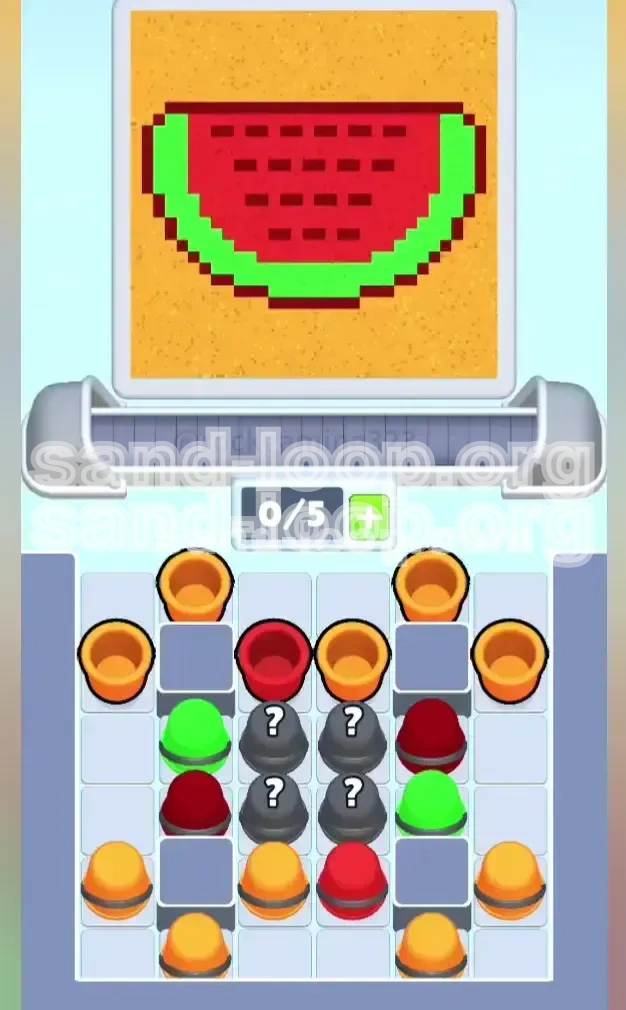
Welcome to Level 16, a stage that marks a significant difficulty spike in your sand sorting journey. Known as the "Watermelon Slice," this level is not just about sorting colors; it is an exercise in spatial management and gridlock resolution. The final image—a refreshing slice of watermelon against a golden background—looks simple, but achieving it requires navigating a bottlenecked tray and a dangerous "Mystery Cluster" right in the center of your board.
The Gridlock Dilemma
Unlike previous levels where you had ample room to shuffle cups, Level 16 starts you with a tray capacity of 0/5. This means every single slot is occupied from the very first second. You are not just sorting; you are excavating. You must make immediate, aggressive moves to clear space, or the conveyor belt will jam before the first layer of sand is even poured.
The Mystery Cluster
The defining feature of this level is the 2x2 block of grey "Question Mark" cups located in the center of the tray. These cups are trapped by "Guard" cups on all sides. You cannot move them until you clear the specific blockers (Top, Bottom, Left, Right). These Mystery Cups act as a time bomb; if you ignore them to focus on the edges, you will run out of moves later when they finally unlock.
The Composition: A Layered Cake
Think of the target image as a layered dessert. The bottom 45% is a golden Yellow background. On top of that sits a Green crescent rind (about 15% of the image). Inside the rind is the bright Red flesh (35%), and finally, tiny Dark Red seeds (5%) are scattered within the flesh. If you pour the layers out of order (e.g., Red before Green), the colors will bleed into each other, and you will fail the accuracy check.
The "Seed Trap" Mechanic
This is the most critical danger zone. The seeds are single-pixel dots. If you flood the canvas with the main Red color first, you will physically bury the slots meant for the Dark Red seeds. Once buried, you cannot fit the nozzle in to paint them without ruining the surrounding flesh. You must prioritize the small details before the flood.
The Conveyor Belt Constraint
The conveyor belt moves constantly. Every second you spend hesitating is a second lost on the clock. You need to execute your moves rhythmically: Clear, Uncover, Process.
Clear Objectives: Your Path to Victory
To beat Level 16, you need a rigid plan. Do not tap randomly. Your goal is to clear the gridlock while reserving the "Critical Colors" for the precise moment the canvas is ready for them.
Objective 1: Immediate Tray Liberation (0-5 Seconds)
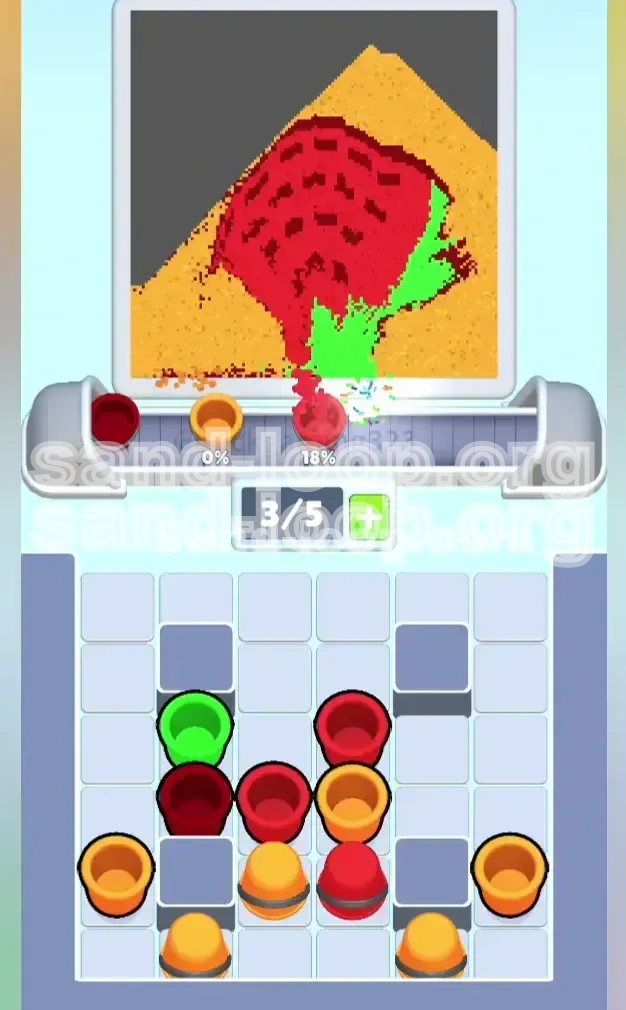
Your first goal is not to paint, but to breathe. You must identify the "expendable" colors that are safe to pour immediately. These are the Yellow/Orange cups located in the corners and periphery. Pouring these serves two purposes: it paints the background, and more importantly, it opens up 3-4 vital slots in your tray, allowing you to move the trapped cups in the center.
Objective 2: The "Unwrapping" Phase
You must systematically strip away the cups guarding the central Mystery Cluster. Identify the specific cups physically blocking the grey squares from moving. Usually, this involves moving a top cup and two side cups. Once these guards are gone, the Mystery Cups become movable tiles, allowing you to integrate them into your sorting strategy.
Objective 3: Establishing Hard Borders
Before you unleash the Red flood, you must define the boundaries of the fruit. This means pouring the Green rind and the Dark Red seeds *before* the main Red flesh arrives. Think of it as coloring inside the lines; you need the green crayon to outline the shape before you fill it in with red.
Objective 4: Managing the Wildcards
The Mystery Cups in the center are variables. They usually contain extra Red or Green, but sometimes they hold critical colors you need early. You must clear the blockers to reveal their contents. Once revealed, you must decide instantly: do they fit into the current flow, or do they need to be stored? Treating them as "wildcards" that can fill gaps in your color collection is key.
Objective 5: The Perfect Fill
To achieve a Perfect rating, you need a fill accuracy of over 95%. This means no color bleeding. The Green must stay on the rind, the Dark Red must hit *only* the seeds and bottom edge, and the Red must fill the rest without overlapping the background.
Color Order: The Logical Sequence
The order in which you process colors is the single most important factor in this level. Do not deviate from this sequence unless you are an advanced player looking for a high-risk strategy.
Priority 1: Yellow (The Foundation)
Percentage of Canvas: ~45%
Cup Type: Orange/Amber
Why First? Yellow is the safest color. It occupies the corners and background. It has no small details and no adjacency issues with the flesh (initially). Pouring this first clears the clutter from your tray and establishes the base layer. It is impossible to mess up the Yellow if you do it first, so clear all Orange cups immediately.
Priority 2: Green (The Container)
Percentage of Canvas: ~15%
Cup Type: Green
Why Second? The Green rind acts as a dam. It separates the Yellow background from the Red flesh. If you pour Red first, it will bleed into the Yellow areas, creating a muddy orange border. By pouring Green second, you draw a hard line that the subsequent Red sand cannot cross.
Priority 3: Dark Red (The Details)
Percentage of Canvas: ~5%
Cup Type: Dark Red / Maroon
Why Third? This is the "Critical Color." These cups are usually small but contain the sand needed for the tiny seed pixels and the dark bottom edge of the rind. These must be poured *before* the main Red flood. Once the bright Red covers the flesh, you cannot easily fit the Dark Red seeds in without ruining the edges.
Priority 4: Bright Red (The Flood)
Percentage of Canvas: ~35%
Cup Type: Bright Red / Scarlet
Why Last? This is the "flood" color. You likely have multiple Red cups. You must save these for the late game. The nozzle will swing back and forth, filling the large empty space left by the Yellow and Green borders. Since you have already placed the Dark Red seeds, the Red sand will flow naturally around them.
Priority 5: Mystery Colors (The Variables)
Content: Unknown
Strategy: Treat the Mystery Cups as "floaters." Process them as soon as they are free from the center cluster. If they reveal a color you have already finished (like Yellow), pour them immediately to clear the tray. If they reveal a needed color (like Green), add them to your Green queue.
Step-by-Step Walkthrough
Follow these actions in the first 30 seconds of the level to ensure a stable board state.
Phase 1: The Corner Sweep (Seconds 0-5)
When the level starts, your tray is jammed. Ignore the center cluster for a moment. Look at the top-left, top-right, and bottom corners of your tray. You will see Orange cups (Yellow sand).
- Action: Rapidly tap all visible Orange cups on the periphery.
- Result: This sends 3-4 cups to the belt immediately.
- Benefit: The nozzle will paint the background yellow, which is harmless. Crucially, this opens up 3-4 slots in your tray, preventing an immediate "Game Over" due to gridlock.
Phase 2: Cracking the Guard (Seconds 5-10)
Now look at the center. The Mystery Cluster (2x2 grey cups) is trapped. You will see a Red cup above it, Green cups to the sides, and perhaps Dark Red cups nearby.
- Action: Identify the cups physically touching the Mystery Cluster. You need to move these "Guard" cups.
- The Move: If the top cup is Red, and you already have Red on the belt (from the corner sweep), wait. If the top cup is Green or Dark Red, tap it.
- Goal: Your aim is to "unwrap" the center package so the grey cups become movable tiles.
Phase 3: The Border Setup (Seconds 10-20)
With the corners cleared, you should have space to manage the specific detail colors.
- Action: Look for the Green cups. Send one Green cup.
- Timing: Watch the belt. As the Green cup is pouring, look for the Dark Red cup.
- Spacing: Do not send the Dark Red cup immediately after the Green. Leave a 1-second gap. You want the nozzle to finish the Green arc (the rind) and reset before it attempts to hit the tiny pixels for the seeds.
Phase 4: The Mystery Reveal (Seconds 20-30)
By now, the guards should be gone. The 2x2 grey block is loose.
- Action: Tap the Mystery Cups one by one.
- Reaction: As they hit the belt, they will reveal their true color.
- Strategy: 90% of the time, these are Red or Green. If they are Red, let them queue up behind your current pours. If one is Dark Red, you must pause other pours to ensure it hits the seed spots correctly.
Phase 5: The Final Flood (Seconds 30+)
Your tray should now be mostly empty except for the remaining Red cups.
- Action: Unleash the remaining Red cups in rapid succession.
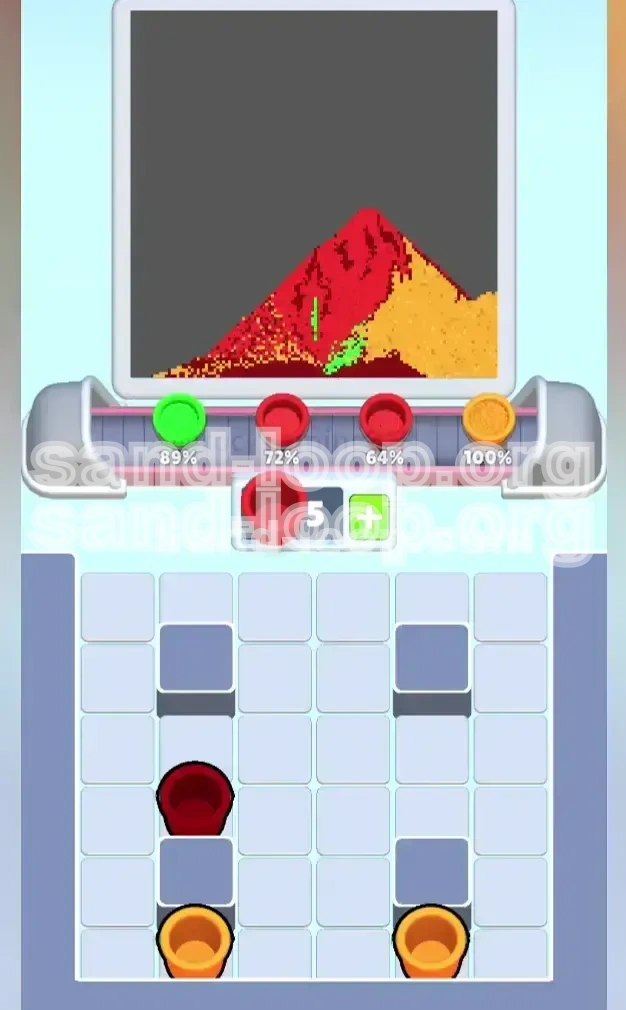
- Visual Check: You should see the watermelon flesh turning solid red, while the Dark Red seeds and Green rind remain crisp and untouched.
- Completion: If the seeds were placed correctly in Phase 3, the Red sand will automatically flow around them, filling the gaps perfectly.
Common Mistakes to Avoid
Learning from others' failures is the fastest way to beat Level 16.
Mistake 1: The "Early Flood" (Most Common)
Players see the large Red cups and tap them immediately to get them out of the way. Do not do this. Pouring Red first buries the seed slots. You will end up with 98% completion but be unable to fix the last 2% because the seeds are blocked by bright red sand.
Mistake 2: Ignoring the Mystery Block
Some players focus entirely on the outer edges and ignore the center cluster. Eventually, the belt jams because the Mystery cups are stuck behind guards you haven't cleared. The Fix: Make cracking the center cluster a priority within the first 15 seconds.
Mistake 3: Color Confusion
The "Orange" cups actually contain Yellow sand. The "Red" cups contain Bright Red. The "Dark Red" looks almost black. Do not mix up the Dark Red (seeds) with the standard Red (flesh). Using Dark Red for the flesh will look wrong, and using Red for the seeds will make them disappear.
Mistake 4: Panic Pouring
When the tray gets full, players panic and start tapping random cups. This inevitably leads to the wrong color entering the nozzle at the wrong time. The Fix: If you are stuck, pause for 0.5 seconds. Identify the one color that is *safest* to pour right now (usually Yellow) and tap only that one.
Mistake 5: Neglecting the Rind
If you pour the Green rind too hastily, it often comes out jagged or misses the bottom curve. The Green rind defines the fruit. If the rind is messy, the whole watermelon looks like a blob. Ensure you give the Green cup enough time on the belt to complete the full arc.
Solutions for When You Are Stuck
Hit a wall? Here is how to troubleshoot your specific situation.
Situation: "My Tray is Full and Nothing is Moving"
Diagnosis: You have a gridlock at the conveyor belt entrance. The belt is likely full of one color, and your tray is full of other colors.
Solution: Look at the cup currently on the belt. Is it pouring? If yes, wait. If no (blocked by something else), you have a jam. You need to clear the current cup on the belt immediately. If you can't, you might need to restart, as this level has very little margin for error with tray capacity.
Situation: "I Can't Find the Seeds"
Diagnosis: You are looking for a specific cup, but the tray is chaotic.
Solution: Stop looking for the cup and look at the canvas. Is the bottom dark edge painted? If yes, the seeds are likely the only remaining pixels. If the Dark Red cup is buried in your tray, you must pour other cups to free it. Do not pour Red flesh until the Dark Red cup is free and ready to be sent next.
Situation: "I Keep Missing the Seed Pixels"
Diagnosis: You are pouring the Dark Red, but it's not hitting the target.
Solution: This is a timing issue. You are likely pouring it while the nozzle is still moving from a previous color. Let the belt run empty for 1 second. Let the nozzle settle to a neutral position. Then, send the Dark Red cup. This ensures the nozzle makes a fresh, accurate pass over the canvas.
Situation: "Mystery Cups are Useless Colors"
Diagnosis: You revealed a Mystery Cup, and it's a color you already finished (e.g., Yellow) or don't need.
Solution: Treat it as trash. Send it to the belt immediately to get it off your tray. Don't worry about overfilling the Yellow background slightly; it's better than having a clogged tray. Even if the canvas is 100% yellow, getting that cup off the tray is worth the minor point deduction for overfilling (if any).
Speed Run Tips
For those aiming to top the leaderboards or achieve a 3-Star time score.
Tip 1: The "Pre-Load" Strategy
As soon as the level loads, don't wait for the sand to start falling. Identify the three Orange cups in the corners. Tap them all before the first cup even hits the canvas. This queues up the belt immediately and shaves 2 seconds off your time.
Tip 2: Chain Combos
Try to send cups of the same color in groups. If you have three Green cups, tap them all in a row so they flow onto the belt one after another. The game often grants a small speed bonus or "smooth flow" bonus when you don't switch colors constantly. It also keeps the nozzle swinging in the same arc, increasing efficiency.
Tip 3: Ignore Perfection
During a speed run, 100% accuracy is not required; you only need ~95% for a win. If a seed is slightly misaligned or the Green rind is 1 pixel too thick, do not restart. Keep pouring. The time lost fixing minor details is greater than the point penalty for slight imperfection.
Tip 4: Tray Optimization
While the "Mystery Cluster" is solving itself, use that downtime to organize the remaining cups in your tray. Drag a Red cup closer to the "send" zone. By the time the Mystery cups are cleared, your next move should be instantly ready. Micro-optimization like this saves precious milliseconds.
Tip 5: Know the Animation Cycles
Learn exactly how long it takes for the Green cup to complete the bottom arc. Once you have this internal clock, you can tap the Red cup *exactly* as the Green cup finishes, minimizing the gap between pours. This "perfect weaving" of colors is the secret to sub-30 second times.