
Level 382
HARDHow to solve Sand Loop level 382? Get instant solution for Sand Loop 382 with our step by step solution & video walkthrough. Sand Loop 382 tips and guide.
Play Sand Loop Now
Experience the puzzle challenge firsthand
Game Screenshots
Sand Loop Level Guides
Sand Loop Level 382: Complete Strategy Guide
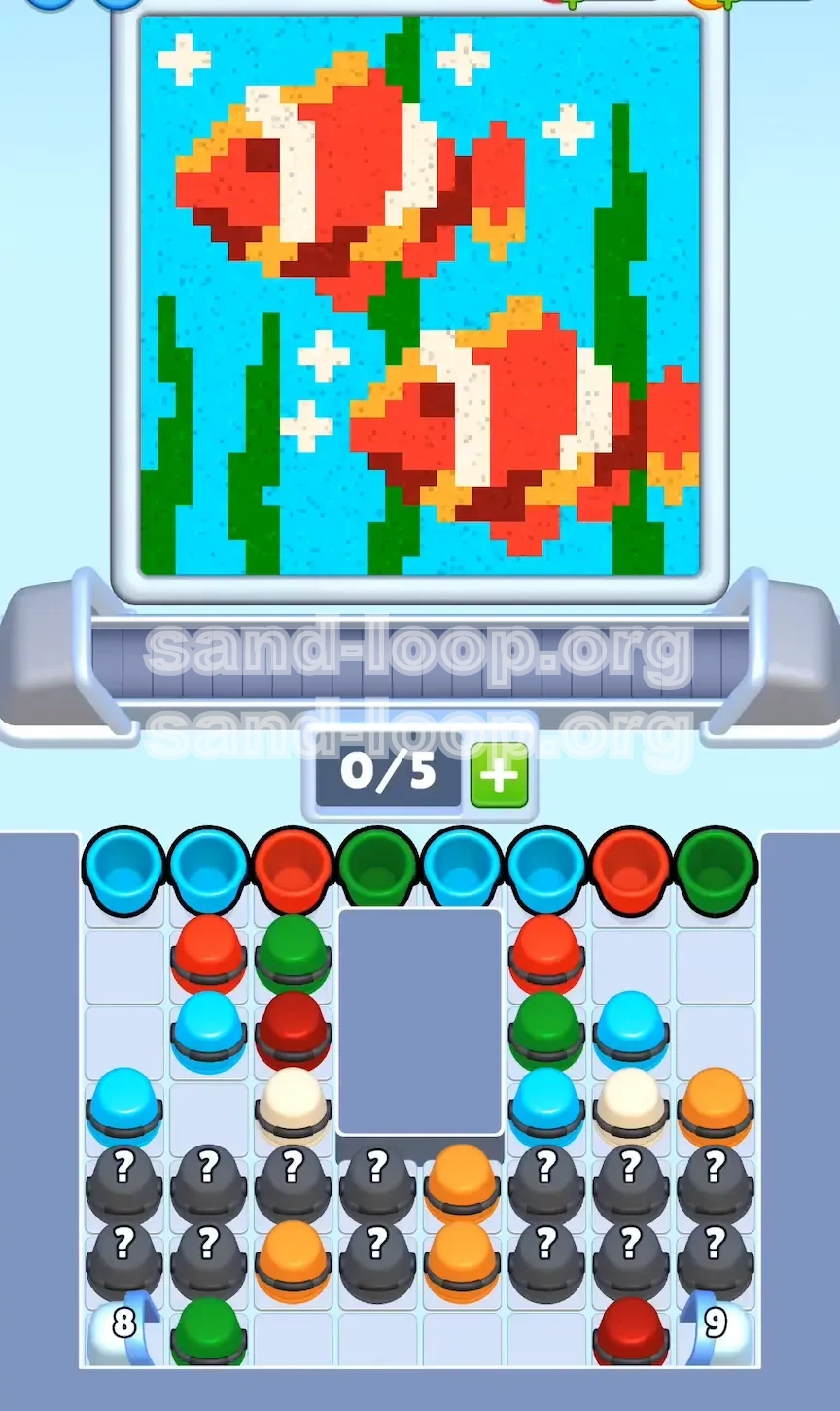
Welcome to the ultimate walkthrough for Sand Loop Level 382. This stage is a significant difficulty spike, testing your ability to manage inventory under pressure while solving a logic puzzle hidden behind a "Fog of War" mechanic. While the image of the Clownfish amidst seaweed looks peaceful, the gameplay is a frantic battle against a limited tray capacity and hidden resources. This guide will dismantle the level's logic, providing you with a step-by-step roadmap to secure the victory.
1. Level Overview and Core Mechanics
Before you tap a single cup, you need to understand why this level fails so many players. Level 382 is not just about filling colors; it is about inventory management. The level is vertically oriented, meaning your painting pattern must go from top to bottom in columns, rather than side-to-side in rows. If you treat this like a standard level, you will fill your tray with the wrong colors and soft-lock (get stuck with no moves) within seconds.
The Vertical Painting Constraint
Unlike previous levels where you might circle around the canvas, this level requires a strict top-to-bottom approach. The art features tall stalks of seaweed on the left and right edges, and the fish bodies are stacked vertically.
The Inventory Bottleneck
You have a 5-slot conveyor belt. In this level, 50% of your incoming supply is hidden inside Mystery Cups (marked with a '?'). This means you cannot plan your next 3 moves with certainty. You are constantly reacting to what is revealed.
The "Fog of War" Mechanic
Rows 4, 5, and 6 of the cup dispenser are completely hidden. You cannot see what colors are coming until you clear the rows above them. This adds a layer of probability management to the game.
Color Distribution Analysis
The palette consists of 5 colors: Cyan (Water), Red/Orange (Fish), Green (Seaweed), and Cream (Stripes). The Cyan is the most abundant but acts as a trap if collected too early. The Red and Orange are your primary blockers, and the Cream is the most critical scarce resource.
The "Question Mark" Trap
The biggest threat to your run is tapping a Grey Question Mark cup at the wrong time. If your tray is full (5/5) and you tap a '?' that reveals a color you don't need right now, that cup becomes "dead weight," occupying a slot you desperately need for the correct color.
2. Essential Preparation and Objectives
To beat Level 382, your objective is not just "to paint the picture," but to do so while maintaining a fluid state of movement. You must avoid stopping to wait for cups. Here is what you need to achieve to secure the 3-star rating.
Maintain the 2-Slot Buffer Rule
Never let your tray fill up to 5/5 if there are Question Marks on the board. You must always keep at least 2 slots open (ideally 3) before tapping a Mystery Cup. This ensures that if the cup reveals the wrong color, you have space to hold it until you need it.
Prioritize Green Seaweed Early
The Green seaweed lines are thin and run from the bottom to the top of the canvas. If you miss a single pixel of Green early on, it is incredibly difficult to fix later because the game will stop feeding you Green cups once the main seaweed areas are "mostly" done. You must secure the Green edges first.
Unlock the Corner Generators
At the bottom left and right (Dispensers 8 and 9), there are large reserves of paint, likely Cyan for the background water. Your secondary objective is to clear the vertical columns of cups blocking these dispensers so you can access the infinite paint supply for the final stretch.
Master the Red-Cream-Orange Sandwich
The Clownfish are not painted in one go. They follow a specific order: Red Body (Shadow) -> Cream Stripe (Separator) -> Orange Body (Highlight). If you paint the Red and Orange adjacent to each other without the Cream separator, the art will look muddy, and you will waste paint correcting it.
Avoid the Trash Can
Using the Trash Can to destroy cups gives you a time penalty and wastes potential resources. In Level 382, resources are tight. If you find yourself wanting to trash a cup, it usually means you painted the wrong section of the canvas earlier. Focus on using every cup you pick up.
3. Detailed Walkthrough: Phase 1 (The Foundation)
The game starts with a specific configuration of visible cups. Do not tap randomly. Follow this exact sequence to build a foundation that supports the complex middle section.
Step 1: Initial Tray Assessment
Look at the top row. You will see a pattern of Cyan and Green cups, with Reds mixed in. Do not touch the Red cups yet. They are for the fish, which sit in the middle of the canvas. Start by identifying the Green cups. They are your priority number one.
Step 2: Painting the Seaweed Columns
Take the Green cups immediately. Paint the far left and far right columns of the canvas where the seaweed is located. Do not paint the middle. You want to establish the vertical boundaries of the image first. This prevents the "Sand Loop" mechanics from drifting your paint into the wrong areas.
Step 3: Controlled Cyan Usage
Once the Green stalks are started, pick up the Cyan cups. Do not fill your entire tray with Cyan. Pick up one Cyan, paint the top-left water corner, then look for the next Green. You are alternating between Green (for structure) and Cyan (for background) to keep the flow moving.
Step 4: Ignoring the Initial Red Bait
You will see Red cups in the initial tray. Ignore them. The fish bodies are lower down. If you pick up Red now, it will sit in your tray, taking up a valuable slot that you need for the Mystery Cup reveals. Only pick up Red when the water level (Cyan) has dropped to the height where the fish begin.
Step 5: Triggering the First Mystery Row
After clearing the first visible layer of Green and Cyan, you will expose the first row of Question Marks. Stop! Check your tray capacity. Ensure you have only 2 or 3 cups in your tray. Now, tap the '?' cups one by one.
4. Detailed Walkthrough: Phase 2 (The Fish & The Mystery)
This is the most chaotic part of the level. You are dealing with the fish's complex colors while revealing hidden supplies. Precision is key.
Revealing the Cream Supply
The first row of Mystery Cups usually contains the much-needed Cream (White) paint. When you reveal a Cream cup, do not use it immediately if the Red body of the fish hasn't been painted yet. If you have space, hold the Cream cup. If you don't have space, paint a small bubble in the water to free up a slot, then grab the Cream.
The Red Layer Strategy
Now is the time to use the Red cups you ignored in Phase 1. The Red paint creates the shadowy underside of the Clownfish. Paint the Red sections on the left fish first. Do not go all the way to the edge; leave 2-3 pixels of space for the Cream stripe.
Applying the Cream Separator
Immediately after Red, switch to the Cream cup you revealed. Paint the vertical stripe down the middle of the fish. This stripe acts as a hard color stop. If you miss this step, the subsequent Orange paint will bleed into the Red, ruining the contrast of the image.
Orange and Highlights
With the Red and Cream in place, look for the Mystery Cups to reveal Orange. Orange is used for the top-side of the fish and the highlights. Paint the Orange sections immediately adjacent to the Cream stripe. The order Red -> Cream -> Orange is vital for the "pop" of the character art.
Managing the Middle Tray Jam
By now, your tray will likely have a mix of unused Cyan and leftover Green. As you work on the fish, you must aggressively clear these out. Use small dots of Cyan to fill any remaining water pockets in the background just to clear the slot, ensuring you always have room for the next fish color.
5. Speed Run and Optimization Tips
Once you understand the logic, you can aim for a faster completion time. These tips are for players who are comfortable with the mechanics but want to maximize efficiency.
The "Tap-Reveal" Rhythm
Develop a rhythm of "Paint, Paint, Reveal." Don't batch your reveals. As soon as you have 1 open slot, tap a '?' cup. If it's a color you need, use it. If it's a color you need later, hold it. This keeps the conveyor belt moving constantly, preventing idle time.
Pre-Positioning for Generators
Mid-game, start clearing the columns of cups that sit directly above the #8 and #9 generators at the bottom corners. Even if you don't need the paint yet, clearing these cups unlocks the "infinite" paint generators, which act as a safety net for the final 10% of the level.
Batching the Bubbles
The bubbles in the background (Cream/White) can be painted at any time. However, for speed runs, save the bubbles. When you are stuck waiting for a Red cup to regenerate, use a Cream cup to paint 3-4 bubbles in rapid succession. This clears your tray and builds your score multiplier simultaneously.
Recognizing the "Soft Lock" Early
If you ever have a full tray (5/5) and the *only* move available requires a color you don't have, you are in a "Soft Lock." You have about 5 seconds to fix this before the timer forces a fail. Immediately trash the least useful color (usually extra Cyan) to free up a slot for a Mystery reveal.
6. Troubleshooting and Common Mistakes
Even with a guide, things can go wrong. Here is how to diagnose and fix the most common failure points in Level 382.
Mistake: Painting Water Too Early
The most common error is filling the background with Cyan before the seaweed and fish are done. This leaves you with a tray full of Cyan while the game demands Red and Orange. Always prioritize the "objects" (fish and plants) over the "background" (water).
Mistake: Ignoring the Vertical Seams
The Sand Loop engine detects "spills." If you paint a wide horizontal stroke of Red, it might drip into the Cyan water section if you aren't careful. Always paint in vertical strokes to match the game's grid orientation. This minimizes pixel spill-over.
Solution: Trapped Generators
If you reach 90% completion and cannot find the final Blue/Cyan you need for the top corner, check the bottom corners of the cup tray. You likely left a single Question Mark cup sitting on top of the #8 or #9 generator. Clear that specific cup to release the final flood of paint.
Solution: The Missing Stripe
Did you finish the fish but it looks like a blob? You likely missed the Cream stripe or painted it too thinly. If you run out of Cream, you cannot finish the level perfectly. If you are out of Cream, you must restart, as there are no extra Cream cups hidden in the late game generators.